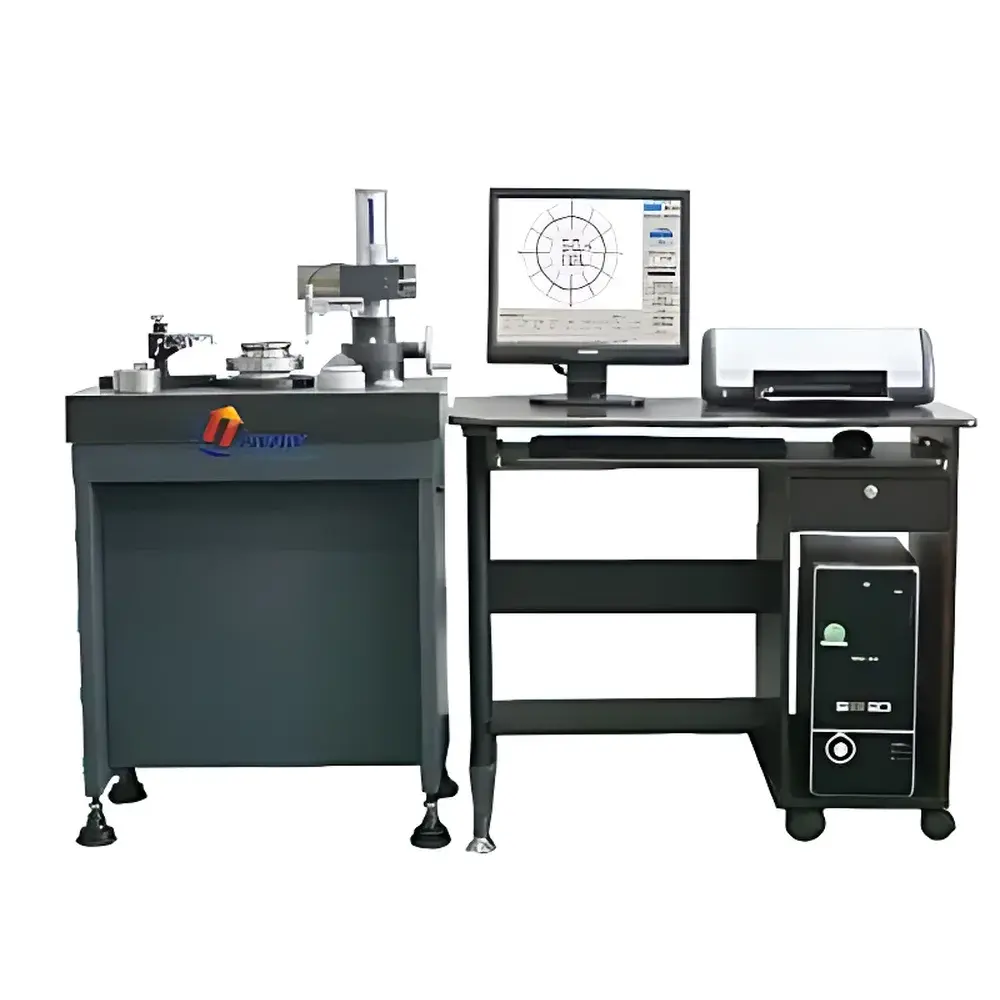
MC012-Y9025C Roundness and Cylindricity Measuring Instrument
| Origin | China |
|---|---|
| Manufacturer Type | Authorized Distributor |
| Model | MC012-Y9025C |
| Spindle Accuracy | ±0.025 µm |
| System Accuracy | 0.06 µm |
| Data Acquisition | Hall-effect Sensor |
| Max. External Diameter | Ø140 mm (expandable) |
| Min. Internal Diameter | Ø3 mm |
| Max. Measurement Height | 200 mm (extendable) |
| Radial Range | ≤30 µm |
| Sensor Resolution | 0.01 µm |
| Max. Load Capacity | 10 kg |
| Rotational Speed | 115 rpm |
| Power Supply | 220 V, 50 Hz, 250 W |
| Air Pressure Requirement | ≥0.45 MPa |
Overview
The MC012-Y9025C Roundness and Cylindricity Measuring Instrument is a high-precision geometric metrology system engineered for traceable, repeatable assessment of rotational symmetry and form deviations in precision-machined components. Operating on the principle of rotating part measurement with radial displacement sensing, it employs a high-stiffness air-bearing spindle to minimize mechanical drift and thermal hysteresis—ensuring sub-micron repeatability over extended operational cycles. Designed for compliance with ISO 1101 (Geometrical Product Specifications – Geometrical tolerancing), ISO 12181 (Roundness), and ISO 12180 (Cylindricity), the instrument delivers calibrated form error evaluation across multiple datum strategies—including least-squares, minimum-zone, minimum-circumscribed, and maximum-inscribed circle methods. Its architecture supports both laboratory-grade calibration verification and shop-floor deployment, meeting the dimensional integrity requirements of bearing manufacturers, aerospace component suppliers, and medical device OEMs.
Key Features
- Air-bearing main spindle with ±0.025 µm radial runout and zero-contact wear—ensuring long-term stability and metrological integrity without lubrication or maintenance-induced drift.
- Integrated dual-sensor configuration: interchangeable contact probes optimized for external diameters (Ø3–140 mm) and internal bores (Ø3 mm minimum), enabling seamless transition between ring, roller, and ball geometry measurements.
- Real-time graphical interface powered by Windows-based proprietary software, supporting dynamic waveform display, polar plot overlays, harmonic decomposition, and automated report generation with timestamped metadata.
- Full spectral analysis capability: extracts amplitude and phase information for individual harmonic orders (up to 50th order), facilitating root-cause diagnosis of machining errors such as chucking vibration, spindle imbalance, or tool wear signatures.
- Modular height extension kit (optional) and configurable workholding fixtures allow adaptation to tall cylindrical parts up to 200 mm height—with load capacity rated at 10 kg for robust handling of production-intent hardware.
- Keyboard- and mouse-driven operation with customizable shortcut mapping, supporting operator-defined workflows aligned with ISO/IEC 17025-compliant measurement procedures.
Sample Compatibility & Compliance
The MC012-Y9025C accommodates a broad spectrum of rotationally symmetric components, including but not limited to: inner/outer bearing races, rolling elements (steel balls and cylindrical rollers), hydraulic spools, turbine shaft journals, and orthopedic implant stems. It supports evaluation of roundness, cylindricity, coaxiality, perpendicularity, parallelism, flatness, and eccentricity—all referenced to user-defined datums per ASME Y14.5 and ISO GPS standards. The system’s measurement uncertainty budget has been validated against NIST-traceable artifact masters and conforms to the verification protocols outlined in ISO/IEC 17025:2017 Clause 6.5 (Measurement Traceability). Environmental tolerance permits operation within ambient temperature ranges of 15–25 °C and relative humidity ≤65% RH—no active climate control required for routine use in controlled manufacturing environments.
Software & Data Management
The embedded measurement software provides full audit trail functionality compliant with FDA 21 CFR Part 11 requirements, including electronic signatures, role-based access control, and immutable data logging. All raw sensor traces, harmonic spectra, and form deviation maps are stored in vendor-neutral .CSV and .XML formats, ensuring interoperability with third-party SPC platforms (e.g., Minitab, JMP) and enterprise MES/QMS systems. Calibration history, probe offset compensation logs, and environmental condition stamps (temperature, air pressure) are automatically embedded into each measurement record. Export options include PDF analytical reports with GD&T callouts, annotated polar plots, and FFT magnitude-phase diagrams suitable for engineering review and supplier quality audits.
Applications
- Quality assurance of bearing raceways during final inspection—quantifying waviness amplitudes that correlate directly with NVH (noise, vibration, harshness) performance in automotive transmissions.
- In-process validation of grinding and honing operations—identifying harmonic patterns indicative of wheel dressing frequency or machine tool resonance.
- Root cause analysis of premature bearing failure—correlating measured eccentricity vectors and phase angles with assembly misalignment hypotheses.
- Process capability studies (Cpk/Ppk) for cylindrical grinding lines—generating statistical summaries across batch-lot sampling per ISO 22514-2.
- Calibration support for coordinate measuring machines (CMMs)—serving as a reference standard for rotational axis error mapping in multi-axis metrology labs.
FAQ
What standards does the MC012-Y9025C comply with for roundness measurement?
It adheres to ISO 12181-1 (roundness definition and evaluation), ISO 12180-1 (cylindricity), and ISO 1101 (tolerancing of form, orientation, location, and run-out). Measurement algorithms implement all four classical roundness evaluation methods per ISO 12181-2.
Can the system measure internal bores smaller than Ø5 mm?
Yes—the standard probe configuration supports internal diameters down to Ø3 mm using a miniature stylus with 0.3 mm tip radius and low-contact force (<0.05 N), minimizing deformation risk on thin-walled components.
Is air supply conditioning required beyond the specified 0.45 MPa minimum pressure?
A dedicated coalescing filter and desiccant dryer are recommended upstream of the instrument inlet to maintain dew point below −20 °C and particulate filtration to ISO 8573-1 Class 2, ensuring sustained air-bearing performance and longevity.
Does the software support automated pass/fail decision logic based on GD&T tolerances?
Yes—users can define bilateral or unilateral tolerance zones per feature control frame, with real-time color-coded deviation mapping and automatic flagging of nonconforming harmonics or total form error thresholds.
How is traceability maintained for periodic recalibration?
The system includes a certified reference artifact set (NIST-traceable master rings and cylinders), and calibration certificates document measurement uncertainty budgets per ISO/IEC 17025 Annex A.3, including contributions from environmental, operator, and equipment factors.