
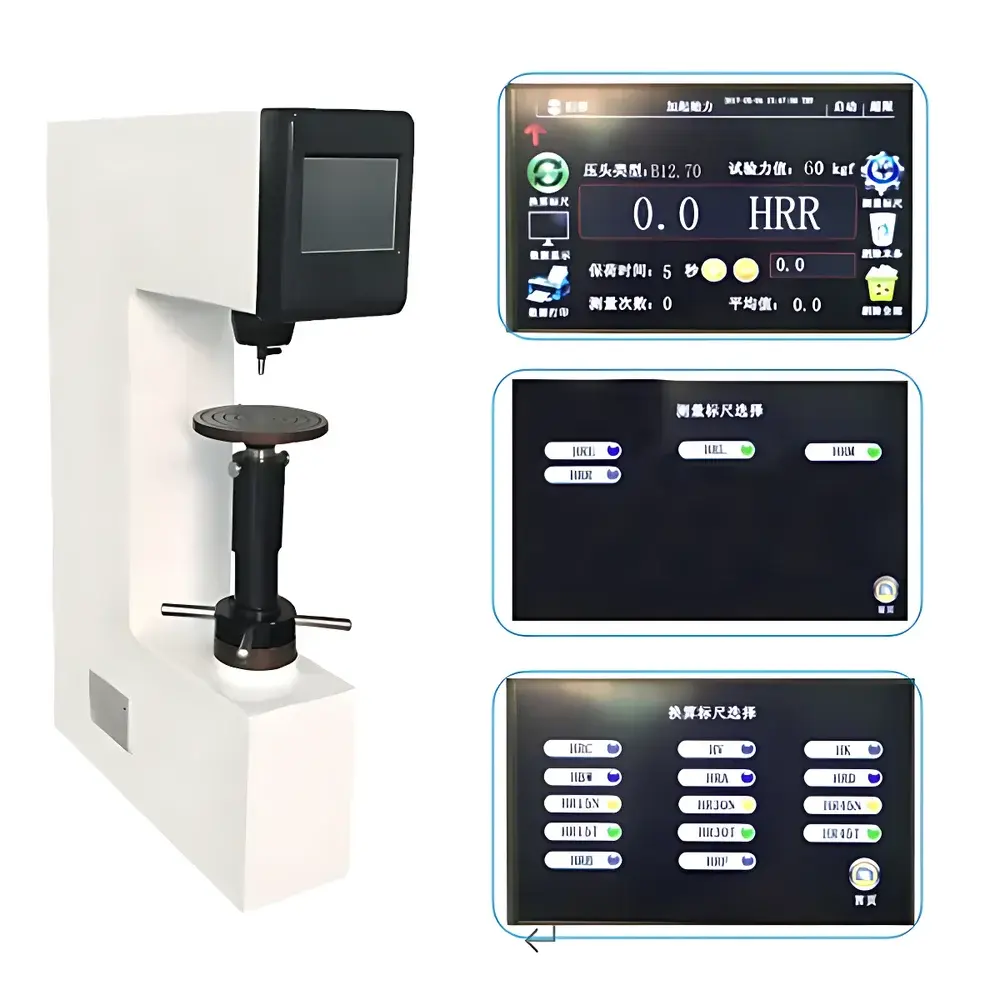
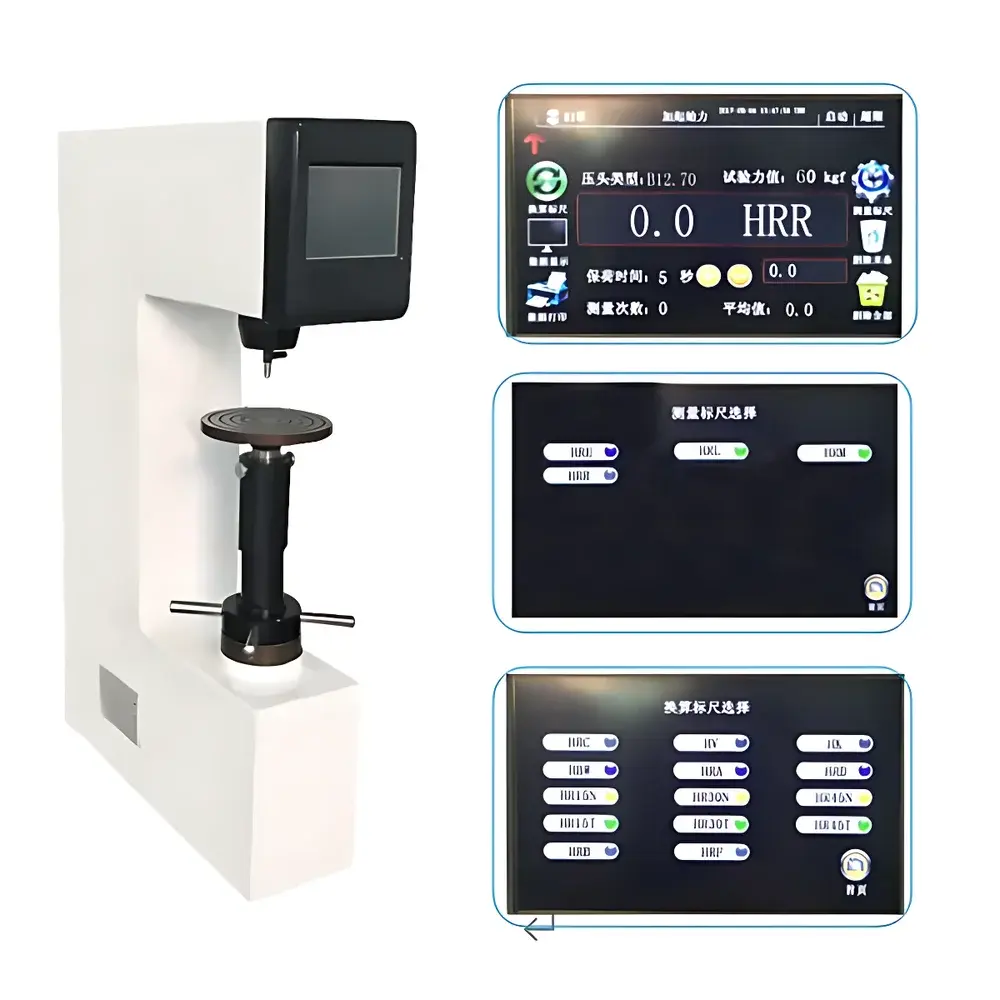
YANRUN XHRS-150M Touchscreen Plastic Rockwell Hardness Tester
| Brand | YANRUN |
|---|---|
| Origin | Shanghai, China |
| Manufacturer Type | Manufacturer |
| Product Origin | Domestic (China) |
| Model | XHRS-150M |
| Instrument Type | Rockwell Hardness Tester |
| Rockwell Scales | HRE, HRL, HRM, HRR |
| Measurement Range | HRE: 70–94, HRL: 100–120, HRM: 85–120, HRR: 114–125 |
| Preliminary Test Force | 98.07 N (10 kgf) |
| Total Test Forces | 588 N (60 kgf), 980 N (100 kgf), 1471 N (150 kgf) |
| Specimen Height Capacity | 200 mm (standard), optional 400 mm |
| Depth of Throat | 160 mm |
| Hardness Resolution | 0.1 HR |
| Dwell Time | 0–60 s (adjustable in 1 s increments) |
| Compliance | GB/T 230.2, JJG 112 |
| Dimensions (W×D×H) | 535 × 150 × 700 mm |
| Weight | ~90 kg |
| Power Supply | AC 220 V |
Overview
The YANRUN XHRS-150M Touchscreen Plastic Rockwell Hardness Tester is a fully automated, microprocessor-controlled instrument engineered for precise and repeatable Rockwell hardness measurement on non-metallic and low-to-medium strength metallic materials. Based on the classical Rockwell principle—applying a preliminary minor load followed by a major load, then measuring the permanent depth increment of indentation—the XHRS-150M delivers high reproducibility for polymers, thermosets, elastomers, composites, and soft metals where conventional metallurgical Rockwell testers may lack sensitivity or risk specimen damage. Its dedicated scale set (HRE, HRL, HRM, HRR) employs larger-diameter tungsten carbide ball indenters (3.175 mm, 6.25 mm, and 12.7 mm) and lower total test forces (60–150 kgf), optimizing penetration response for viscoelastic and heterogeneous plastic substrates. Designed to meet GB/T 230.2 (equivalent to ISO 6508-2) and calibrated per JJG 112 national verification regulation, the system supports routine quality control, incoming material inspection, and R&D validation in polymer processing, automotive interior component manufacturing, packaging development, and electrical insulation testing.
Key Features
- 10.1-inch full-color capacitive touchscreen with intuitive menu-driven interface—no physical buttons; all functions navigated via tap/swipe gestures
- Rigid cast-iron frame with vibration-damping base and precision-machined load train—ensures mechanical stability during force application and eliminates frame deflection under maximum 150 kgf load
- Integrated thermal-compensated load cell and closed-loop servo control—guarantees accurate force delivery within ±1.0% of set value across full range (10–150 kgf)
- Digital hardness readout with 0.1 HR resolution and automatic zeroing at start of each cycle—eliminates parallax and interpolation errors inherent in analog dials
- Built-in thermal line printer with real-time output of test ID, scale, hardness value, dwell time, and date/time stamp—supports audit-ready documentation without external PC
- Onboard hardness conversion engine supporting 14 scales including HRC, HV, HBW, HK, HRA, HRB, HRF, HR15N–HR45N, HR15T–HR45T—enables cross-material comparison per ASTM E140 and ISO 18265
- Modular indenter and anvil assembly—facilitates rapid field replacement of 3.175 mm / 6.25 mm / 12.7 mm WC ball indenters and V-block, flat, or medium-height anvils
Sample Compatibility & Compliance
The XHRS-150M accommodates specimens up to 200 mm in height (optional 400 mm column extension available) and 160 mm in throat depth—suitable for molded plaques, extruded profiles, laminated sheets, brake pads, gaskets, and machined polymer housings. Its HRE/HRL/HRM/HRR scale configuration complies with ISO 2039-2 for plastics and ASTM D785 for rigid plastics, while its mechanical design conforms to GB/T 230.2–2012 (identical to ISO 6508-2:2015) for Rockwell hardness testing machines. Calibration traceability follows JJG 112–2013 verification procedure for Rockwell hardness testers, ensuring metrological validity for internal QA audits and third-party certification (e.g., IATF 16949, ISO 9001). All hardness blocks supplied (HRE, HRL, HRM, HRR) are certified per GB/T 230.3 and include individual calibration certificates.
Software & Data Management
While the XHRS-150M operates autonomously via embedded firmware, it supports USB export of CSV-formatted test logs (including operator ID, sample ID, scale, hardness value, standard deviation, and timestamp) for integration into LIMS or statistical process control (SPC) platforms. The system maintains an onboard audit trail storing the last 500 test records with immutable timestamps—meeting basic data integrity requirements aligned with GLP principles. Optional RS-232 interface enables remote command triggering (e.g., “START”, “PRINT”) from external PLCs or custom LabVIEW applications. No proprietary software installation is required; exported data is natively readable in Excel, Minitab, or JMP.
Applications
- Quality assurance of injection-molded ABS, PC, PA6/66, POM, and PBT components in automotive and consumer electronics
- Evaluation of heat aging effects on PVC compounds and thermoplastic elastomers (TPEs)
- Batch-to-batch consistency checks for phenolic resins, melamine-formaldehyde laminates, and fiber-reinforced composites
- Hardness profiling across thickness gradients in co-extruded films and multilayer packaging substrates
- Verification of surface hardening treatments on aluminum alloys used in enclosures and heat sinks
- Comparative analysis of friction materials (brake linings, clutch facings) per SAE J661 requirements
FAQ
What Rockwell scales does the XHRS-150M support—and why are they appropriate for plastics?
The instrument implements HRE, HRL, HRM, and HRR—scales specifically defined in ISO 2039-2 for plastics using 1/8″, 1/4″, and 1/2″ diameter ball indenters with light-to-moderate major loads (60–150 kgf). These prevent excessive creep or cracking in polymeric matrices while delivering statistically robust readings.
Can the XHRS-150M be used for metals—and if so, which types?
Yes, but only for softer metallic materials such as annealed aluminum, tin, lead, zinc, copper, brass, and low-carbon steels (HRB, HRF ranges). It is not intended for hardened steels or case-hardened surfaces—those require HRC-capable testers with diamond cone indenters.
Is the built-in printer compliant with FDA 21 CFR Part 11 requirements?
The internal printer provides permanent, human-readable records suitable for GMP environments; however, full Part 11 compliance (electronic signatures, audit trails, system validation) requires integration with validated third-party document management software—not provided with the base unit.
How frequently should verification with certified hardness blocks be performed?
Per GB/T 230.2, daily verification before first use is recommended when operating in regulated environments; weekly verification suffices for routine industrial QA. Each block must be used within its certified shelf life and stored in controlled humidity.
Does the XHRS-150M support GLP/GMP-compliant data archiving?
It maintains local test history and supports CSV export for external archival. For full GLP compliance—including user access control, electronic signatures, and change control—the instrument must be connected to a validated laboratory information management system (LIMS).



