
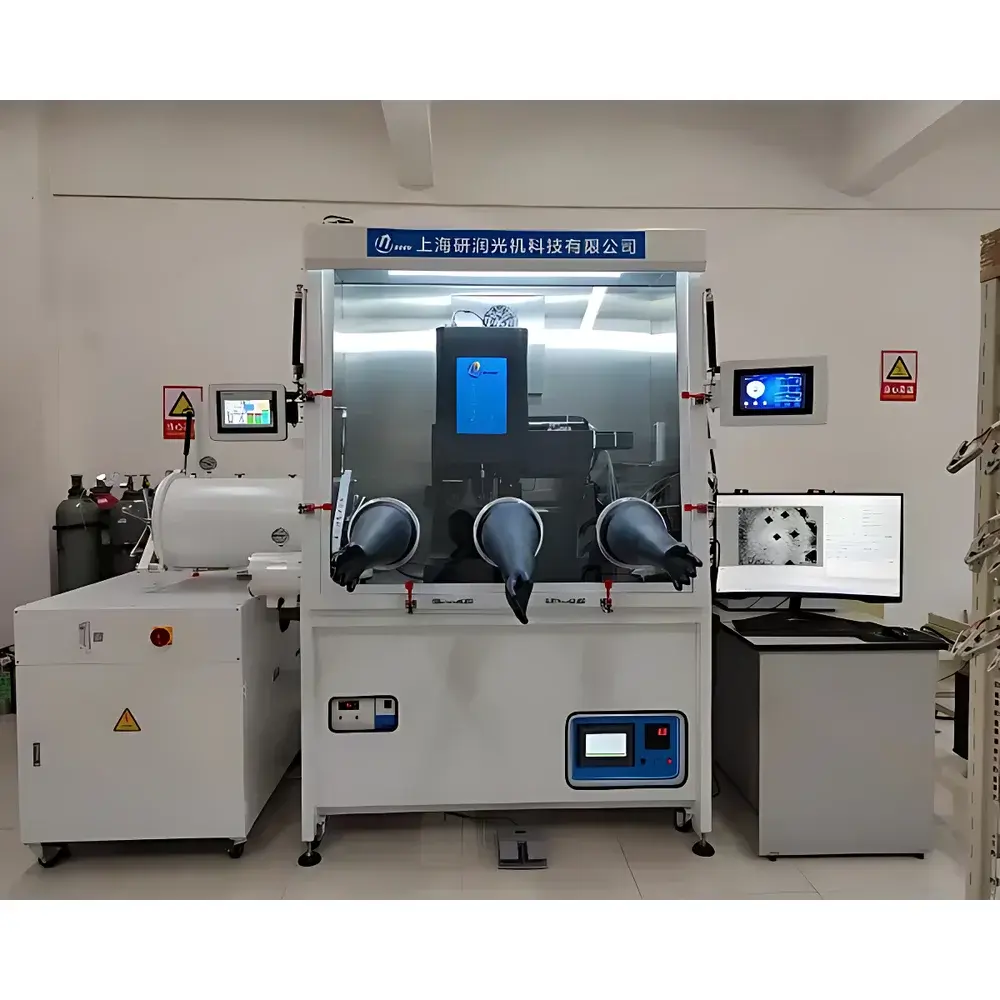
YANRUN IMAS-HT1500CM Full-Field Dynamic High-Temperature Indentation Tester (1400 °C)
| Brand | YANRUN |
|---|---|
| Origin | Shanghai, China |
| Manufacturer Type | OEM Manufacturer |
| Country of Origin | China |
| Model | IMAS-HT1500CM |
| Instrument Type | Vickers Hardness Tester |
| Temperature Range | 400–1400 °C |
| Max Furnace Temperature | 1500 °C |
| Load Range | 0.1–30 kgf (standard), up to 150 kgf (optional) |
| Optical Working Temp | ≤1400 °C (10×/20× objective) |
| Position Resolution | 500 nm (standard), down to >20 nm (laser displacement option) |
| Hold Time | up to 72 h |
| Thermal Uniformity | ≤±5 °C across 100×80×80 mm cavity |
| Temp Control Accuracy | ±1 °C |
| Heating Rate | 1–40 °C/min |
| Sample Size Limit | ≤φ30×30 mm |
| Multi-Axis Control | up to 9 axes |
| Quick-Change Cycle | ≤50 s at 1400 °C |
| Glovebox O₂/H₂O | ≤1 ppm |
| Cooling | Water + inert gas dual-mode |
| Power Supply | 220 V, >6.5 kW |
| Weight | 1800 kg |
| Dimensions | 2400×1500×2350 mm |
Overview
The YANRUN IMAS-HT1500CM is a full-field, in-situ dynamic high-temperature indentation tester engineered for quantitative mechanical characterization of advanced materials under extreme thermal conditions—from 400 °C up to 1400 °C. Unlike conventional hardness testers limited to ambient or moderate temperatures, the IMAS-HT1500CM integrates a vacuum-compatible, MoSi₂-heated furnace with a thermally stable optical path and high-precision load-displacement-time acquisition architecture. Its core measurement principle relies on controlled quasi-static and dynamic indentation using a diamond Vickers indenter, with simultaneous real-time capture of force (F), displacement (δ), time (t), and high-resolution optical imaging—all within a uniform, isothermal field. This enables direct correlation between microstructural evolution (e.g., crack initiation, plastic flow, phase transformation) and mechanical response under sustained thermal load. The system supports ASTM E384-compliant Vickers hardness evaluation, as well as extended property derivation including fracture toughness (KIC), elastic modulus (via unloading slope analysis per ISO 14577), creep compliance, and time-dependent deformation kinetics—without sample removal or thermal cycling.
Key Features
- Full-field isothermal operation from 400 °C to 1400 °C, with furnace stability ±1 °C and axial/radial temperature gradient ≤±5 °C across 100×80×80 mm cavity
- High-temperature optical train featuring 10× and optional 20× objectives rated for continuous operation at ≤1400 °C; system magnification up to 2000×; resolution down to 1.19 µm
- Dynamic loading module with programmable force range (0.1–30 kgf standard; 1–150 kgf optional), offering position-controlled, force-controlled, and rate-controlled modes with ≤0.01% FS force resolution
- In-situ high-speed data acquisition at ≥100 Hz, capturing synchronized F–δ–t streams during loading, hold (up to 72 h), and unloading phases
- Multi-axis motion platform (up to 9 axes) with sub-micron positioning accuracy (≤±1 µm), enabling precise alignment, rapid sample exchange (<50 s at 1400 °C), and automated multi-point mapping
- Dual-cooling architecture: closed-loop water cooling (±0.3 °C stability, 13 L/min flow) plus inert-gas quenching (≤5 s cooldown to <55 °C)
- Integrated glovebox (H₂O/O₂ ≤1 ppm) with 1.5 workstations, vacuum transition lock, and optional large-volume chamber for sensitive or reactive samples
Sample Compatibility & Compliance
The IMAS-HT1500CM accommodates disk-shaped specimens up to φ30×30 mm and is compatible with metallic alloys, refractory ceramics, CMCs, intermetallics, and nuclear-grade cladding materials. All high-temperature components—including the indenter (1700 °C-rated Vickers pyramid), load train, and optical mounts—are fabricated from oxidation-resistant, low-thermal-expansion alloys and ceramic composites. The system conforms to ISO 14577-1:2015 (Metallic materials — Instrumented indentation test), ASTM E384-22 (Standard Test Method for Knoop and Vickers Hardness of Materials), and supports GLP/GMP-compliant audit trails when configured with IMAS V7.0 software and FDA 21 CFR Part 11–enabled user access controls. Calibration traceability follows NIST-traceable force and displacement standards, with in-situ verification via certified reference materials (e.g., sapphire, tungsten carbide blocks) pre-characterized across the operational temperature range.
Software & Data Management
IMAS V7.0 control and analysis suite provides a unified interface for experiment design, real-time monitoring, and post-processing. It supports script-based automation (Python API integration), multi-parameter curve fitting (e.g., Oliver–Pharr, Nix–Gao models), and statistical mapping of hardness, modulus, and creep strain across temperature–load matrices. Raw F–δ–t datasets are stored in HDF5 format with embedded metadata (timestamp, thermal history, axis positions, environmental logs). Export options include CSV, MATLAB .mat, and MIF-compliant reports aligned with ASTM E2387. Audit logging records all user actions, parameter changes, and calibration events with digital signatures and time stamps—fully compliant with regulated environments requiring 21 CFR Part 11 electronic records and signatures.
Applications
- Thermomechanical property mapping of turbine blade superalloys (e.g., Inconel 718, CMSX-4) across service-relevant temperature gradients
- Creep–fatigue interaction studies in SiC/SiC composites for Gen-IV nuclear reactor applications
- In-situ quantification of thermal softening onset and recovery kinetics in TiAl-based intermetallics
- Fracture toughness evaluation of ultra-high-temperature ceramics (UHTCs) such as ZrB₂–SiC under oxidizing and inert atmospheres
- Validation of constitutive models for finite element simulation of hot-forming processes and additive manufacturing residual stress evolution
- High-throughput screening of coating adhesion and interfacial delamination mechanisms at elevated temperatures
FAQ
What is the maximum continuous operating temperature of the optical system?
The 10× and 20× objectives are rated for uninterrupted operation at ≤1400 °C, with verified performance over 50 hours per cycle.
Can the system perform hardness testing per ASTM E384 at 1400 °C?
Yes—when operated with calibrated Vickers indenters, traceable load cells, and validated thermal drift compensation, it meets ASTM E384 requirements for elevated-temperature hardness determination.
Is remote operation and data monitoring supported?
The IMAS V7.0 software includes secure web-based remote access (HTTPS/TLS), live video streaming, and real-time dashboard visualization for distributed research teams.
How is thermal drift compensated during long-duration hold tests?
A dual-sensor architecture—combining high-stability capacitive displacement transducers and redundant laser interferometers—enables real-time thermal expansion correction using in-situ reference measurements from fixed fiducials.
Does the system support custom indenter geometries beyond Vickers?
Yes—ball (100–1000 µm), conical, Berkovich, and cylindrical indenters are available as factory-installed options, each qualified for operation up to 1700 °C.



