
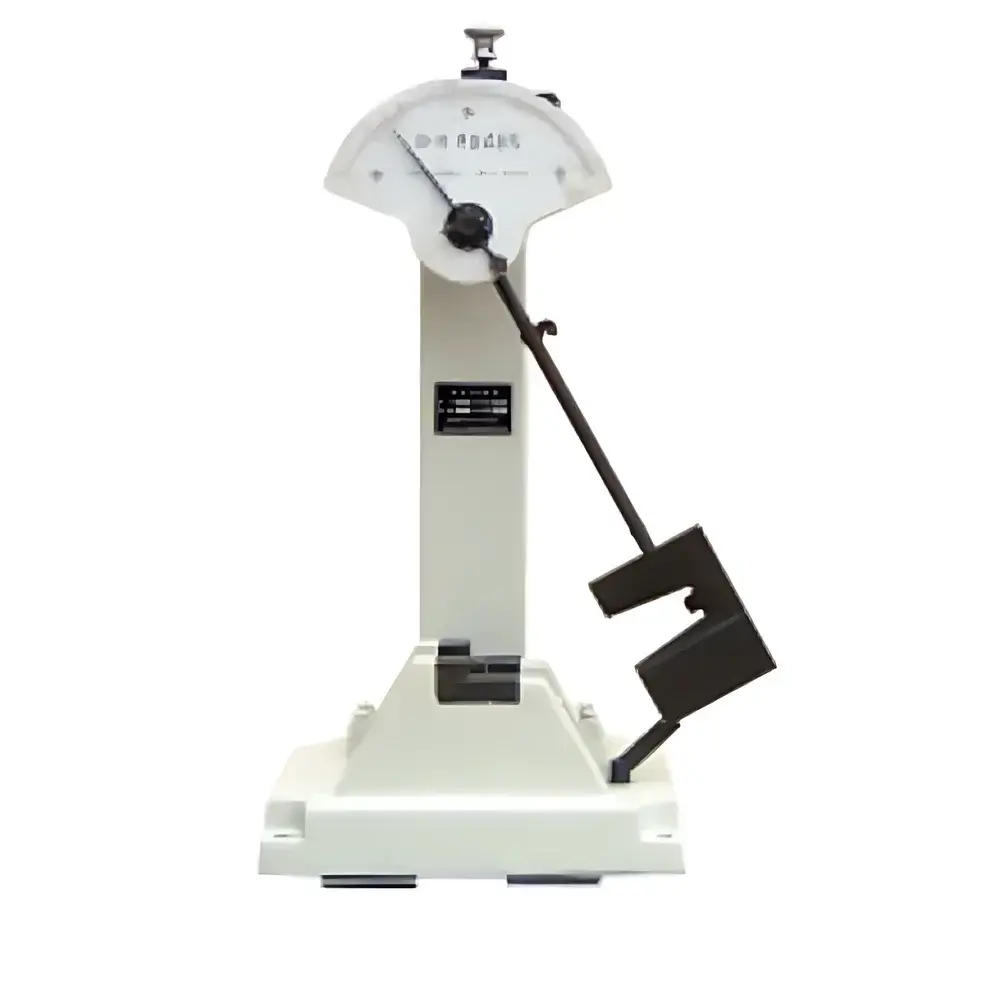
YANRUN JB-50 Manual Pendulum Impact Testing Machine
| Brand | YANRUN |
|---|---|
| Origin | Shanghai, China |
| Manufacturer Type | Direct Manufacturer |
| Country of Origin | China |
| Model | JB-50 |
| Instrument Type | Pendulum Impact Tester |
| Impact Energy | 50 J (large hammer), 25 J (small hammer) |
| Impact Velocity | 4.0 m/s |
| Pre-lift Angle | 150° |
| Support Span | 40 mm |
| Anvil Radius | R1.0–R1.5 mm |
| Striking Edge Radius | R2.0–R2.5 mm |
| Distance from Pendulum Center to Impact Point | 550 mm |
| Standard Specimen Dimensions | 10 × 10 × 55 mm |
| Overall Dimensions | 800 × 530 × 1200 mm |
| Weight | 150 kg |
Overview
The YANRUN JB-50 Manual Pendulum Impact Testing Machine is a precision-engineered mechanical impact tester designed for Charpy and Izod impact testing of metallic and polymeric materials in quality control, metallurgical research, and industrial certification laboratories. It operates on the classical pendulum principle: gravitational potential energy is converted into kinetic energy as the pendulum arm swings from a fixed pre-lift angle (150°), delivering a controlled impact to a notched or unnotched specimen clamped between standardized supports. The energy absorbed by the specimen—calculated from the difference between initial and residual pendulum height—is quantified in joules (J), providing critical data on material toughness, ductile-to-brittle transition behavior, and fracture resistance under sudden loading. With dual-energy capability (25 J and 50 J), the JB-50 accommodates both small-scale validation tests and full-thickness structural material evaluations per ISO 148-1, ASTM E23, and GB/T 229 standards.
Key Features
- Robust cast-iron base and rigid steel frame ensure mechanical stability and minimal vibration during impact, contributing to high test reproducibility.
- Dual-pendulum configuration: Interchangeable 25 J and 50 J hammers allow flexible adaptation to specimen geometry, material thickness, and standard requirements without recalibration.
- Precision-machined anvil with standardized 40 mm support span and R1.0–R1.5 mm radius ensures consistent specimen alignment and compliance with ISO/ASTM support geometry tolerances.
- Striking edge manufactured to R2.0–R2.5 mm radius meets ISO 148-2 and ASTM E23 dimensional specifications for Charpy V-notch testing.
- Fixed pendulum center-to-impact-point distance of 550 mm guarantees repeatable lever-arm dynamics and minimizes angular deviation error.
- Integrated specimen alignment tools—including a dedicated specimen centering gauge and support adjustment calibrator—reduce operator-induced positioning variability.
- Manual operation with mechanical locking and release mechanism eliminates electronic dependencies, enhancing long-term reliability and reducing maintenance complexity.
Sample Compatibility & Compliance
The JB-50 is optimized for standard 10 × 10 × 55 mm specimens (Charpy type), but accommodates alternative cross-sections—including 7.5 × 7.5 × 55 mm and 5 × 5 × 55 mm—using optional support inserts. It supports both V-notch (ISO 148-1, ASTM E23 Type A) and U-notch configurations via interchangeable anvils and striker blades. All mechanical dimensions—including support span, anvil radius, striking edge radius, and pendulum geometry—conform to the metrological requirements of ISO 148-2:2021 (Verification of pendulum impact machines) and ASTM E23-23 (Standard Test Methods for Notched Bar Impact Testing of Metallic Materials). The system is suitable for GLP-compliant environments where traceable mechanical verification—not electronic data logging—is the primary audit requirement.
Software & Data Management
As a fully manual mechanical tester, the JB-50 does not incorporate embedded electronics or digital readout systems. Impact energy values are determined visually via a calibrated angular scale and manually recorded. This architecture aligns with laboratories maintaining strict separation between measurement hardware and data processing systems—particularly those operating under ISO/IEC 17025 or GMP frameworks where instrument qualification emphasizes mechanical integrity over software validation. Users may integrate external digital calipers, high-speed cameras (for velocity verification), or standalone torque-angle sensors for enhanced metrological traceability. Documentation packages include calibration certificates for pendulum moment of inertia and striker geometry, supporting IQ/OQ protocols.
Applications
- Quality assurance of structural steels, aluminum alloys, and engineering plastics in foundries, rolling mills, and automotive component suppliers.
- Evaluation of heat-treated condition effects on fracture toughness in weld procedure qualification (WPQR) per ISO 15614-1.
- Teaching laboratories for fundamental mechanics of materials education, emphasizing energy-based failure analysis.
- Third-party testing labs performing accredited Charpy impact testing under ISO/IEC 17025 scope.
- Validation of low-temperature impact performance for cryogenic piping materials (e.g., ASTM A333 Grade 6).
FAQ
Is the JB-50 compliant with ISO 148 and ASTM E23?
Yes—the mechanical geometry, energy calibration, and specimen support specifications meet the verification criteria outlined in ISO 148-2:2021 and ASTM E23-23 Annex A1.
Can it perform both Charpy and Izod tests?
It is configured for Charpy testing (horizontal specimen, supported at both ends); Izod testing requires vertical clamping and a different anvil design—JB-50 does not support Izod out-of-the-box.
What maintenance is required?
Routine inspection of bearing play, striker edge wear (R2.0–R2.5 mm tolerance), and anvil surface flatness; annual verification of pendulum moment of inertia is recommended.
Is calibration documentation provided?
Yes—each unit ships with a factory-verified calibration report covering pendulum mass distribution, center-of-rotation alignment, and striker geometry conformity.
Does it require electrical power?
No—operation is purely mechanical; only manual effort is needed for pendulum lifting and release.



