
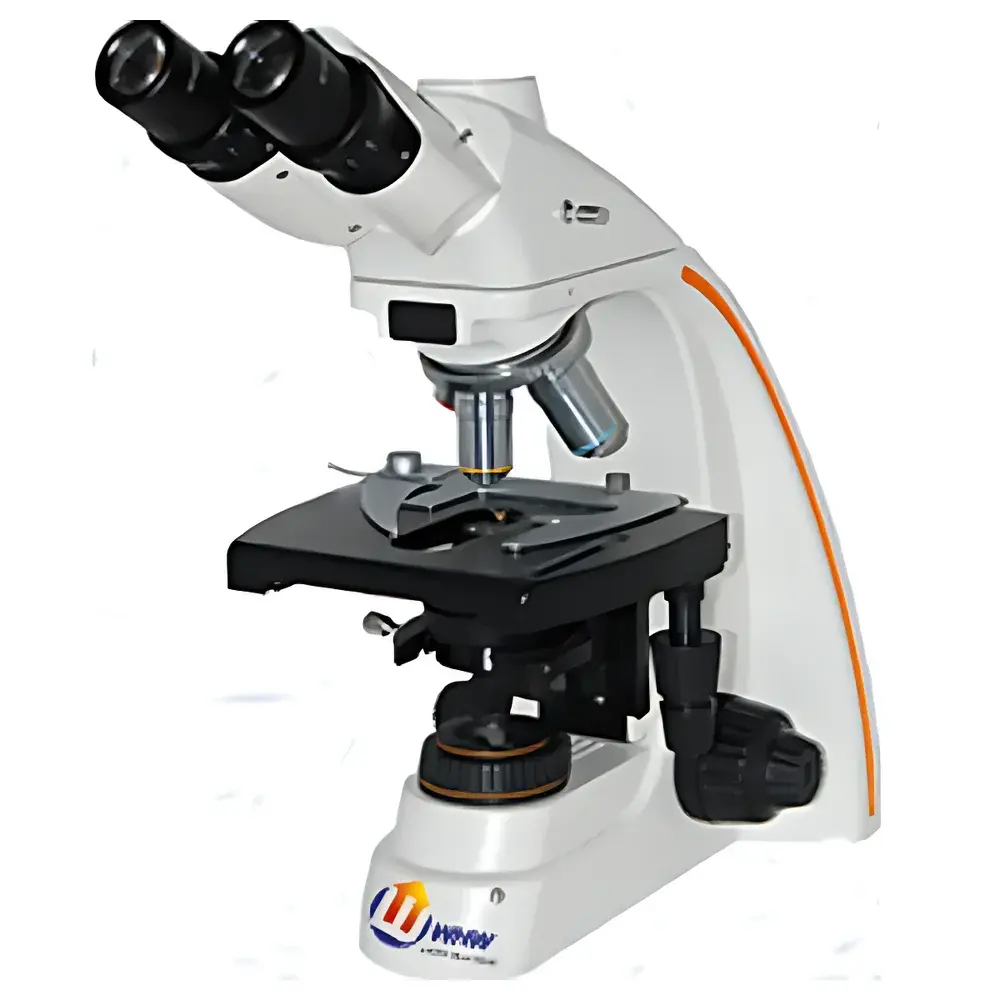
YANRUN BI-23 Biological Inverted Microscope
| Brand | YANRUN |
|---|---|
| Origin | Shanghai, China |
| Manufacturer Type | Direct Manufacturer |
| Product Category | Domestic (China-Made) |
| Model | BI-23 |
| Instrument Type | Inverted Microscope |
| Eyepiece Configuration | Binocular |
| Optical System | Infinity-Corrected |
| Magnification Range | 40×–1000× |
| Objective Conjugate Distance | ∞ |
| Eyepiece Port Diameter | 30 mm |
| Parfocal Distance | 10 mm |
| Eyepieces | Widefield WF10X (Φ22 mm) |
| Interpupillary Adjustment Range | 48–75 mm |
| Objectives | Infinity Plan Achromat 4X/0.10 (WD 19.8 mm), 10X/0.25 (WD 5 mm), 40X/0.65 (spring-loaded, WD 0.66 mm), 100X/1.25 (spring-loaded, oil immersion, WD 0.36 mm) |
| Coverslip Thickness Specification | 0.17 mm (for 40X & 100X) |
| Eyepiece Tube | 30° inclined binocular tube with adjustable brightness |
| Focus Mechanism | Coaxial coarse/fine focus |
| fine focus graduation | 2 µm |
| Nosepiece | Four-position inward-rolling ball bearing turret with positive positioning |
| Stage | Dual-layer mechanical stage (193 mm × 155 mm) |
| travel range | 75 mm × 50 mm |
| Condenser | Abbe condenser, N.A. 1.25, vertically adjustable |
| Filters | Blue filter, ground glass |
| Built-in Field Diaphragm | Yes |
| Illumination | 3 V LED, continuously adjustable brightness |
Overview
The YANRUN BI-23 Biological Inverted Microscope is engineered for routine and advanced life science applications requiring high optical fidelity, ergonomic usability, and modular expandability. Designed around an infinity-corrected optical pathway, the BI-23 delivers consistent resolution and contrast across its full magnification range (40× to 1000×), making it suitable for both fixed and live-cell observation in culture vessels—including Petri dishes, multi-well plates, and flasks. Its inverted configuration places the objective lenses beneath the specimen stage, enabling direct access to samples during manipulation—particularly advantageous for time-lapse imaging, micromanipulation, and long-term cell culture monitoring. The system adheres to fundamental microscopy design principles defined in ISO 8578 (Microscopes — Mechanical Tube Length and Related Dimensions) and supports alignment protocols compliant with ISO 10934-1 (Optics and photonics — Microscopes — Nomenclature of parts and functions).
Key Features
- Infinity-corrected plan achromat objective lens set (4×, 10×, 40×, 100× oil), optimized for flat-field imaging and chromatic aberration correction at key wavelengths (486 nm, 546 nm, 656 nm).
- Binocular viewing head inclined at 30°, with interpupillary adjustment (48–75 mm) and diopter compensation per eyepiece; widefield 10× eyepieces (Φ22 mm field number) ensure extended visual comfort during prolonged use.
- Dual-layer mechanical stage (193 mm × 155 mm) with coaxial gear-driven X-Y translation (75 mm × 50 mm travel), precision-machined for low backlash and repeatable positioning—critical for coordinate-based sample mapping and serial acquisition workflows.
- Coaxial coarse/fine focusing system featuring adjustable coarse-focus tension, mechanical lock, and upper/lower travel limits; fine focus resolution calibrated to 2 µm per division, supporting precise Z-stack acquisition.
- Abbe condenser (N.A. 1.25) with vertical height adjustment and integrated field diaphragm, enabling Köhler illumination optimization and controlled contrast modulation via aperture control.
- LED illumination module (3 V DC, continuous brightness control) provides stable, cool, and flicker-free illumination with >25,000-hour rated lifetime—eliminating thermal drift during extended live-cell imaging sessions.
Sample Compatibility & Compliance
The BI-23 accommodates standard culture formats including 35 mm–150 mm Petri dishes, T-flasks (T25–T225), and 6–96-well plates without stage adapter modification. Its working distance compatibility (e.g., 19.8 mm at 4×, 0.36 mm at 100× oil) allows unobstructed access to specimens under standard cover glasses (thickness 0.17 mm) and common bottom materials (glass, polymer, or treated plastic). The microscope meets electromagnetic compatibility requirements per IEC 61326-1 and electrical safety standards per IEC 61010-1. While not certified for clinical diagnostic use under FDA 21 CFR Part 866, it supports GLP-aligned documentation practices through traceable calibration records and user-defined SOPs for illumination intensity, focus repeatability, and stage positioning.
Software & Data Management
The BI-23 is compatible with third-party digital imaging platforms via USB or analog video output (optional camera adapters). When paired with compliant CMOS/CCD cameras, it supports image acquisition software that implements audit-trail functionality (e.g., timestamped metadata, user ID logging, and parameter change history), aligning with basic data integrity expectations under ALCOA+ principles. Firmware-independent hardware controls ensure deterministic behavior during acquisition—no embedded OS or proprietary drivers required. Optional phase contrast and darkfield modules integrate seamlessly into standardized contrast workflow protocols referenced in ASTM E2812 (Standard Guide for Microscopy in Materials Science).
Applications
- Routine morphology assessment of adherent mammalian cells (e.g., HEK293, HeLa, primary fibroblasts) in monolayer culture.
- Live-cell monitoring of proliferation, migration, and confluence dynamics using time-lapse sequences.
- Phase contrast imaging of unstained, transparent specimens such as organoids, spheroids, and early-stage embryos.
- Oil-immersion high-resolution screening of Gram-stained bacterial preparations or immunofluorescent tissue sections (post-fixation).
- Support platform for microinjection, patch-clamp electrode positioning, and laser ablation setups due to unobstructed top-side access.
- Teaching laboratory use for undergraduate and graduate instruction in cell biology, histology, and microbiology curricula.
FAQ
Is the BI-23 suitable for fluorescence imaging?
No—the base configuration lacks epi-illumination capability, filter cubes, or excitation light sources required for fluorescence. Fluorescence functionality requires retrofitting with a dedicated epi-fluorescence attachment and compatible objectives.
Can the BI-23 be used with automated stage systems?
Yes—its mechanical stage features standardized M4 mounting threads and linear travel interfaces compatible with third-party motorized XY stages (e.g., Prior Scientific, Ludl Electronic Products) when equipped with appropriate controller integration.
What is the maximum usable magnification with the 100× oil objective?
At 100× objective magnification and 10× eyepieces, total magnification is 1000×. For optimal resolution, this should be used with a numerical aperture ≥1.25 condenser and immersion oil matching the objective’s design wavelength (typically nD = 1.515).
Does the BI-23 support DIC (Differential Interference Contrast)?
Not natively—the optical path lacks prism slots and strain-free objectives required for DIC. However, the infinity-corrected tube lens design permits future upgrade paths with vendor-supplied DIC kits if matched components are available.
How is calibration maintained over time?
Calibration relies on mechanical reference points: stage micrometer verification for lateral scale, stage Z-height markers for focus repeatability, and LED current measurement for illumination stability. No internal software calibration routines are implemented—user responsibility per ISO/IEC 17025 Clause 6.5.



