
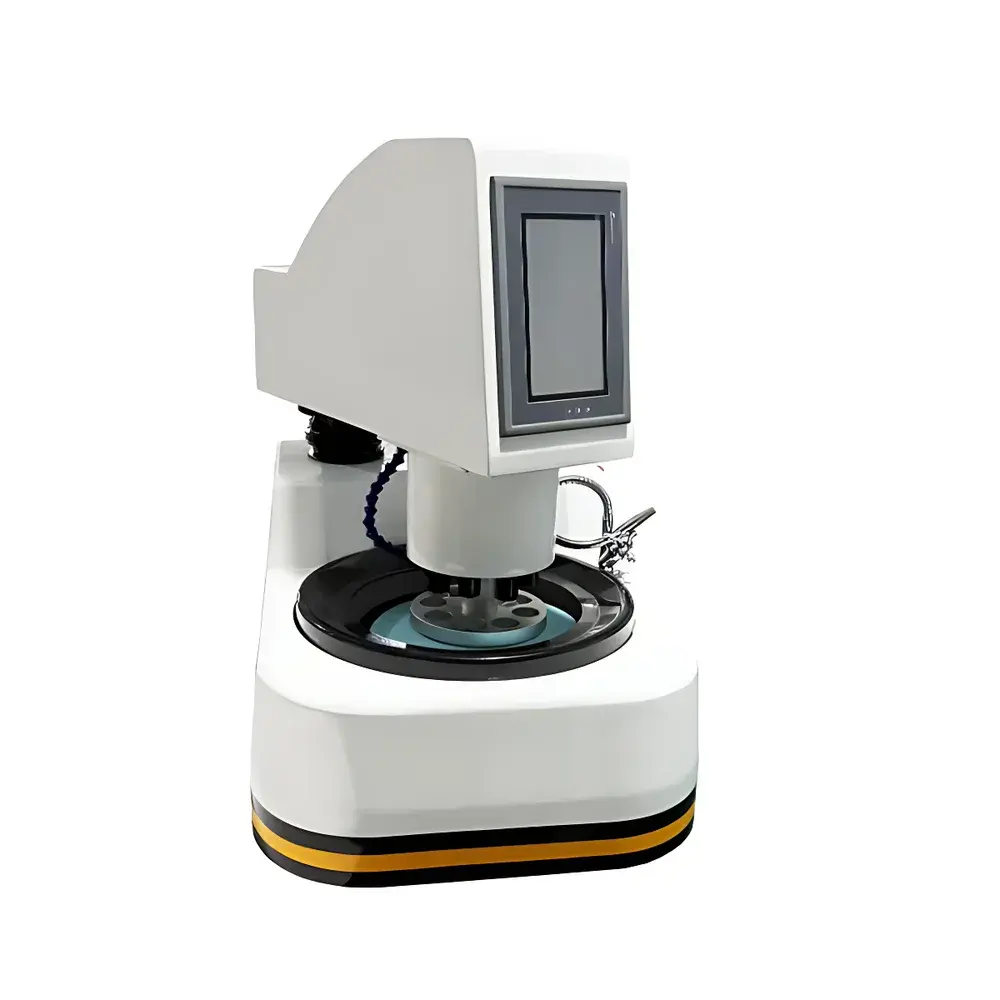
YANRUN ZMP-1000Z Intelligent Automated Metallographic Grinding and Polishing System
| Brand | YANRUN |
|---|---|
| Origin | Shanghai, China |
| Manufacturer Type | Direct Manufacturer |
| Region of Origin | Domestic (China) |
| Model | ZMP-1000Z |
| Speed Range | 50–1500 rpm (intelligent auto-adjustable) |
| Platen Diameter | 230 mm (optional: 200 / 250 / 300 mm) |
| Number of Platens | 1 |
| Dimensions (L×W×D) | 450 × 650 × 700 mm |
| Sample Capacity | 8 specimens per cycle |
| Pressure Control | Pneumatic (single-point or center loading |
| Feed System | Dual-channel automated abrasive dispensing (minimum interval: 0.1 s |
| minimum duration | 0.1 s) |
| Storage Capacity | 100 programmable grinding-polishing protocols |
| Motor Power | 1000 W |
| Specimen Diameter Range | Φ8–40 mm (customizable) |
| Platen Speed | 20–200 rpm |
| Grinding/Polishing Time | 0–9999 s |
| Power Supply | 220 V / 50 Hz |
Overview
The YANRUN ZMP-1000Z Intelligent Automated Metallographic Grinding and Polishing System is a precision-engineered benchtop instrument designed for reproducible, high-throughput specimen preparation in metallurgical, materials science, and failure analysis laboratories. Based on standardized metallographic sample preparation principles—sequential abrasive grinding followed by progressive polishing—the ZMP-1000Z implements closed-loop pneumatic pressure control, digitally regulated rotational dynamics, and synchronized abrasive delivery to ensure consistent surface removal rates and minimized edge rounding or relief artifacts. Its architecture conforms to core ISO 16381:2017 (Metallographic specimen preparation — General principles) and supports traceable process execution required under GLP and GMP-aligned quality systems. Unlike manual or semi-automated units, the ZMP-1000Z integrates deterministic motion control with programmable protocol sequencing, enabling strict adherence to ASTM E3-22 (Standard Guide for Preparation of Metallographic Specimens) and ISO 643:2021 (Steels — Micrographic determination of ferrite grain size).
Key Features
- Intelligent protocol management: Stores up to 100 fully parameterized grinding-polishing sequences—including speed, pressure, time, and abrasive feed schedules—for rapid recall and cross-laboratory method transfer.
- PLC-driven automation: Industrial-grade programmable logic controller paired with a high-resolution color touchscreen interface enables intuitive menu navigation, real-time status monitoring, and password-protected user-level access control (operator, technician, administrator).
- Dual-channel abrasive dispensing system: Independently controllable nozzles deliver precise volumes of diamond suspension or alumina slurry at programmable intervals (down to 0.1 s) and durations (down to 0.1 s), minimizing waste and ensuring uniform lubrication and particle replenishment across the platen surface.
- Pneumatic loading architecture: Single-point or center-loading configuration delivers repeatable force application (1–72 N per station or 300 N centralized load) with ±0.5 N pressure stability, critical for maintaining consistent material removal rates across heterogeneous alloys or composite specimens.
- Multi-specimen capability: Accommodates eight standard specimens (Φ8–40 mm) simultaneously using precision-machined holders with automatic clamping; custom fixtures available for irregular geometries or non-circular cross-sections.
- Adaptive speed control: Independent regulation of platen rotation (20–200 rpm) and specimen carrier rotation (50–1500 rpm) enables optimized kinematic coupling for coarse grinding, fine grinding, and final polishing stages.
Sample Compatibility & Compliance
The ZMP-1000Z supports preparation of ferrous and non-ferrous metals, sintered carbides, ceramics, and polymer composites. Its modular platen design (230 mm standard; optional 200/250/300 mm) accommodates industry-standard consumables—including silicon carbide papers, diamond-impregnated discs, and woven polishing cloths—from major global suppliers (e.g., Struers, Buehler, Leco). All operational parameters—including pressure setpoints, timing logs, and protocol versions—are timestamped and stored locally with audit-trail capability, satisfying documentation requirements for ISO/IEC 17025 accreditation and internal QA/QC review. The system operates within Class I electrical safety standards (IEC 61010-1) and meets CE marking directives for laboratory equipment.
Software & Data Management
No external PC dependency is required: all control logic, data logging, and protocol editing occur onboard via the embedded HMI. Each executed run generates a digital log file containing start/stop timestamps, applied pressure profiles, rotational speed traces, abrasive dispensing events, and operator ID (if enabled). Logs are exportable via USB port in CSV format for integration into LIMS or statistical process control (SPC) platforms. Firmware updates are delivered via secure USB media, preserving configuration integrity during version upgrades. While not natively 21 CFR Part 11 compliant, the system supports integration with third-party electronic signature and audit trail middleware when deployed in regulated environments.
Applications
- Routine quality control of castings, forgings, and weldments in foundry and aerospace manufacturing.
- Research-grade microstructural analysis of phase transformations, inclusion distributions, and grain boundary characterization in advanced high-strength steels.
- Failure analysis labs preparing cross-sections for SEM-EDS, EBSD, or microhardness mapping where surface integrity directly impacts analytical fidelity.
- Academic teaching laboratories requiring robust, repeatable training platforms for undergraduate metallurgy curricula.
- ISO-certified testing facilities performing accredited metallographic evaluations per EN 10365 or ASTM E112.
FAQ
What types of specimens can be processed simultaneously on the ZMP-1000Z?
Up to eight cylindrical or rectangular specimens (diameter Φ8–40 mm) can be mounted and processed concurrently using standardized holders; custom fixtures are available for non-standard geometries.
Is the abrasive dispensing system compatible with both water-based and oil-based suspensions?
Yes—the dual-channel fluid path is chemically resistant to common metallographic media including aqueous diamond slurries, colloidal silica, and oil-based alumina dispersions.
Can the system be integrated into an existing laboratory network for remote monitoring?
While the ZMP-1000Z lacks built-in Ethernet or Wi-Fi, its USB-exported logs support offline synchronization with centralized data repositories; optional RS-232 or Modbus RTU interfaces are available upon request for industrial SCADA integration.
Does the unit comply with international electrical safety standards?
Yes—it conforms to IEC 61010-1 for laboratory electrical equipment and carries CE marking for use in EU member states and other regions recognizing harmonized standards.
How is calibration and performance verification performed?
Pressure transducers and tachometric sensors are factory-calibrated; users perform routine verification using NIST-traceable torque wrenches and optical tachometers—procedures documented in the included maintenance manual.



