
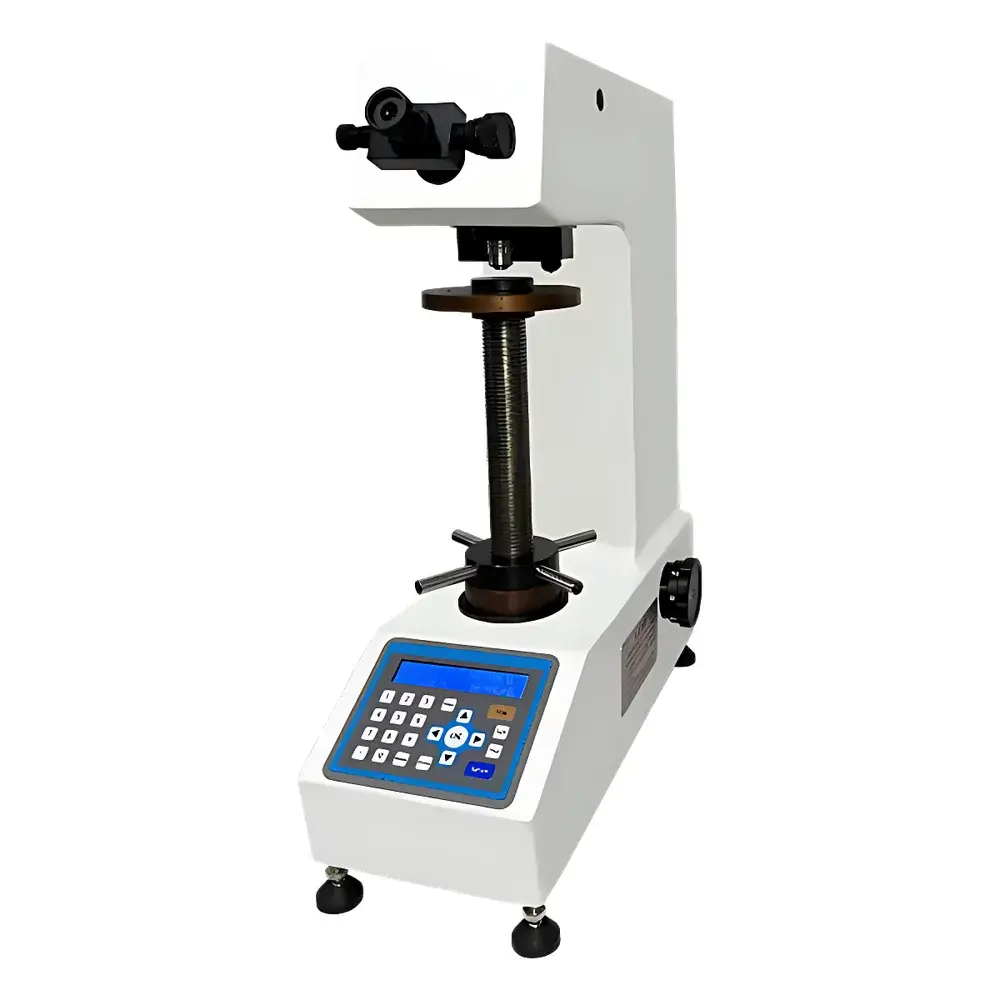
YANRUN HV-5Z Automatic Turret Vickers Hardness Tester
| Brand | YANRUN |
|---|---|
| Origin | Shanghai, China |
| Manufacturer Type | Manufacturer |
| Product Category | Domestic |
| Model | HV-5Z |
| Instrument Type | Vickers Hardness Tester |
| Measurement Range | 0.001–6000 HV |
| Test Force Options | 0.2–50 kgf (6 ranges) |
| Loading Mode | Fully Automatic (Load–Hold–Unload) |
| Standards Compliance | GB/T 4340, ISO 6507 |
| Magnification | 100× (observation), 200× (measurement for 5/10 kgf) |
| Objective Lenses | 10× (observation), 20× (measurement, 5/10 kgf only) |
| Eyepiece | 10× Measuring Eyepiece |
| Minimum Detectable Indentation Length | 0.12 µm (10× objective), 0.06 µm (20× objective) |
| Dwell Time | 0–60 s (1 s increments) |
| Max Specimen Height | 235 mm |
| Distance from Indenter Center to Chamber Wall | 130 mm |
| Power Supply | AC 220 V / 50 Hz |
| Dimensions (L×W×H) | 570 × 220 × 680 mm |
| Net Weight | 46.0 kg |
Overview
The YANRUN HV-5Z Automatic Turret Vickers Hardness Tester is an engineered solution for precise micro- and macro-scale hardness evaluation of metallic, ceramic, and composite materials. Based on the Vickers indentation principle—where a diamond pyramid indenter (136° apex angle) is applied under controlled load to produce a geometrically similar impression—the instrument quantifies hardness as the ratio of applied test force (kgf) to the surface area of the residual indentation. Designed for laboratories requiring high reproducibility and minimal operator influence, the HV-5Z integrates closed-loop force control, motorized turret positioning, and dual-path measurement capability (manual eyepiece + optional PC-based image analysis). Its architecture supports both routine QC verification and R&D-level material characterization across metallurgical, aerospace, automotive, and academic settings.
Key Features
- Motorized turret system enabling automatic switching between indenter and objective lenses—eliminating manual alignment errors and ensuring repeatable positioning accuracy.
- Closed-loop test force control mechanism delivering ±0.5% force accuracy across six selectable force ranges (0.2–50 kgf), with fully automated loading, dwell (0–60 s adjustable in 1 s steps), and unloading cycles.
- Dual optical path configuration: 10× observation objective (100× total magnification) and 20× measurement objective (200× total magnification for 5/10 kgf models); 10× objective used for both observation and measurement at higher loads (30/50 kgf).
- 10× measuring eyepiece with calibrated micrometer scale; minimum detectable diagonal length resolution of 0.12 µm (10×) and 0.06 µm (20×), enabling sub-micron indentation metrology.
- Large-format LCD display showing real-time parameters: indentation diagonal lengths (d₁/d₂), calculated HV value, applied load, dwell time, measurement count, date/time, and hardness conversion status.
- Integrated thermal printer and RS-232 serial interface for direct data export to external PCs or LIMS systems—supporting traceable recordkeeping and batch reporting.
Sample Compatibility & Compliance
The HV-5Z accommodates specimens up to 235 mm in height and 130 mm from indenter center to chamber interior wall—suitable for bulk components, cross-sectioned welds, heat-treated parts, and thin coatings (with appropriate load selection). It conforms to GB/T 4340.1–2023 and ISO 6507-1:2018 for Vickers hardness testing methodology, including indenter geometry verification, force calibration, and uncertainty estimation protocols. The instrument’s mechanical stability, temperature-compensated load cell, and rigid C-frame construction ensure compliance with GLP and GMP environmental requirements when operated in controlled laboratory conditions (20 ± 2 °C, <60% RH). While not FDA 21 CFR Part 11–certified out-of-the-box, its audit-ready data logs (via RS-232) support validation workflows in regulated manufacturing environments.
Software & Data Management
The HV-5Z supports standalone operation via front-panel controls and LCD interface, but also enables enhanced analysis through optional PC-connected software. This software provides digital image capture, semi-automated indentation detection, statistical reporting (mean, SD, CV%), trend charting, and customizable report generation (PDF/CSV). All measurements include timestamps and operator ID fields (configurable), satisfying basic ALCOA+ data integrity principles. Raw indentation length values and final HV results are stored locally on the instrument’s non-volatile memory (≥1000 records), with full export capability via RS-232—enabling integration into enterprise QA databases or SPC platforms. Calibration certificates and maintenance logs can be archived alongside test data for full traceability.
Applications
- Quality assurance of hardened steels, tool alloys, and case-hardened components in automotive and bearing manufacturing.
- Heat treatment process validation—including carburizing, nitriding, and induction hardening—via cross-sectional hardness profiling.
- Mechanical property correlation studies (e.g., HV vs. tensile strength, HV vs. grain size) in metallurgical research labs.
- Thin film and coating hardness assessment (e.g., TiN, DLC, PVD layers) using low-force regimes (0.2–1 kgf) and high-magnification optics.
- Educational use in materials science curricula for demonstrating indentation plasticity, work hardening behavior, and anisotropic response in polycrystalline aggregates.
FAQ
What standards does the HV-5Z comply with?
It meets GB/T 4340.1–2023 and ISO 6507-1:2018 for Vickers hardness testing procedures, including indenter qualification, force application tolerances, and measurement uncertainty guidance.
Can the HV-5Z perform automatic indentation measurement without PC software?
Yes—the built-in 10× measuring eyepiece with micrometer scale allows manual diagonal measurement and on-device HV calculation. Automatic image-based measurement requires optional PC software and camera module.
Is calibration verification supported per ISO 6507-3?
The instrument includes provisions for certified reference blocks (e.g., NIST-traceable Vickers standards) and supports periodic verification of force accuracy, indenter geometry, and optical magnification per ISO 6507-3:2018 Annex A.
What is the maximum specimen weight the stage can support?
While max height is specified as 235 mm, the stage load capacity is designed for typical metallographic samples and small machined parts; heavier specimens require stable placement and center-of-gravity alignment to prevent tilt-induced measurement error.
Does the HV-5Z support Rockwell or Brinell conversions?
Yes—it provides real-time conversion between HV and HK, HRA, HRB, HRC, HBW, and other common hardness scales based on ASTM E140–22 standard conversion tables embedded in firmware.



