
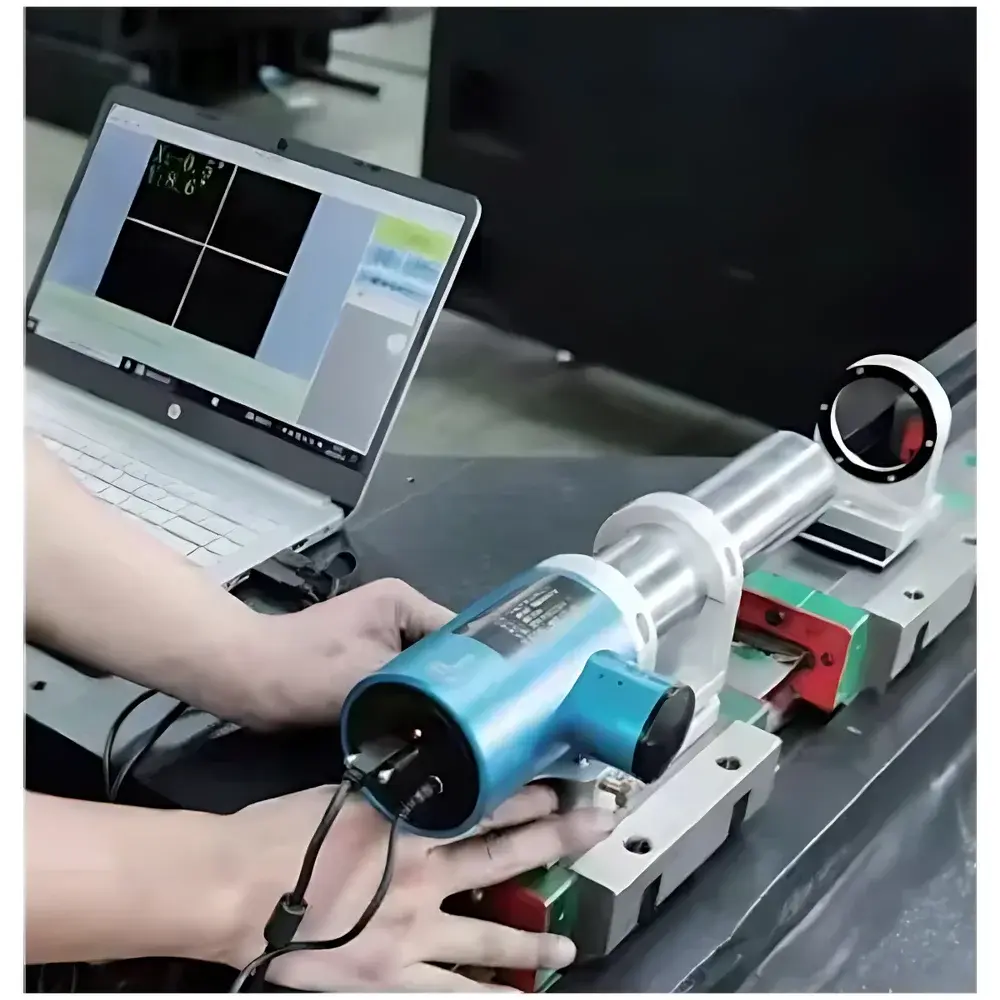
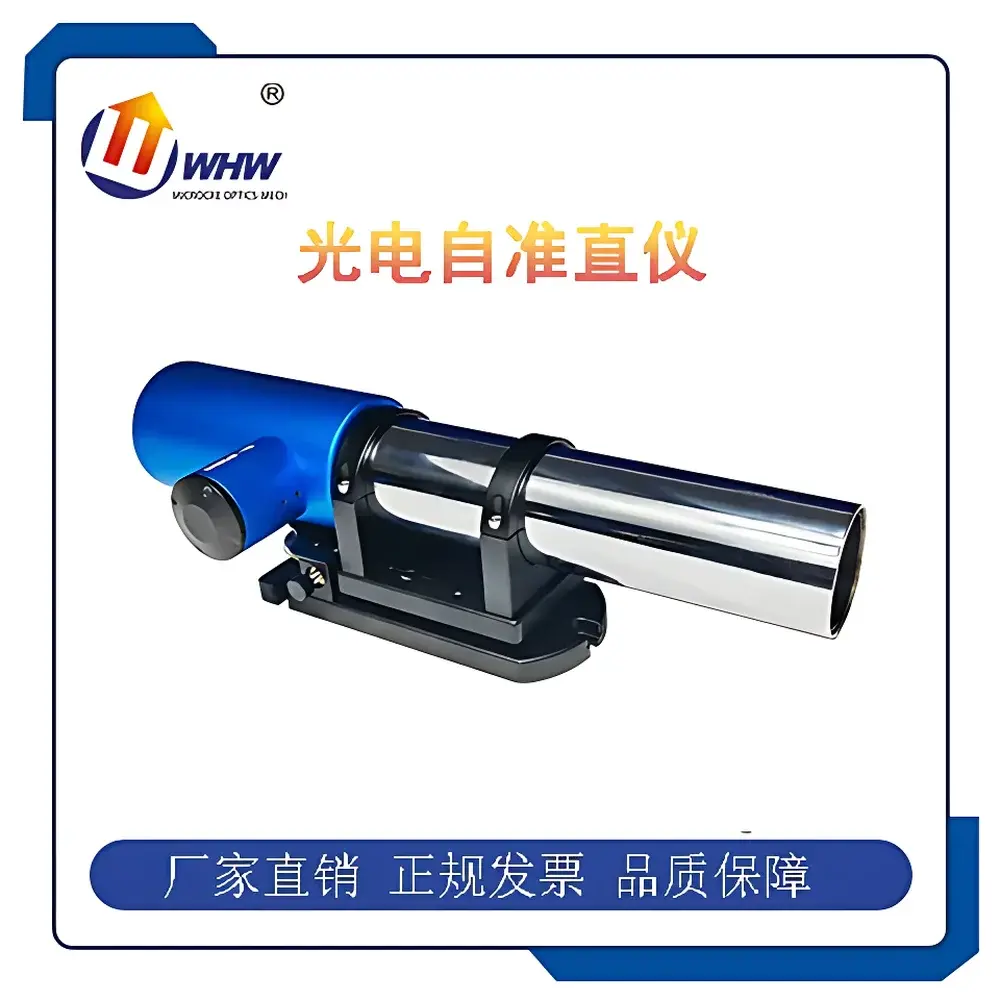
YANRUN MC030-YRUH3000/0.1 Dual-Axis Photoelectric Autocollimator
| Brand | YANRUN |
|---|---|
| Origin | Shanghai, China |
| Manufacturer Type | Manufacturer |
| Product Category | Domestic |
| Model | MC030-YRUH3000/0.1 |
| Focal Length | 300 mm |
| Objective Aperture | 48 mm |
| Light Source | High-Stability Semiconductor LED |
| Measurement Range | 0–30 m |
| Angular Resolution | Adjustable down to 0.0001″ (arc second) |
| Field of View (X/Y) | 1900″ × 1400″ (arc sec) |
| Accuracy (Center) | ±0.1″ (0–±100″), ±0.5″ (0–±600″) |
| Sampling Frequency | ≤30 Hz |
| Interface | USB 2.0 |
| Operating System | Windows 7 or later (64-bit) |
| Minimum PC Requirements | Intel Core i3-4th Gen or equivalent, ≥2.3 GHz CPU, 4 GB RAM |
Overview
The YANRUN MC030-YRUH3000/0.1 Dual-Axis Photoelectric Autocollimator is an advanced optomechanical metrology instrument engineered for high-precision angular measurement in industrial metrology, precision assembly, and calibration laboratories. It operates on the fundamental principle of optical autocollimation: a collimated beam—generated by projecting a reticle image through a telecentric objective lens onto its focal plane—is reflected back from a planar mirror orthogonal to the optical axis. Any angular deviation (α) of the mirror induces a linear displacement (ΔS) of the returned reticle image on a high-resolution photodetector array, where ΔS = 2f·tan(α) ≈ 2f·α (for small angles in radians). This linear-to-angular conversion enables traceable, non-contact, real-time angle quantification with sub-arcsecond resolution. Unlike traditional visual autocollimators requiring subjective eyepiece alignment, the MC030-YRUH3000/0.1 integrates a CMOS-based imaging sensor, digital signal processing, and real-time centroid detection algorithms to eliminate parallax and observer-dependent bias. Its 300 mm focal length objective delivers optimal sensitivity and working distance balance, while the 48 mm aperture ensures sufficient light throughput for stable operation up to 30 meters—making it suitable for large-scale machine tool verification and optical bench alignment.
Key Features
- Dual-axis simultaneous measurement (X and Y) with independent angular readouts, enabling full 2D tilt vector analysis without mechanical reorientation.
- Real-time electronic eyepiece display showing live centroid-tracked crosshair image; eliminates human aiming error and improves repeatability.
- Adjustable angular resolution down to 0.0001 arc second via software-selectable averaging and interpolation modes—supporting both rapid screening and ultra-fine calibration tasks.
- Stable semiconductor LED illumination with >50,000-hour lifetime; intensity-regulated and thermally compensated to minimize drift during extended measurements.
- Compact, modular architecture with integrated two-axis kinematic base for precise mirror positioning and coarse alignment prior to fine measurement.
- USB 2.0 interface ensures plug-and-play compatibility with standard industrial PCs; no external power supply or frame grabber required.
- Multi-language UI (English, Chinese, Russian, Korean) compliant with international deployment requirements in global manufacturing facilities.
- Supports ISO 230-1 (machine tool testing), ISO 10360 (CMM verification), and ASTM E2922 (optical alignment procedures) workflows via configurable reporting templates.
Sample Compatibility & Compliance
The MC030-YRUH3000/0.1 is designed for use with standard optical flat mirrors (λ/10 or better surface quality), retroreflective targets, and kinematic mirror mounts compliant with DIN 55350 and ISO 10791-7. It accommodates reflective surfaces ranging from 10 mm to 300 mm in diameter within its 30 m operational range. The system meets CE marking requirements for electromagnetic compatibility (EN 61326-1) and safety (EN 61010-1). Measurement data integrity adheres to principles outlined in ISO/IEC 17025:2017 for calibration laboratories, supporting audit-ready traceability when paired with NIST-traceable angular reference standards. While not inherently 21 CFR Part 11 compliant, optional software modules provide electronic signature capability, audit trail logging, and user-access controls for regulated environments (e.g., aerospace MRO, medical device manufacturing).
Software & Data Management
The bundled YANRUN AutoAlign Suite runs natively on Windows 7+ (64-bit) and requires no additional runtime libraries. It features real-time centroid tracking, automatic curve fitting (linear, polynomial, spline), and deviation mapping against nominal geometry. All raw pixel coordinates, calculated angles, timestamps, and environmental metadata (ambient temperature, operator ID) are stored in structured HDF5 format. Export options include CSV, XML, and native Excel (.xlsx) files with embedded formulas for uncertainty propagation per GUM (JCGM 100:2008). Batch processing mode enables unattended multi-point scans across predefined grids—ideal for flatness or straightness evaluation per ISO 1101. Software updates are delivered via secure HTTPS channel with SHA-256 signature verification. Calibration coefficients are digitally signed and locked to hardware serial number to prevent unauthorized modification.
Applications
- Precision alignment of CNC machine tool spindles, guideways, and rotary tables per ISO 230-1 Annex B.
- Verification of optical component angular orientation in laser cavity assembly and interferometer setup.
- Dynamic tilt monitoring of vibration-isolated optical platforms during long-duration experiments.
- Calibration of inclinometers, tilt sensors, and MEMS gyroscopes using reversal method protocols.
- Geometric error mapping of coordinate measuring machines (CMMs) and laser trackers.
- Plane mirror interferometry support for flatness assessment of granite surface plates (ISO 8512-2).
- Education and research in undergraduate optics labs—demonstrating wavefront tilt, Abbe error, and thermal drift compensation techniques.
FAQ
What is the recommended warm-up time before high-accuracy measurement?
For measurements requiring ≤±0.1″ accuracy, preheat the instrument for ≥15 minutes in a thermally stable environment (±0.5°C/h). For metrological certification, allow ≥24 hours of thermal equilibration at constant ambient temperature.
Can the system measure dynamic angular changes?
Yes—the maximum sampling rate is 30 Hz, supporting characterization of low-frequency mechanical oscillations such as servo loop response or thermal drift profiles.
Is external calibration required, and how often?
Initial calibration must be performed using a certified angular standard (e.g., NIST SRM 2089). Recalibration is recommended annually or after any physical shock exceeding 5 g, per ISO/IEC 17025 clause 7.7.
Does the software support automated report generation for ISO-compliant documentation?
Yes—templates conform to ISO 17025, ISO 9001, and AS9100 requirements, including uncertainty budgeting, equipment identification, environmental conditions, and technician signature fields.
What accessories are available for specialized applications?
Optional accessories include motorized mirror stages (for auto-scan), beam expanders (for extended range), vacuum-compatible mounts, and custom target patterns for edge detection or multi-reflection setups.





