
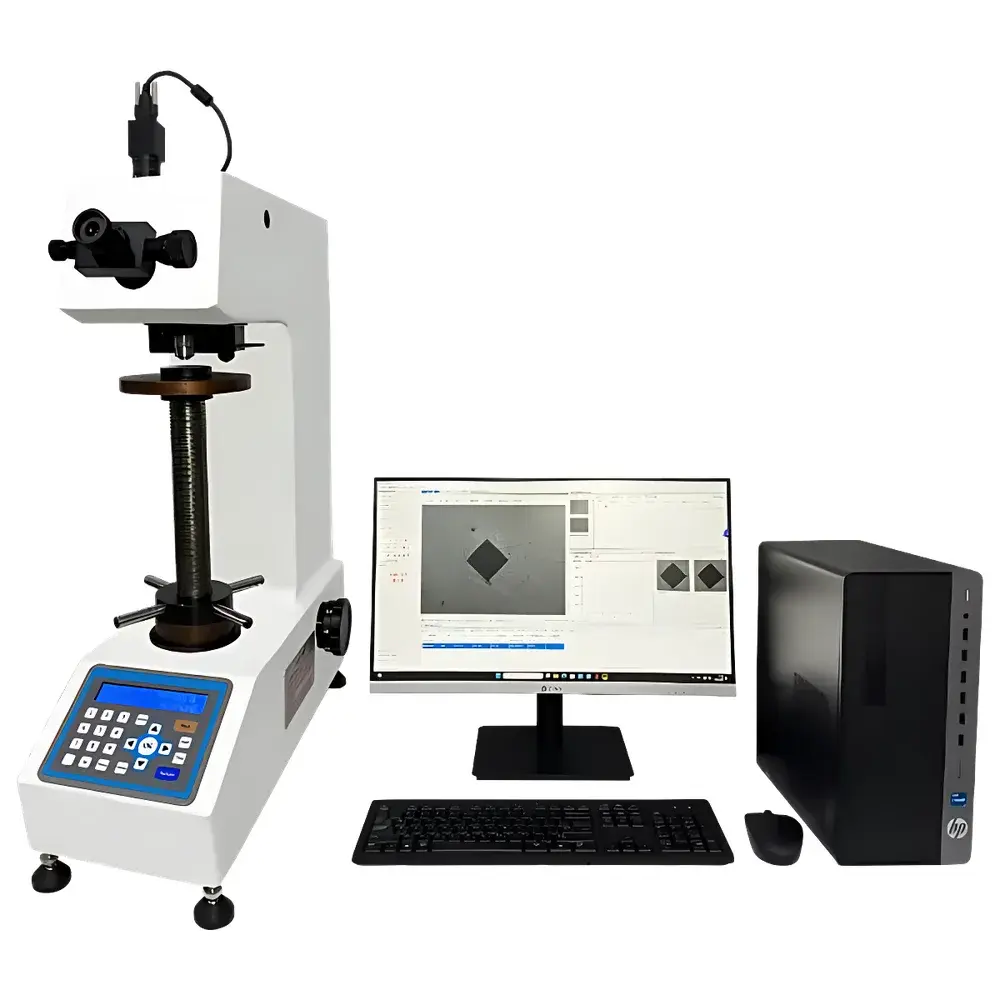
YANRUN HMAS-D5/D10/D30/D50 Vickers Hardness Measurement & Analysis System
| Brand | YANRUN |
|---|---|
| Origin | Shanghai, China |
| Manufacturer Type | Direct Manufacturer |
| Region of Origin | Domestic (China) |
| Model | HMAS-D5 / HMAS-D10 / HMAS-D30 / HMAS-D50 |
| Instrument Type | Vickers Hardness Tester |
| Hardness Measurement Range | 8–3000 HV |
| Test Force Options | 0.2–50 kgf (6 force levels per capacity tier) |
| Compliance | GB/T 4340, ISO 6507 |
| Minimum Detectable Indentation Resolution | 0.06 µm (with 20× objective) |
| Maximum Specimen Height | 235 mm |
| Distance from Indenter Center to Chamber Wall | 130 mm |
| Power Supply | AC 220 V / 50 Hz |
| Dimensions (L×W×H) | 570 × 220 × 680 mm |
| Net Weight | 54.0 kg |
| Gross Weight | 72.0 kg |
Overview
The YANRUN HMAS-D5/D10/D30/D50 Vickers Hardness Measurement & Analysis System is a fully automated, microprocessor-controlled hardness testing platform engineered for precision metallurgical and materials science laboratories. Based on the standardized Vickers indentation principle—where a diamond pyramid indenter (136° apex angle) is applied under controlled static load to produce a geometrically reproducible square impression—the system delivers traceable, high-reproducibility hardness values across the full range of 8–3000 HV. Designed in strict conformance with ISO 6507-1 and GB/T 4340.1, the HMAS series integrates closed-loop electro-mechanical force actuation, real-time positional feedback, and dual-path measurement architecture (standalone touchscreen + PC-based analysis software), enabling compliance-ready operation in quality control, R&D, and third-party certification environments.
Key Features
- Bi-directional real-time communication between controller and software, with sub-10 ms response latency and automatic disconnection detection with visual alert.
- Motorized turret with seamless, silent switching between Vickers indenter and optical objectives—no manual alignment or mechanical backlash.
- Auto-force recognition: software identifies selected test load (e.g., 0.2 kgf, 5 kgf, 30 kgf) and configures actuation parameters accordingly; force change executed with single command.
- Full-cycle indentation control: programmable loading ramp, dwell time (0–60 s, 1 s increments), and unloading sequence—all governed by closed-loop feedback for ≤0.1% repeatability in hardness value output.
- Modular, drag-and-drop user interface with customizable workspaces; frequently used functions accessible without navigation or menu traversal (“zero-click” workflow).
- Six configurable centerline styles (solid/dashed/dotted), adjustable color, line width, and font size—optimized for rapid visual confirmation of indentation centroid location.
- Grid-assisted stage navigation with path planning visualization—particularly advantageous for case depth profiling (e.g., carburized or nitrided layers) where stepwise movement must be both precise and auditable.
- Thirteen real-time background enhancement algorithms dynamically adapt contrast and edge definition across diverse material surfaces (e.g., polished steel, cast iron, Ti alloys, ceramics), ensuring consistent image sharpness without post-capture correction.
- Rolling-wheel continuous zoom (not stepped) with sub-micron positioning resolution (0.1 µm tangential accuracy) for fine-grained indentation boundary delineation.
- Multi-indent viewing mode: simultaneous display and clustering of up to 16 impressions per field; synchronized updates across data table, hardness distribution curve, and spatial heat map—each view exportable independently in CSV, PNG, or PDF.
Sample Compatibility & Compliance
The HMAS-D5/D10/D30/D50 accommodates specimens up to 235 mm in height and 130 mm from indenter center to internal chamber wall—suitable for standard metallographic mounts, machined coupons, and small components. Its dual measurement architecture satisfies dual-audit requirements: hardness values may be recorded directly via the integrated 10× digital eyepiece (with push-button readout) or acquired through the PC-based imaging module using calibrated pixel-to-micron mapping. All test sequences adhere to ISO 6507-1 (Vickers hardness testing—Part 1: Test method) and GB/T 4340.1 (Chinese national standard equivalent), including mandatory verification of indenter geometry, force calibration traceability, and environmental temperature stability reporting. The system supports GLP/GMP-aligned documentation protocols—including electronic audit trails, user access logs, and timestamped result archives—facilitating readiness for FDA 21 CFR Part 11-compliant validation when paired with validated software configuration.
Software & Data Management
The proprietary HMAS Analysis Suite provides comprehensive post-test evaluation capabilities. It supports six operational modes: manual point-and-measure, semi-automated grid scan, fully automated batch testing (with stage coordinate scripting), multi-load comparative analysis, case depth profiling, and statistical process control (SPC) reporting. Each indentation generates a self-contained “micro-report” embedded as a QR code in the image file—scanning retrieves full metadata: test force, dwell time, operator ID, timestamp, calibration certificate ID, raw pixel measurements, and calculated HV value. Reports integrate user-defined fields (e.g., lot number, heat treatment cycle ID), CPK capability indices, histogram overlays, and XY scatter plots. Export formats include ISO/IEC 17025-compliant PDF reports, machine-readable CSV files, and annotated TIFF images with embedded EXIF metadata.
Applications
This system serves critical roles in metallurgical QA/QC labs verifying heat treatment efficacy (e.g., quenching & tempering, surface hardening), failure analysis teams assessing localized embrittlement or decarburization, aerospace component suppliers validating turbine blade coatings, and academic research groups studying nanostructured alloys or additive-manufactured microstructures. Its high-resolution measurement capability (0.06 µm with 20× objective) enables reliable assessment of thin PVD/CVD coatings and diffusion zones. The modular design allows seamless integration into existing LIMS or MES infrastructures via TCP/IP or RS-232 interfaces.
FAQ
Does the HMAS system support ASTM E384 for microhardness testing?
Yes—when configured with test forces ≤0.5 kgf and appropriate objective magnification (20×), the system meets the optical resolution and force accuracy requirements specified in ASTM E384-22.
Can hardness data be exported in a format compatible with Minitab or JMP?
All quantitative results are exportable as UTF-8 encoded CSV files with column headers compliant with common SPC software ingestion standards.
Is the indenter certified and traceable to NIM or NIST standards?
Each diamond indenter is supplied with a manufacturer’s calibration certificate traceable to the National Institute of Metrology (NIM), China; optional NIST-traceable certification is available upon request.
What maintenance intervals are recommended for long-term accuracy?
Annual verification of force actuator linearity and indenter geometry is advised; biannual cleaning and lubrication of the precision trapezoidal lead screw mechanism ensures optimal Z-axis repeatability.
Does the software support multi-user role-based access control?
Yes—administrator, operator, and reviewer profiles can be defined with granular permissions over test method editing, result modification, report generation, and audit log access.



