
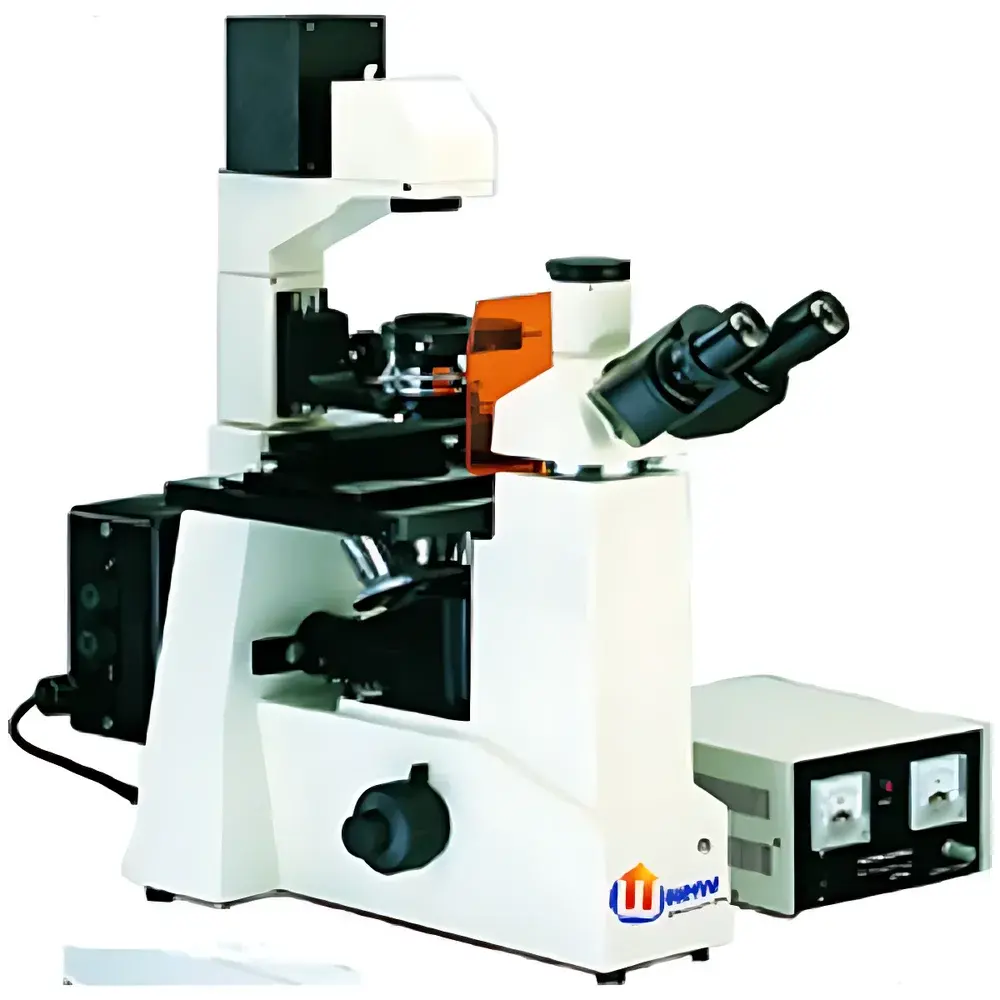
YANRUN FM-100 Inverted Phase Contrast and Epi-Fluorescence Microscope
| Brand | YANRUN |
|---|---|
| Origin | Shanghai, China |
| Manufacturer Type | Direct Manufacturer |
| Product Category | Domestic (China-Made) |
| Model | FM-100 Inverted Phase Contrast and Epi-Fluorescence Microscope |
| Price | USD 1 (Base Unit Quotation — Custom Configuration Required) |
Overview
The YANRUN FM-100 is an engineered inverted optical microscope platform designed for live-cell imaging, long-term culture monitoring, and multi-modal contrast observation in biomedical research and quality control laboratories. Its core architecture integrates three complementary optical modalities: transmitted brightfield, phase contrast, and epi-fluorescence illumination—enabling label-free morphological assessment alongside targeted fluorescent probe detection. The inverted configuration places the objective lenses beneath the specimen stage, allowing unobstructed access to culture vessels—including Petri dishes, flasks, and multi-well plates—while maintaining stable thermal and mechanical conditions during time-lapse experiments. Optical path design adheres to Köhler illumination principles for both transmitted and reflected channels, ensuring uniform intensity distribution and optimal resolution across the full field of view (FOV). The system employs a finite-conjugate optical train optimized for standard 160 mm tube length, compatible with industry-standard accessories and third-party camera adapters.
Key Features
- Hinged binocular observation tube with 30° inclination and individual diopter adjustment for ergonomic extended use;
- Wide-field plan-achromatic eyepieces (WF10X, 20 mm FOV) providing high-fidelity image flatness and chromatic correction;
- Removable mechanical stage (208 × 224 mm) with 79 × 112 mm travel range and interchangeable specimen holders for Φ68 mm, 77 × 29 mm, 82 × 57 mm, and 128 × 85 mm multi-well plates;
- Swing-out condenser assembly enabling contamination-free imaging of tall culture vessels (e.g., T-flasks or roller bottles) without stage repositioning;
- Adjustable trans-illumination source (6 V / 30 W halogen lamp) with spatial alignment capability for precise Köhler setup;
- Dual-band epi-fluorescence illumination module powered by a 100 W mercury arc lamp, supporting four excitation/emission channel combinations: UV (320–380 nm ex / 435 nm em), violet (380–415 nm ex / 475 nm em), blue (450–490 nm ex / 515 nm em), and green (495–555 nm ex / 595 nm em);
- Five-position objective turret with ball-bearing internal positioning and inward curvature for vibration-damped lens switching;
- Dedicated phase contrast system including long-working-distance PLL phase objectives (10X/0.25, 25X/0.4, 40X/0.6), centering telescope, rotating annular diaphragm, and adjustable NA=0.4 condenser (WD = 50 mm).
Sample Compatibility & Compliance
The FM-100 accommodates standard cell culture formats without modification: round dishes (Φ68 mm), rectangular dishes (77 × 29 mm), 96-well microplates (128 × 85 mm), and compact culture inserts (82 × 57 mm). Its long working distance optics support imaging through bottom-glass thicknesses up to 1.2 mm, compatible with common TC-treated polystyrene and glass-bottom vessels. All optical components meet ISO 10934-1 (Microscopy — Nomenclature for Microscopes) and comply with IEC 61000-6-3 (EMC emission standards) and IEC 61000-6-2 (immunity requirements). While not certified for GMP production environments, the system supports GLP-aligned documentation workflows when integrated with compliant digital imaging systems and audit-trail-capable software.
Software & Data Management
The FM-100 operates as a hardware platform compatible with third-party machine vision software (e.g., NIS-Elements, ZEN Blue, or open-source Micro-Manager). When paired with a C-mount adapter and USB3.0 CMOS camera, it enables time-series acquisition, Z-stack reconstruction, and multi-channel fluorescence overlay. Metadata capture includes objective magnification, filter set ID, exposure time, gain, and illumination mode—exportable in TIFF or OME-TIFF format for FAIR (Findable, Accessible, Interoperable, Reusable) data handling. Optional integration with laboratory information management systems (LIMS) is achievable via API-based middleware supporting HL7 or RESTful protocols.
Applications
- Real-time monitoring of adherent and suspension cell cultures under physiological conditions;
- Phase contrast imaging of unstained specimens such as primary neurons, stem cell colonies, and organoids;
- Immunofluorescence localization of cytoskeletal proteins (e.g., actin, tubulin), nuclear markers (DAPI, Hoechst), and membrane dyes (WGA, CTB);
- Calcium flux assays using ratiometric dyes (Fura-2, Indo-1) requiring dual-excitation capability;
- Quality assurance of bioprocess intermediates, including mycoplasma screening and viability assessment;
- Academic teaching labs for comparative microscopy instruction across contrast modalities.
FAQ
Is the FM-100 suitable for live-cell time-lapse imaging?
Yes—the inverted geometry, temperature-stable stage interface, and low-heat halogen/transmitted illumination minimize thermal drift and phototoxicity during extended acquisitions.
Can the mercury lamp be replaced with an LED fluorescence light source?
Yes—via optional C-mount LED adapter modules; however, spectral output must match the installed excitation filters to maintain signal-to-noise integrity.
Does the system support DIC or Hoffman modulation contrast?
No—DIC and Hoffman require specialized prism sets and polarized optics not included in the FM-100 base configuration.
What is the maximum usable magnification with oil immersion?
The FM-100 does not include oil-immersion objectives; its highest native magnification is 400× using the 40X phase objective and 10X eyepieces.
Is service and calibration support available outside mainland China?
YANRUN provides remote technical guidance and collaborates with authorized regional distributors for on-site maintenance contracts; calibration certificates follow ISO/IEC 17025 guidelines upon request.



