
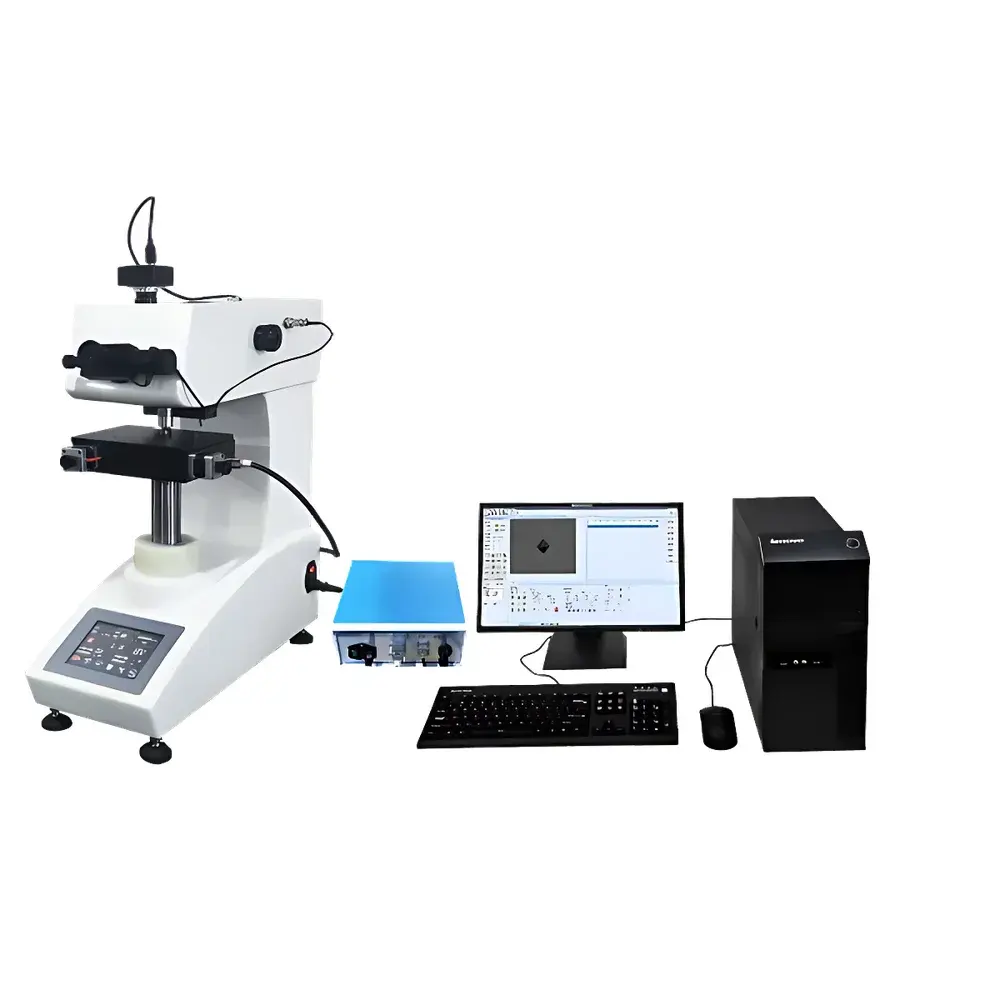
YANRUN HMAS-D1000SMA Fully Automated Vickers Hardness Measurement & Analysis System
| Brand | YANRUN |
|---|---|
| Origin | Shanghai, China |
| Manufacturer Type | Direct Manufacturer |
| Product Category | Domestic |
| Model | HMAS-D1000SMA |
| Instrument Type | Microhardness Tester |
| Hardness Measurement Range | 0.001–6000 HV |
| Test Forces | 10, 25, 50, 100, 200, 300, 500, 1000 gf |
Overview
The YANRUN HMAS-D1000SMA Fully Automated Vickers Hardness Measurement & Analysis System is an integrated microhardness testing platform engineered for precision, repeatability, and compliance in metallurgical laboratories, quality control departments, and R&D facilities. It operates on the fundamental principle of Vickers indentation hardness testing—applying a precisely controlled diamond pyramid indenter (136° apex angle) under defined static load to a polished specimen surface, followed by optical measurement of the resulting diagonal impressions. The system combines high-resolution digital imaging, motorized XYZ stage control, closed-loop force actuation, and ISO/ASTM-compliant software algorithms to deliver traceable, GLP-ready hardness data. Designed for routine and advanced microstructural analysis, it supports both single-point verification and systematic cross-sectional hardness profiling—including case depth evaluation, gradient mapping, and multi-specimen batch analysis—without manual intervention.
Key Features
- Fully automated indentation cycle: motorized Z-axis loading/unloading, programmable dwell time (0–60 s in 1-s increments), and real-time force feedback control.
- Motorized X-Y-Z precision stage: 50 × 50 mm travel range, 50 kg load capacity, equipped with optical encoders for sub-micron positioning accuracy.
- Dual-view optical path: simultaneous observation via 10× digital eyepiece and 5 MP CCD camera; real-time video capture and frame-locked image acquisition.
- Auto-turret with dual-position capability: seamless switching between Vickers indenter and objective lenses (standard 10× and 40×; optional 20×, 50×, or 100×).
- Advanced auto-focus algorithm: high-speed contrast-based focusing optimized for post-indentation clarity—critical for accurate diagonal detection at high magnifications (up to 1600× digitally).
- Mechanical offset calibration: dedicated utility to quantify and compensate for spatial misalignment between indenter axis and optical axis, ensuring geometric fidelity per ASTM E384 Annex A2.
- Curved-surface correction module: implements ASTM E384 Table 1 and Table 2 formulas for spherical and cylindrical specimens, outputting corrected HV values with uncertainty propagation.
Sample Compatibility & Compliance
The HMAS-D1000SMA accommodates specimens up to 180 mm in height and 130 mm from indenter center to chamber wall—suitable for heat-treated gears, turbine blades, thin coatings, and small weld coupons. Its mechanical architecture conforms to GB/T 4340.2 (equivalent to ISO 6507-2) for instrument verification and JJG 151 metrological verification requirements. All hardness calculations adhere to ISO 6507-1, ASTM E384, and ASTM E92 methodologies. Data integrity meets FDA 21 CFR Part 11 criteria through role-based user authentication, electronic audit trails, and immutable result logs. Calibration traceability is supported via dual-mode referencing: optical pixel-to-micron scaling and certified reference blocks (high/low HV), with multi-block segmented calibration for extended range linearity.
Software & Data Management
The embedded analysis software provides full lifecycle data handling—from acquisition to regulatory reporting. Core capabilities include: automatic diamond-shaped impression recognition with adaptive thresholding; manual measurement modes (four-edge, diagonal, four-point); dynamic scaling compensation across magnifications and loads; and real-time HV/HK computation with SI-unit output. The system supports hardness conversion per ISO 18265, ASTM E140, and DIN 50150—covering Vickers (HV), Knoop (HK), Rockwell (HRA–HRK), superficial Rockwell (HR15N–HR45T), and Brinell (HBS/HBW). Path planning includes 17 geometric primitives (e.g., edge normals, circular arcs, matrix grids) for case-depth profiling. Reports export natively to editable Word (.docx) and Excel (.xlsx) formats, with customizable templates, watermarking, and signature fields. Language support includes English, Chinese, German, Spanish, Russian, and French—configured per user session.
Applications
This system serves critical applications in aerospace component certification (e.g., turbine disk case hardening verification), automotive powertrain QA (camshaft nitriding depth validation), biomedical implant coating characterization (TiN/TiAlN adhesion layer hardness gradients), and semiconductor packaging metallurgy (solder joint IMC phase hardness mapping). It enables compliant generation of Jominy end-quench curves, decarburization layer quantification per ASTM E1077, and intergranular corrosion susceptibility assessment via microhardness traverses. In academic settings, it supports quantitative metallography workflows integrating with SEM-EDS correlation and thermal simulation validation.
FAQ
Does the system comply with ISO/ASTM calibration requirements?
Yes—hardware verification follows GB/T 4340.2 and JJG 151; software algorithms implement ISO 6507-1 and ASTM E384 calculation logic, with documented uncertainty budgets.
Can it measure curved or irregular surfaces?
Yes—curved-surface correction uses ASTM E384 Table 1 (spheres) and Table 2 (cylinders), adjusting raw measurements based on radius-of-curvature input.
What video capture resolution is supported?
Standard configuration includes a 5-megapixel progressive-scan CCD camera; third-party GigE Vision or USB3 cameras are compatible via SDK integration.
Is remote operation or network deployment possible?
The software supports LAN-based client-server architecture, enabling centralized database management and multi-station result aggregation under Windows domain authentication.
How is measurement traceability maintained?
Each test record stores indenter serial number, load cell calibration date, optical scale factor, reference block ID, operator credentials, and timestamped audit trail—all exportable as PDF/A-1b for archival compliance.



