
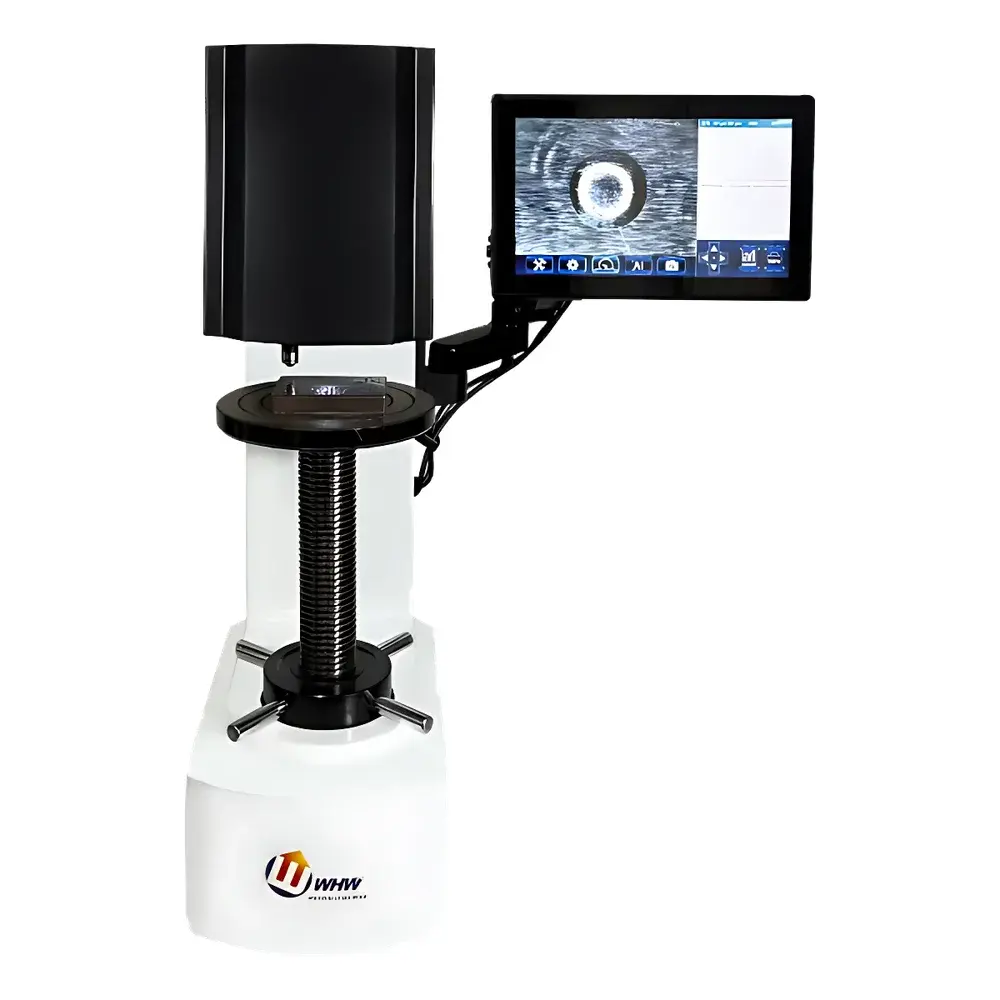
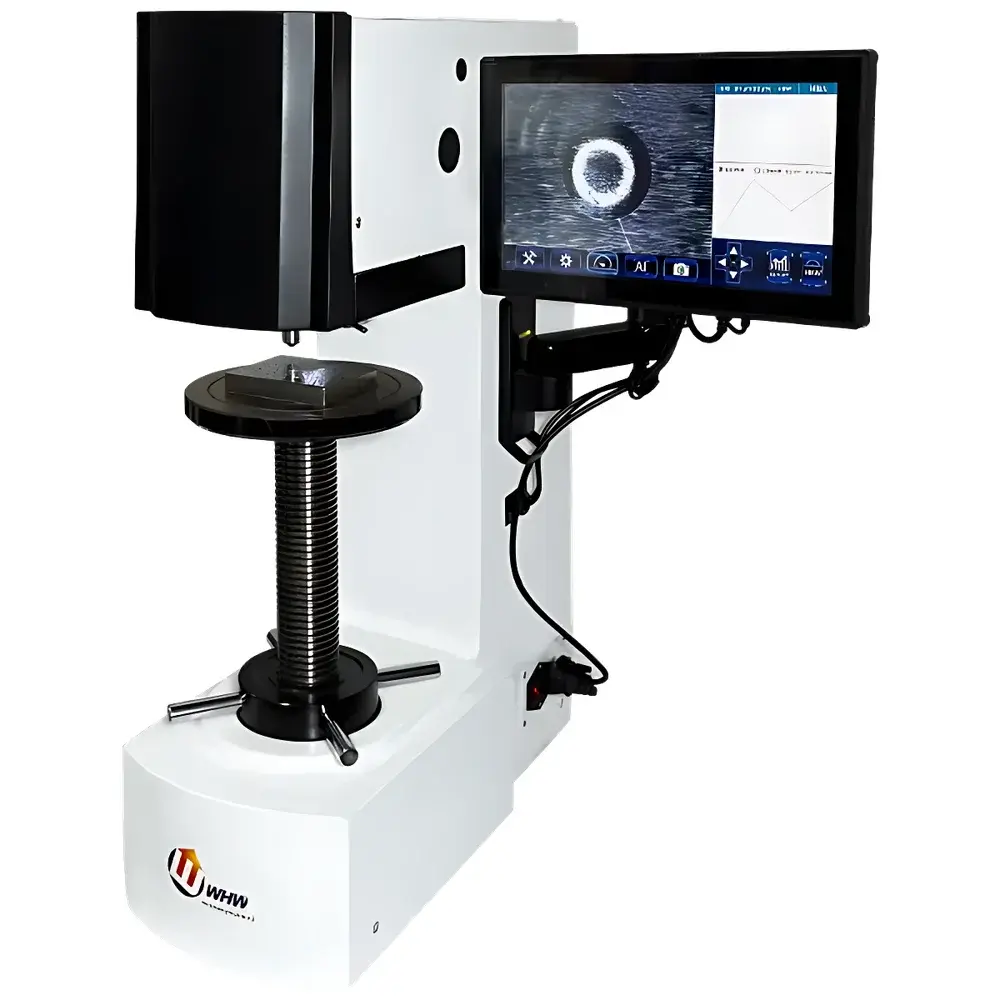
YANRUN VSYD-D3000E11.6V Automated Vision-Based Brinell Hardness Tester
| Brand | YANRUN |
|---|---|
| Origin | Shanghai, China |
| Manufacturer Type | Direct Manufacturer |
| Country of Origin | China |
| Model | VSYD-D3000E11.6V |
| Instrument Type | Brinell Hardness Tester |
| Measuring Range | 8–650 HBW |
| Test Force Levels | 62.5–3000 kgf (612.5–29,400 N) |
| Indentation Measurement | Fully Automated via 2-MP Industrial Camera |
| Load Application | Fully Automatic (Loading–Dwell–Unloading) |
| Dwell Time | 0–99 s (1 s increments) |
| Max Specimen Height | 230 mm |
| Distance from Indenter Center to Front Wall | 150 mm |
| Test Table Options | φ197 mm Flat Table, φ75 mm Flat Table, φ75 mm V-Block |
| Standards Compliance | GB/T 231.1, GB/T 231.2, JJG 150 |
| Hardness Scale Conversion | GB/ASTM/ISO 3771 (Copper Alloys), GB/T 1172 (Carbon & Alloy Steels) |
| Power Supply | AC 220 V / 50 Hz |
| Dimensions (L×W×H) | 496 × 310 × 746 mm |
| Net Weight | 120.5 kg |
| Gross Weight | 146.0 kg |
Overview
The YANRUN VSYD-D3000E11.6V is an automated vision-based Brinell hardness tester engineered for precision, repeatability, and compliance in metallurgical quality control and materials R&D laboratories. It operates on the fundamental Brinell principle: a hardened tungsten carbide ball indenter is applied under a precisely controlled test force onto a prepared specimen surface; after a defined dwell period, the force is removed, and the resulting spherical indentation diameter is measured optically. The Brinell hardness number (HBW) is calculated using the standardized formula HBW = 0.102 × (2F) / [πD(D − √(D² − d²))], where F is the applied test force (N), D is the indenter ball diameter (mm), and d is the mean indentation diameter (mm). Unlike manual or semi-automatic testers, the VSYD-D3000E11.6V integrates a calibrated 2-megapixel industrial CMOS camera with real-time image processing algorithms to autonomously detect, segment, and measure indentation diameters—eliminating operator subjectivity and parallax error. Its rigid C-frame architecture and high-stiffness loading column ensure minimal deflection during high-force testing (up to 3000 kgf), supporting reliable measurements across the full 8–650 HBW range for cast iron, nonferrous metals, annealed steels, and aluminum alloys.
Key Features
- Fully automated test cycle: programmable force application, dwell time (0–99 s in 1 s steps), and unloading—reducing operator dependency and enhancing inter-laboratory reproducibility.
- Vision-based indentation measurement system featuring a 2 MP industrial-grade color camera with adjustable LED illumination (10-level brightness control) for optimal contrast across diverse surface finishes and material types.
- Multi-scale Brinell capability: supports 12 standardized test force–ball diameter combinations per ISO 6506-1 and GB/T 231.1, including HBW 10/3000, HBW 5/750, HBW 2.5/187.5, and others—enabling consistent evaluation of both coarse-grained and thin-sectioned specimens.
- Integrated tablet-based control interface running the proprietary VSYD Hardness Measurement & Analysis System, offering intuitive workflow navigation, real-time load curve visualization, and traceable result logging.
- Comprehensive mechanical design: 120.5 kg net weight, reinforced base, and 230 mm maximum specimen height clearance accommodate large castings and forged components; 150 mm indenter-to-front-wall distance facilitates side-loading of irregular parts.
- Calibration-ready architecture compliant with JJG 150 verification procedures, supporting third-party calibration and routine performance verification using certified Brinell reference blocks (included).
Sample Compatibility & Compliance
The VSYD-D3000E11.6V accommodates a wide variety of metallic specimens—including as-cast, heat-treated, cold-worked, and welded materials—without requiring specialized fixturing beyond the supplied flat, medium, and V-block test tables. Its 197 mm diameter main platform supports large billets and machined housings, while the V-block enables stable testing of cylindrical rods and shafts. All test configurations adhere strictly to GB/T 231.1–2018 (equivalent to ISO 6506-1:2014) for test method validity and GB/T 231.2–2012 for verification of testing machines. Hardness conversions referenced in the system (e.g., GB/T 1172 for carbon steels, ISO 3771 for copper alloys) are derived from empirically validated correlations and are intended for informational comparison—not substitution—for specification-critical decisions. The instrument’s mechanical and software architecture supports audit-ready documentation required under GLP and GMP environments, with timestamped test records, user login tracking, and exportable CSV/PDF reports.
Software & Data Management
The VSYD Hardness Measurement & Analysis System runs on an embedded Android-based tablet with a responsive touchscreen UI. Each test session captures raw indentation images, load–time curves, calculated HBW values, statistical summaries (mean, SD, CV%), and operator metadata. Data files are stored locally with optional USB export and support batch reporting by lot, material grade, or heat number. The software enforces data integrity through automatic file naming (e.g., “VSYD_20240522_143022_HBW10_3000”), prevents post-test value editing, and maintains an immutable internal audit trail of all system actions—including calibration events, user logins, and parameter changes. While not natively 21 CFR Part 11 compliant, the system can be deployed within validated IT infrastructures where electronic records are governed by institutional SOPs and supplementary access controls.
Applications
- Metallurgical QC labs verifying conformance of incoming raw materials (ingots, billets, forgings) against ASTM A370 or GB/T 228.1 tensile–hardness correlation requirements.
- Foundry process validation—monitoring heat treatment efficacy across ductile iron, gray iron, and aluminum-silicon alloys via periodic Brinell sampling.
- R&D centers correlating microstructure (e.g., pearlite fraction, grain size) with bulk mechanical response using standardized HBW–UTS conversion protocols.
- Aerospace MRO facilities performing non-destructive hardness screening of landing gear components and turbine housings prior to rework or acceptance.
- Academic materials science laboratories conducting comparative studies of alloy development, surface hardening treatments (e.g., carburizing, induction hardening), and weld HAZ characterization.
FAQ
What standards does the VSYD-D3000E11.6V comply with?
It fully conforms to GB/T 231.1–2018 (Brinell hardness test—Part 1: Test method), GB/T 231.2–2012 (Verification of testing machines), and JJG 150–2016 (Verification regulation for Brinell hardness testers), which are technically equivalent to ISO 6506-1 and ISO 6506-2.
Can the system measure indentations on curved or rough surfaces?
Flat, ground, or polished surfaces are required per ISO 6506-1. Curved specimens must be supported using the included V-block, and surface roughness should not exceed Ra ≤ 1.6 µm to ensure optical measurement accuracy.
Is remote software update or technical support available?
Firmware updates are delivered via secure USB media; remote desktop assistance is available upon request for troubleshooting—subject to customer network security policies.
How is traceability ensured for calibration and verification?
Each unit ships with three certified Brinell reference blocks (low/mid/high range), and the software logs all calibration events with date, operator ID, block serial numbers, and deviation results.
Does the system support custom hardness scale conversions?
Only the preloaded conversions per GB/T 1172 and ISO 3771 are active; no user-defined formulas or external lookup tables can be imported.



