
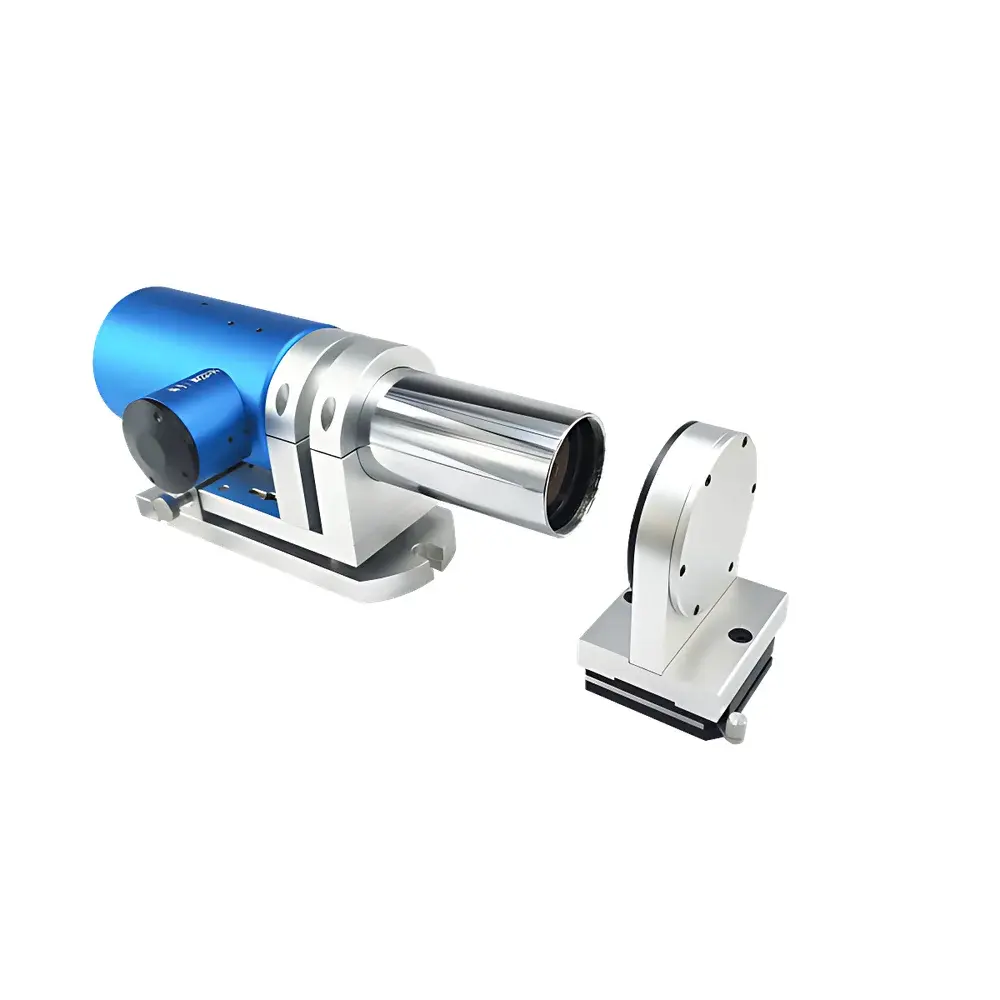
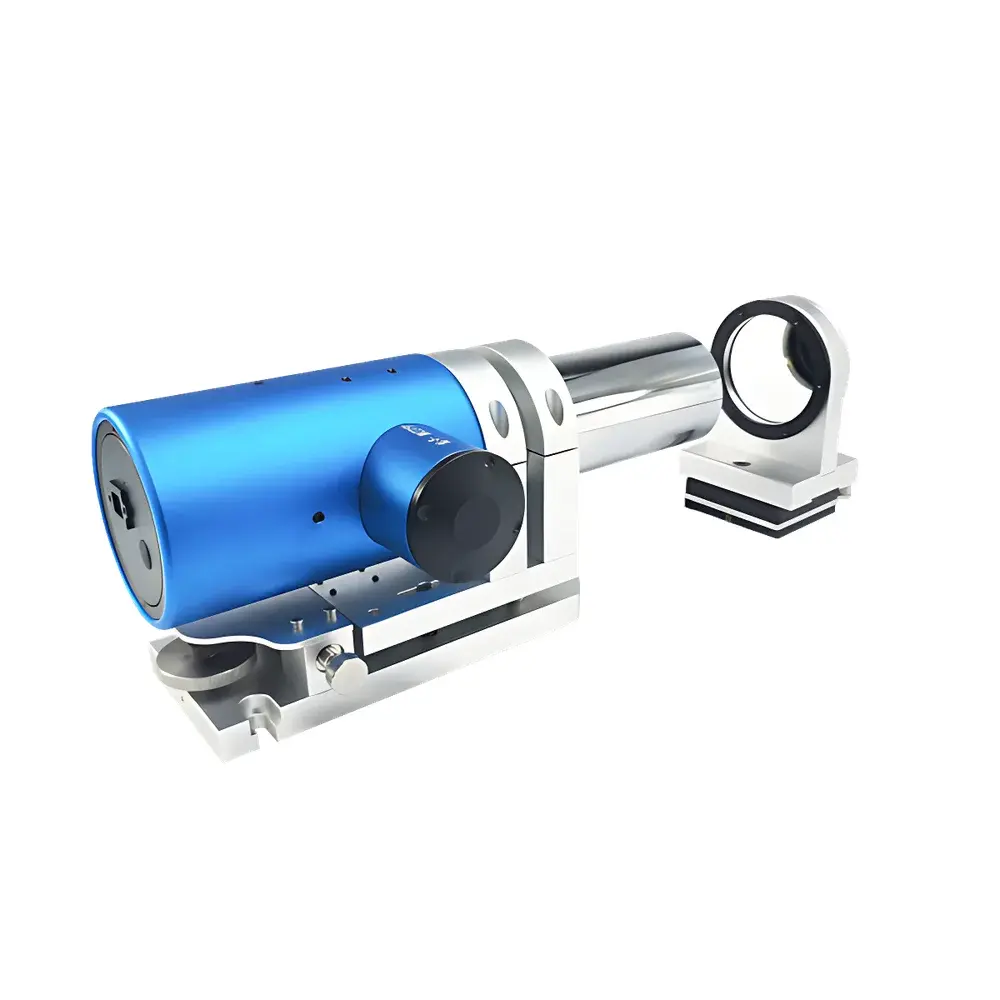
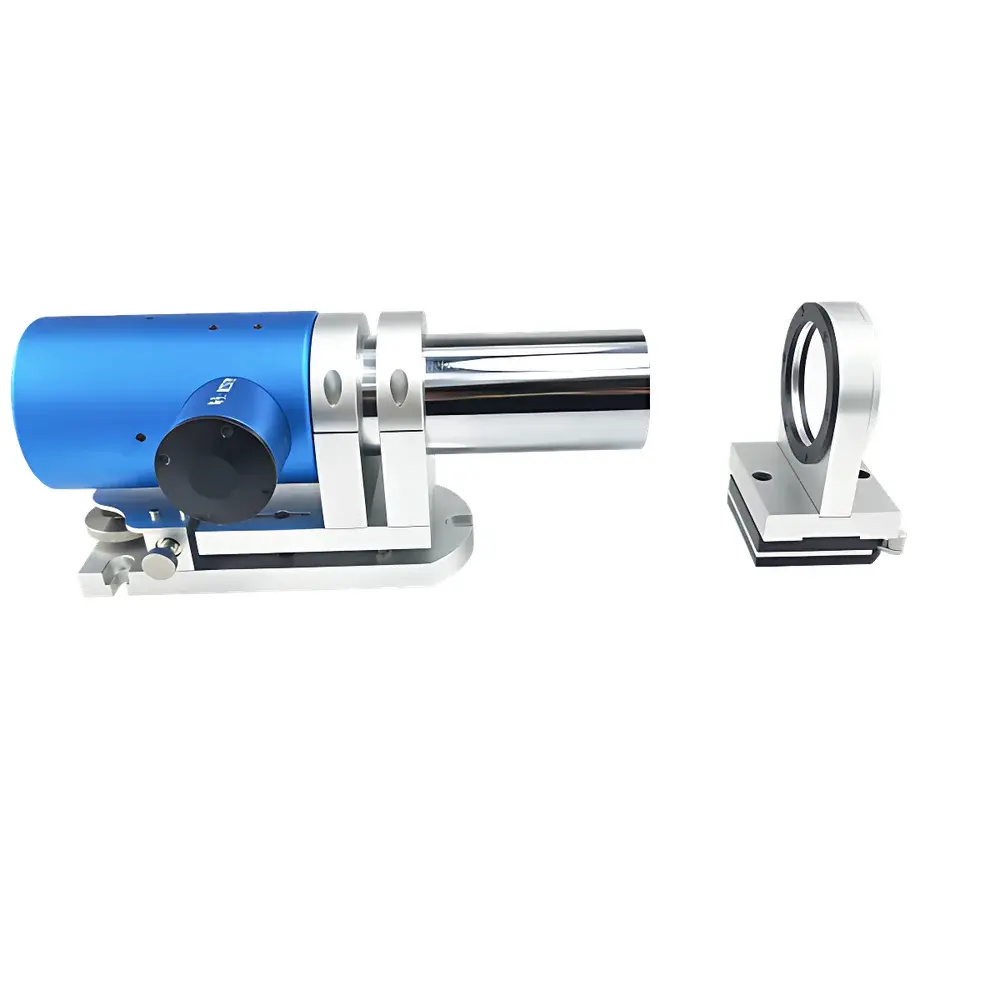
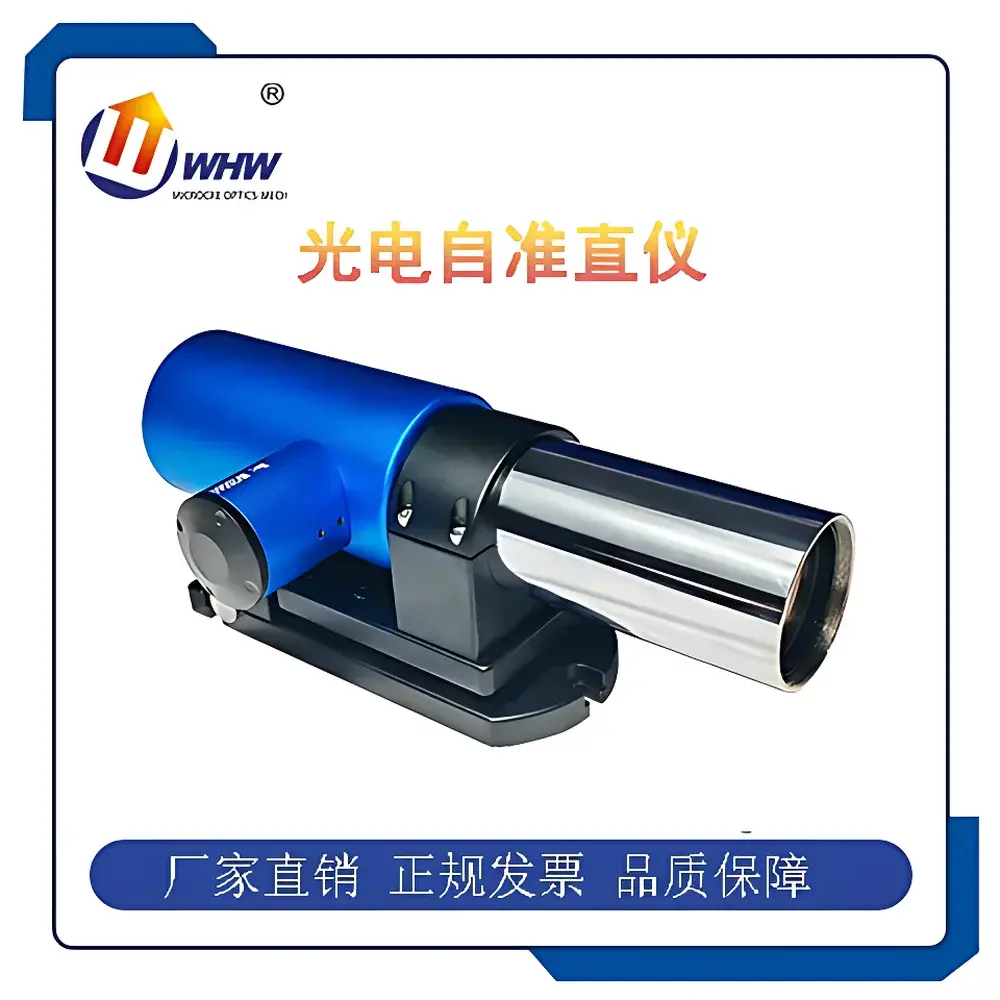
YANRUN MC030-MAT200/48/1 Dual-Axis Photoelectric Autocollimator
| Brand | YANRUN |
|---|---|
| Origin | Shanghai, China |
| Manufacturer Type | Manufacturer |
| Country of Origin | China |
| Model | MC030-MAT200/48/1 |
| Focal Length | 200 mm |
| Aperture | 48 mm |
| Light Source | High-Stability Semiconductor LED |
| Measurement Range | 0–20 m |
| Angular Resolution | Adjustable down to 0.0001″ (arc second) |
| Field of View (X/Y) | 3200″ × 2400″ (arc sec) |
| Accuracy (Center, ±1000″) | ±1″ (arc sec) |
| Sampling Frequency | ≤30 Hz |
| Interface | USB 2.0 |
| Operating System | Windows 7 or later (64-bit) |
| Dimensions | 296 × 115 × 125 mm (L×W×H) |
| Weight | 4.0 kg |
Overview
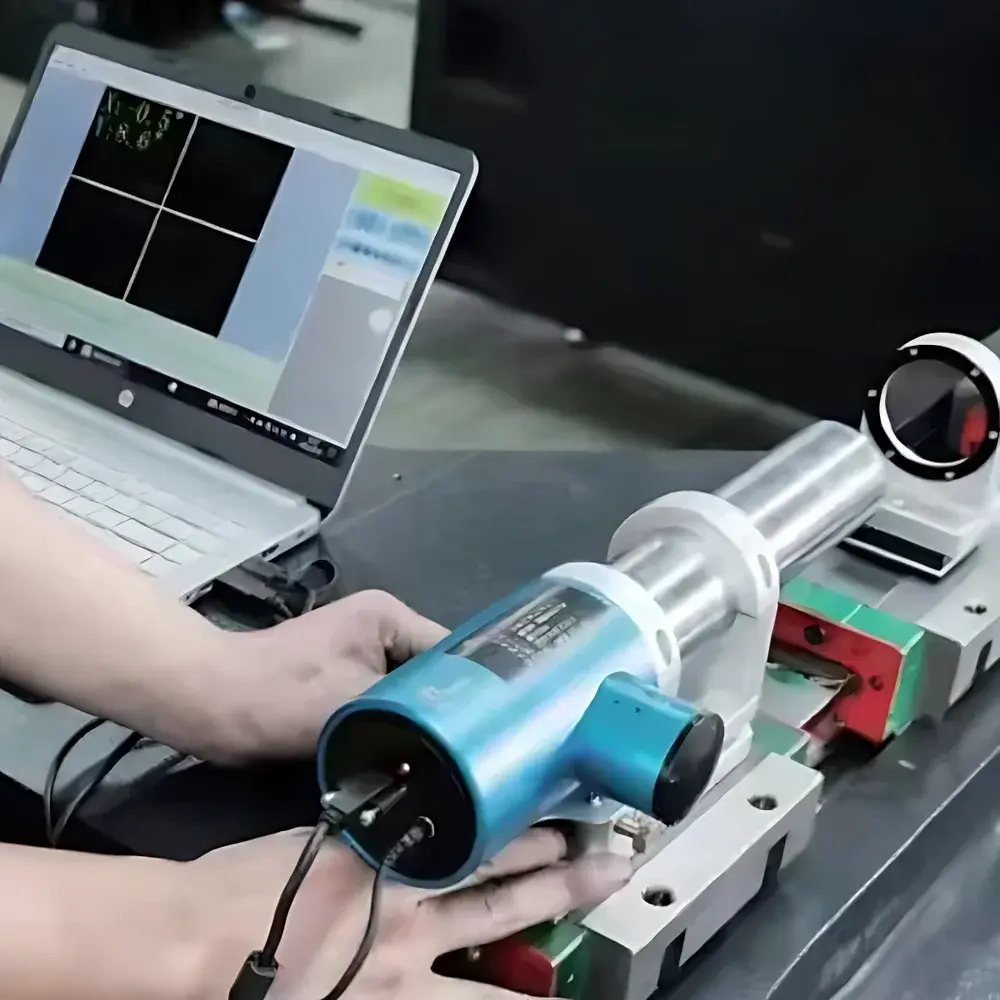
The YANRUN MC030-MAT200/48/1 Dual-Axis Photoelectric Autocollimator is a precision angular metrology instrument engineered for high-reproducibility measurement of minute angular deviations in two orthogonal axes (X and Y) simultaneously. It operates on the fundamental principle of optical autocollimation: a collimated beam—generated by projecting a reticle image located at the focal plane of a 200 mm focal length objective lens—is reflected off a planar mirror surface and re-imaged onto a high-resolution photoelectric sensor positioned at the same focal plane. When the mirror rotates by an angle α, the returned image shifts by ΔS, corresponding to a total angular deviation of 2α. This displacement is digitized with sub-arcsecond resolution, enabling traceable, non-contact angular metrology compliant with ISO 10110-5, ISO 230-1, and relevant sections of VDI/VDE 2617. Designed for integration into calibration laboratories, machine tool verification workflows, and optical alignment processes, the system eliminates human parallax error inherent in traditional visual autocollimators while maintaining full compatibility with international angular metrology standards.
Key Features
- Dual-axis synchronous acquisition: Real-time simultaneous measurement of X- and Y-direction angular displacements with independent resolution control down to 0.0001″ (arc second).
- High-stability illumination: Internally mounted long-life semiconductor LED light source (rated >50,000 hours), providing consistent spectral output and thermal stability without external power regulation.
- Optimized optical architecture: 48 mm clear aperture objective lens with 200 mm focal length ensures high light throughput and low aberration across the full 3200″ × 2400″ field of view.
- USB 2.0 interface with deterministic latency: Enables plug-and-play operation under Windows 7+ (64-bit); supports real-time streaming at up to 30 Hz sampling frequency with hardware-synchronized frame capture.
- Embedded measurement engine: On-host software performs real-time centroid calculation, error curve generation, and statistical analysis—including peak-to-valley, RMS, and best-fit line evaluation—per ASTM E1316 and ISO 10360-8 protocols.
- Modular expandability: Supports optional accessories including motorized mirror mounts, rotary stages, linear translation stages, and dedicated analysis modules for straightness, flatness, perpendicularity, and parallelism evaluation.
- Multi-language UI: Interface available in English, Chinese, Russian, and Korean—fully localized for technical terminology and unit conventions.
Sample Compatibility & Compliance
The MC030-MAT200/48/1 is compatible with standard optical flats (e.g., Grade 0 and Grade 1 fused silica or borosilicate mirrors per ISO 10110-7), kinematic mirror mounts, and industrial-grade retroreflectors. Its measurement uncertainty budget has been validated under controlled environmental conditions (20 ±0.5 °C, <40% RH, vibration-isolated bench), meeting the requirements for GLP-compliant calibration records. The system supports audit-trail-enabled data logging in accordance with FDA 21 CFR Part 11 when used with validated software configurations. All mechanical and optical components are manufactured to ISO 9001-certified production processes, and the instrument carries a Chinese Utility Model Patent (ZL202XXXXXXXX.X). For traceability, angular measurements are referenced to NIM (National Institute of Metrology, China) certified angle artifacts; users may perform in-house verification using calibrated wedge plates per ISO 7985.
Software & Data Management
The included Windows-based control and analysis software provides a modular framework for both routine inspection and advanced metrology tasks. Core functions include live video overlay of crosshair position, dynamic offset tracking, time-series waveform capture, and automated report generation in standardized Excel (.xlsx) format compliant with ISO/IEC 17025 documentation requirements. Data export includes raw pixel coordinates, calculated angular values (in arc seconds, milliradians, or degrees), statistical summaries, and annotated measurement plots. The software supports user-defined pass/fail thresholds, tolerance band visualization, and batch processing of multi-point alignment sequences. Audit logs record operator ID, timestamp, configuration parameters, and any manual overrides—enabling full traceability during GMP or ISO 17025 audits. Optional SDK access allows integration with LabVIEW, MATLAB, or custom Python-based automation platforms via COM/ActiveX interfaces.
Applications
- Metrological verification of linear and rotary axes in CNC machine tools (per ISO 230-1 and ISO 230-2).
- Alignment and stability monitoring of optical benches, interferometer paths, and laser cavity components.
- Flatness and straightness assessment of granite surface plates, air-bearing guideways, and hydrostatic slides.
- Angle calibration of goniometers, tilt tables, and hexapod positioning systems in aerospace ground test facilities.
- In-process angular feedback for active optical alignment in semiconductor lithography tool assembly.
- Teaching and research applications in university physics and precision engineering labs—supporting experimental validation of small-angle approximation, beam steering dynamics, and thermal drift modeling.
FAQ
What is the minimum recommended warm-up time before high-precision measurement?
For measurements requiring ≤±1″ accuracy, a minimum 15-minute power-on stabilization period is required to allow thermal equilibrium of the LED source and sensor electronics.
Is the instrument suitable for outdoor or factory-floor use?
It is designed for laboratory or climate-controlled industrial environments; ambient temperature must remain within 20 ±2 °C for specified accuracy. Vibration isolation and draft shielding are strongly recommended.
Can the system measure dynamic angular motion?
Yes—continuous acquisition at ≤30 Hz enables characterization of low-frequency angular oscillations, such as thermal drift or servo-induced jitter, provided mechanical mounting rigidity exceeds 100 Hz resonance frequency.
Does the software support automated reporting for ISO/IEC 17025 accreditation?
Yes—reports include instrument ID, calibration due date, environmental conditions, operator signature, and full metadata; configurable templates align with ILAC-P14 and CNAS-CL01 requirements.
Are custom firmware or OEM integration options available?
Yes—YANRUN offers white-label firmware deployment, API licensing, and mechanical/electrical customization for OEM integration into larger metrology platforms.




