
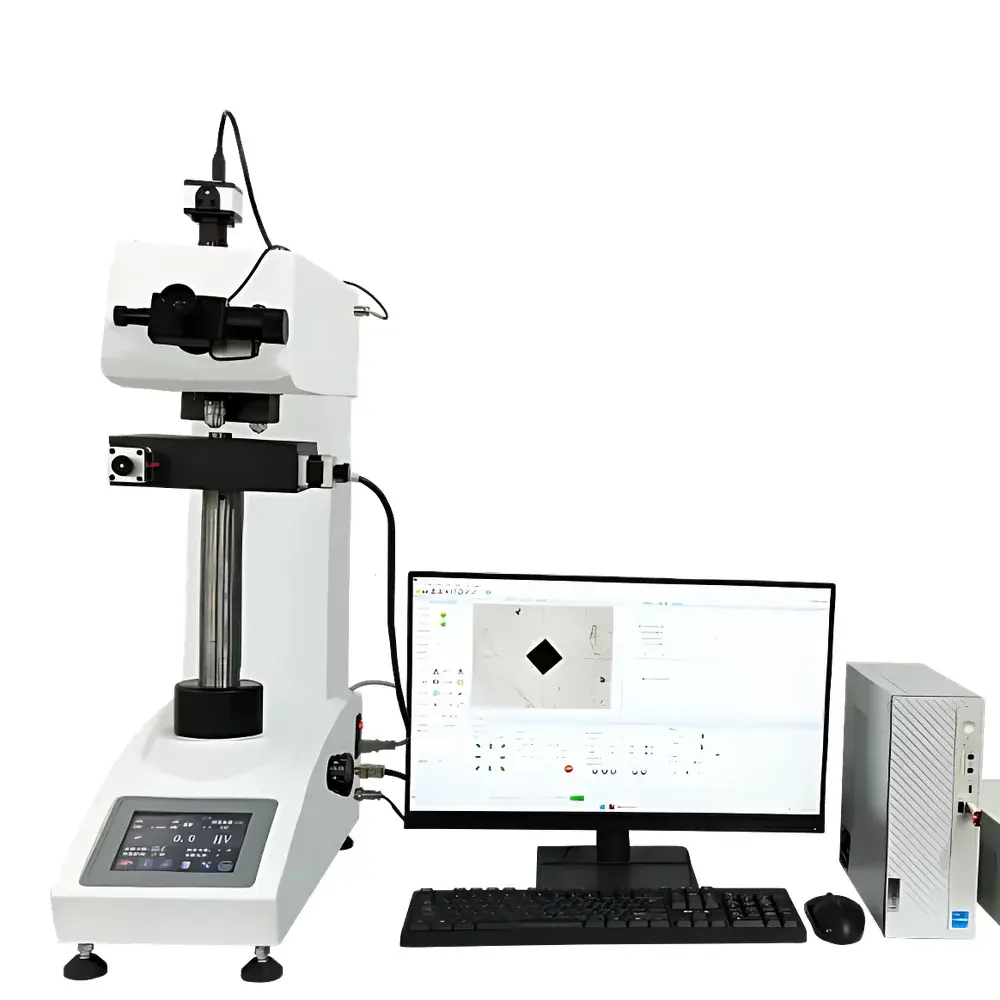
YANRUN HMAS-D5MZ/D10MZ/D30MZ/D50MZ Automated Vickers Hardness Testing System
| Brand | YANRUN |
|---|---|
| Origin | Shanghai, China |
| Manufacturer Type | Direct Manufacturer |
| Region of Origin | Domestic (China) |
| Model | HMAS-D5MZ / D10MZ / D30MZ / D50MZ |
| Instrument Type | Vickers Hardness Tester |
| Hardness Measurement Range | 8–3000 HV |
| Test Force Options | 0.2–50 kgf (6 force ranges across four models) |
| Compliance | GB/T 4340, ISO 6507 |
| Minimum Detectable Indentation Resolution | 0.06 µm (with 20× objective) |
| Maximum Specimen Height | 235 mm |
| Distance from Indenter Axis to Chamber Wall | 130 mm |
| Power Supply | AC 220 V / 50 Hz |
| Dimensions (L×W×H) | 570 × 220 × 680 mm |
| Net Weight | 54.0 kg |
| Gross Weight | 72.0 kg |
Overview
The YANRUN HMAS-D5MZ/D10MZ/D30MZ/D50MZ is a fully automated Vickers hardness testing system engineered for precision metrology in metallurgical laboratories, quality control departments, and R&D facilities. It operates on the principle of optical indentation measurement: a diamond pyramid indenter (136° apex angle) is applied to the specimen surface under controlled static load; following unloading, the diagonals of the resulting square impression are measured microscopically and converted into Vickers hardness values (HV) using standardized algorithms per ISO 6507-1 and GB/T 4340.1. The system integrates a motorized turret, closed-loop force actuation, high-resolution digital imaging, and dual-path measurement—enabling simultaneous verification via built-in 10× digital eyepiece and PC-based image analysis software. Designed for repeatability-critical environments, it achieves ≤0.1% indentation depth reproducibility across its full 0.2–50 kgf test force range.
Key Features
- Fully automated turret switching: seamless, silent transition between Vickers indenter and optical objectives (10× observation / 20× measurement) under software command—no manual intervention required.
- Intelligent load recognition: system auto-detects selected test force (e.g., 1 kgf, 10 kgf, 30 kgf) and configures loading/holding/unloading parameters accordingly.
- Closed-loop indentation cycle: precise control over loading rate, dwell time (0–60 s in 1 s increments), and unloading profile—ensuring compliance with ASTM E384 and ISO 6507 mechanical requirements.
- Modular, drag-and-drop UI: customizable workspace layout with zero-click access to frequently used functions—including six operational modes (manual, semi-auto, auto-single, batch-grid, case-depth mapping, and multi-point profiling).
- Advanced image processing engine: 13 real-time background enhancement algorithms adapt dynamically to material reflectivity (e.g., polished steel, nitrided layers, ceramic coatings), delivering consistently high-contrast indentation images.
- Micron-level positioning accuracy: integrated grid-assisted navigation and path planning support case-depth profiling with step resolution down to 0.1 µm—critical for carburized, nitrided, or PVD-coated cross-sections.
- Multi-view data synchronization: simultaneous display of indentation map, hardness curve, and statistical histogram—all updated in real time; each view supports independent export (CSV, PNG, PDF).
Sample Compatibility & Compliance
The HMAS series accommodates specimens up to 235 mm in height and 130 mm from indenter axis to chamber interior wall—suitable for large forgings, heat-treated plates, and coated substrates. It supports both bulk metallographic mounts and as-received industrial parts. All models conform to international calibration and reporting standards: ISO 6507-2 (verification of hardness testers), ISO 6507-3 (calibration of reference blocks), and GB/T 4340.2–2012. The dual-measurement architecture (eyepiece + software) satisfies internal audit requirements for traceability and operator independence. Data logs include full metadata (operator ID, timestamp, environmental conditions, force calibration certificate ID), supporting GLP/GMP documentation workflows and FDA 21 CFR Part 11 readiness when deployed with validated software configuration.
Software & Data Management
The proprietary YANRUN Hardness Analysis Suite (v5.2+) provides comprehensive data lifecycle management—from acquisition to reporting. Each indentation generates a unique QR-coded “micro-report” embedding raw pixel coordinates, diagonal lengths, HV value, test force, dwell time, and instrument serial number. Reports are configurable per ISO/IEC 17025 templates and include CPK capability indices, X-bar & R charts, and Weibull distribution analysis. Audit trails record all user actions—including parameter edits, result overrides, and report exports—with immutable timestamps. Export formats include CSV (for SPC integration), XML (LIMS compatibility), and PDF/A-2 (long-term archival). Software supports multi-user role permissions (Admin, QA, Technician) and optional network deployment with centralized database logging.
Applications
- Heat treatment validation: quantifying case depth gradients in carburized gears, induction-hardened shafts, and through-hardened tool steels.
- Coating adhesion assessment: measuring interfacial hardness transitions in thermal spray, PVD, and CVD coatings (e.g., TiN, CrN, Al₂O₃).
- Failure analysis labs: correlating localized hardness anomalies with SEM-EDS elemental maps and microstructural features.
- Aerospace component certification: verifying hardness uniformity across turbine blades, landing gear alloys (e.g., Inconel 718, Ti-6Al-4V), per AMS 2430 and NADCAP requirements.
- Academic materials research: high-throughput screening of novel alloys, composites, and additive-manufactured microstructures under variable loads.
FAQ
What standards does the HMAS system comply with for calibration and verification?
It meets ISO 6507-2:2018 for hardness tester verification and GB/T 4340.2–2012 for periodic calibration using certified reference blocks traceable to NIM (National Institute of Metrology, China).
Can the system perform case depth analysis automatically?
Yes—using the grid-based path planner and auto-focus stacking, it acquires sequential indentations along a defined line or area, computes hardness vs. depth curves, and identifies effective case depth (e.g., 550 HV limit) per ASTM E384 Annex A3.
Is remote operation supported?
The system supports LAN-based remote monitoring and control via secure RDP or VNC protocols; full operation—including test execution and report generation—requires local authentication.
How is measurement uncertainty managed?
Uncertainty contributors (indenter geometry, optical magnification error, force calibration drift, environmental temperature) are logged per test and aggregated in the final report using GUM-compliant methodology per ISO/IEC Guide 98-3.
Does the software support LIMS integration?
Yes—via configurable ODBC drivers and HL7-compliant XML output, enabling bidirectional data exchange with major laboratory information management systems including Thermo Fisher SampleManager and LabWare LIMS.



