
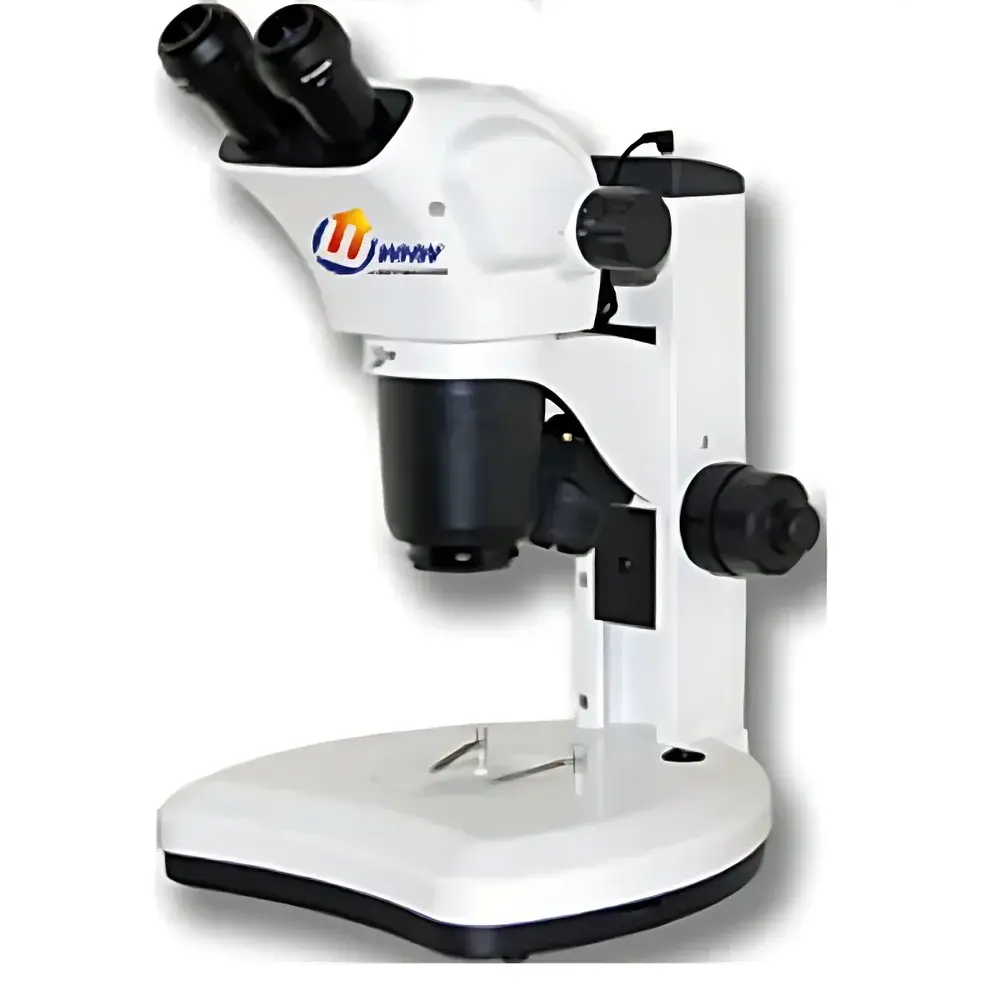
YANRUN SM-10L Continuous Zoom Stereo Microscope
| Brand | YANRUN |
|---|---|
| Origin | Shanghai, China |
| Manufacturer Type | Direct Manufacturer |
| Product Type | Upright |
| Total Magnification Range | 7X–63X |
| Eyepieces | Widefield 10X (Φ22 mm) |
| Objective Zoom Ratio | 0.7X–6.3X |
| Field of View | Φ33.8 mm–Φ3.49 mm |
| Working Distance | 110 mm |
| Vertical Travel | 220 mm |
| Base Dimensions | 310 mm × 280 mm |
| Illumination | Top-mounted 3 W high-brightness LED + Bottom-mounted 5 W high-brightness LED |
| Optional Accessories | WF15X (Φ15 mm), WF20X (Φ12 mm), WF25X (Φ9 mm), 10X reticle eyepiece (0.1 mm/div), Auxiliary objectives (0.5X, 1.5X, 2X), LED epi-fluorescence illuminator, Ring fluorescence illuminator |
Overview
The YANRUN SM-10L Continuous Zoom Stereo Microscope is an upright, dual-illumination stereoscopic imaging system engineered for high-fidelity visual inspection and documentation of opaque, reflective, or low-contrast macro-to-micro surface features. Based on the Greenough optical design principle—featuring two independent objective paths with convergent light axes—the SM-10L delivers true stereoscopic depth perception without parallax distortion across its full 9:1 zoom ratio (0.7X–6.3X). When combined with standard 10X widefield eyepieces, the system achieves a calibrated total magnification range of 7X to 63X, optimized for applications requiring both ergonomic observation and stable mechanical reproducibility. Its fixed 110 mm working distance enables unobstructed access for probe manipulation, soldering, micro-assembly, or non-contact measurement tasks—making it particularly suited for quality control in electronics manufacturing, precision machining, metallurgical sample preparation, and failure analysis laboratories where consistent illumination geometry and minimal vibration sensitivity are critical.
Key Features
- Continuous zoom optics with 9:1 magnification ratio (0.7X–6.3X), enabling seamless transition between overview and detail-level inspection without objective lens swapping
- Upright configuration with rigid cast-aluminum base (310 mm × 280 mm) and 220 mm vertical column travel for flexible sample positioning and multi-angle viewing
- Dual independent LED illumination system: top-mounted 3 W cool-white LED for reflected-light observation of metallic or coated surfaces; bottom-mounted 5 W high-CRI LED for transmitted-light contrast enhancement of semi-transparent specimens
- Standard widefield 10X eyepieces (Φ22 mm field number) providing comfortable eye relief and uniform edge-to-edge image brightness
- Mechanically stabilized zoom and focus mechanisms with precision-ground helical gears and anti-backlash adjustment—designed for long-term repeatability under routine industrial use
- Modular accessory interface compatible with standardized C-mount adapters, allowing future integration with digital imaging modules or machine vision systems
Sample Compatibility & Compliance
The SM-10L accommodates specimens up to 150 mm in height and 200 mm in width, supporting common metallurgical samples (e.g., polished cross-sections, fracture surfaces, solder joints), PCB assemblies, small mechanical components, and botanical or geological macro-specimens. Its 110 mm working distance permits simultaneous use of fine-tipped tweezers, micro-manipulators, or stylus-based profilometers during real-time observation. While the microscope itself does not carry CE, UKCA, or FDA registration, its electrical components comply with IEC 61000-6-3 (EMC emission standards) and IEC 62368-1 (safety requirements for audio/video and ICT equipment). The dual-LED illumination architecture meets ISO 9241-307 recommendations for task lighting uniformity and flicker-free operation in extended-duration visual tasks.
Software & Data Management
The SM-10L is supplied as a standalone optical instrument without embedded digital imaging hardware or proprietary software. However, its trinocular port (standard C-mount thread) supports third-party USB 3.0 or HDMI-compatible CMOS cameras (e.g., Thorlabs DCx series, Edmund Optics EO-2, or Lumenera Lt-series), enabling integration into validated laboratory informatics environments. When paired with compliant imaging software (e.g., ImageJ with FIJI distribution, NIS-Elements BR, or Olympus cellSens), the system can support audit-trail-enabled workflows aligned with GLP and GMP documentation requirements—including timestamped image capture, user authentication logs, and metadata embedding per ASTM E2016 and ISO/IEC 17025 guidelines.
Applications
- Metallurgical quality assurance: grain structure evaluation, inclusion analysis, coating thickness estimation, and weld seam inspection on prepared metallographic mounts
- Electronics manufacturing: solder joint integrity verification (IPC-A-610 Class 2/3), component placement accuracy, and rework process monitoring
- Research & development: prototype assembly validation, microfluidic device inspection, and additive manufacturing part surface characterization
- Educational laboratories: comparative morphology studies, dissection assistance, and hands-on training in optical alignment and depth-of-field management
- Forensic toolmark analysis: striation pattern comparison and impression evidence documentation under controlled oblique illumination
FAQ
Does the SM-10L include a built-in camera or image analysis software?
No—the SM-10L is delivered as a pure optical platform. Digital imaging requires optional C-mount camera integration and third-party software.
Can auxiliary objectives be used simultaneously with the zoom body?
Yes—0.5X, 1.5X, and 2X auxiliary lenses mount externally at the objective nosepiece and extend the effective magnification range while maintaining mechanical stability and parfocality.
Is the LED illumination intensity adjustable?
Both top and bottom LED sources feature continuous analog dimming via front-panel potentiometers, enabling precise luminance control from 10% to 100% output without spectral shift.
What is the maximum specimen weight the stage can support?
The reinforced base and column assembly support static loads up to 5 kg when centered; dynamic loads (e.g., motorized stage actuation) should remain below 2.5 kg to preserve mechanical longevity.
Are calibration certificates available for magnification accuracy?
YANRUN provides factory-verified magnification verification reports traceable to NIM (National Institute of Metrology, China) reference standards upon request—suitable for internal QA documentation and ISO 17025-compliant lab audits.





