
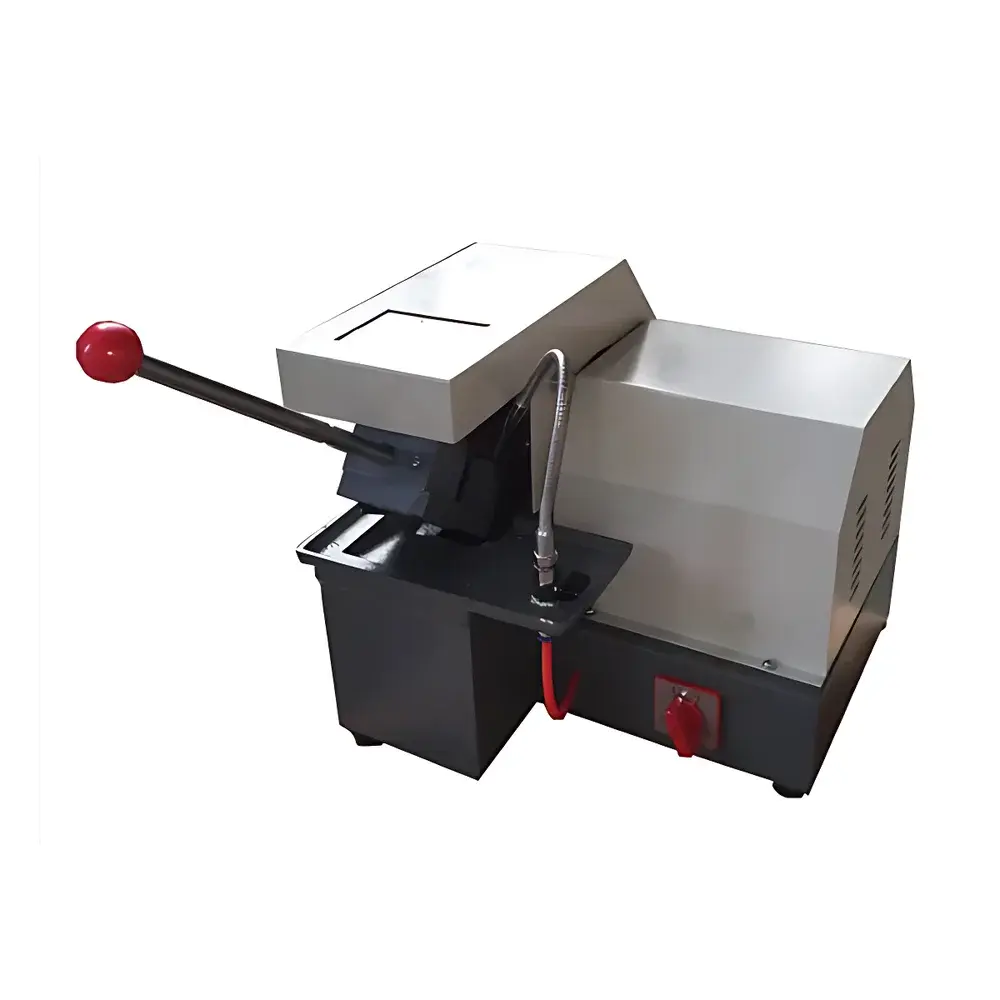
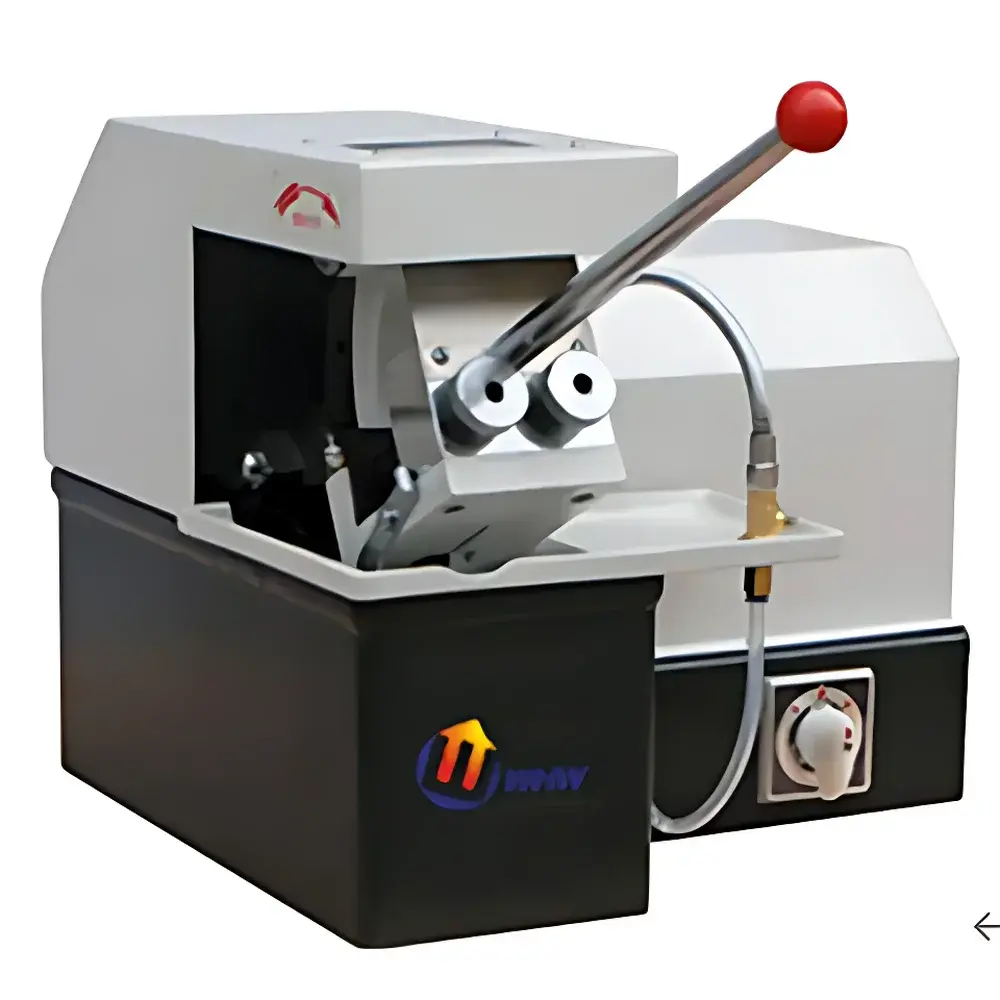
YANRUN QG-1 Metallographic Specimen Cutting Machine
| Brand | YANRUN |
|---|---|
| Origin | Shanghai, China |
| Manufacturer Type | Direct Manufacturer |
| Country of Origin | China |
| Model | QG-1 |
| Instrument Type | Metallographic Cutting Machine |
| Max Cutting Cross-Section | Ø50 × 50 mm |
| Motor Power | 1.1 kW / 380 V, 50 Hz |
| Grinding Wheel Specification | Ø300 × Ø32 × 2.0 mm |
| Overall Dimensions | 580 × 560 × 680 mm |
| Spindle Speed | 2800 rpm |
| Net Weight | 60 kg |
| Optional Accessory | Quick-Release Sample Clamp |
Overview
The YANRUN QG-1 Metallographic Specimen Cutting Machine is a precision-engineered benchtop cutting system designed for the initial stage of metallographic sample preparation. It employs high-speed abrasive wheel technology—specifically, a reinforced resin-bonded silicon carbide or aluminum oxide thin-section wheel rotating at 2800 rpm—to achieve clean, distortion-free sectioning of metallic, ceramic, and composite specimens. The machine operates on the principle of controlled mechanical abrasion under continuous coolant flow, minimizing thermal damage to microstructural features such as grain boundaries, phase distributions, and interfacial zones. Engineered for reliability in routine laboratory environments, the QG-1 serves as a foundational tool in metallurgical laboratories, quality control departments, failure analysis centers, and academic research facilities where reproducible specimen geometry and edge integrity are prerequisites for subsequent mounting, grinding, polishing, and microscopic evaluation.
Key Features
- Robust cast-iron base and rigid column structure ensure minimal vibration during high-speed cutting, contributing to dimensional accuracy and surface finish consistency.
- Integrated recirculating coolant system with adjustable flow rate and directional nozzles prevents localized overheating and suppresses dust generation—critical for preserving microstructural fidelity and operator safety.
- Manually operated vertical feed mechanism with calibrated depth scale enables precise control over cut depth and repeatable positioning across sequential samples.
- Ergonomic sample clamping assembly (standard vise with optional quick-release clamp) accommodates irregular geometries while maintaining secure fixation under lateral cutting forces.
- Compliance-ready design: Electrical components meet IEC 61000-6-2 (immunity) and IEC 61000-6-4 (emission) standards; enclosure conforms to IP2X touch-protection requirements per IEC 60529.
- Tool-free wheel replacement and accessible maintenance points reduce downtime and simplify preventive servicing—aligned with GLP-aligned lab operation protocols.
Sample Compatibility & Compliance
The QG-1 accepts specimens up to Ø50 mm in diameter or 50 mm square cross-section, including ferrous alloys (e.g., carbon steels, stainless steels), non-ferrous metals (e.g., aluminum, copper, titanium), sintered powders, cemented carbides, and brittle ceramics. Its cutting performance adheres to ASTM E3-22 “Standard Guide for Preparation of Metallographic Specimens” and ISO 14487:2017 “Metallographic examination — Preparation of specimens”. While not an automated or CNC-controlled unit, its mechanical repeatability supports traceable documentation under ISO/IEC 17025:2017 Clause 7.2.2 (method validation) when integrated into validated sample prep workflows. No CE marking is affixed; users deploying the instrument within EU-regulated environments must conduct local risk assessment per Machinery Directive 2006/42/EC.
Software & Data Management
The QG-1 is a standalone electromechanical instrument with no embedded firmware, touchscreen interface, or digital connectivity. All operational parameters—including feed rate, cut duration, and coolant activation—are manually set and recorded externally. Laboratories requiring audit-trail compliance may document usage via paper-based logbooks or integrate the device into electronic lab notebook (ELN) systems such as LabArchives or Benchling using manual entry. For GMP/GLP environments, it is recommended to establish SOPs covering wheel wear monitoring, coolant concentration verification (via refractometry), and pre-use visual inspection—practices consistent with FDA 21 CFR Part 11 data integrity expectations for ancillary equipment.
Applications
- Routine sectioning of tensile bars, weld coupons, and castings prior to microstructural analysis per ASTM E112 (grain size) or ASTM E1245 (inclusion rating).
- Preparation of cross-sectional specimens for SEM-EDS elemental mapping, especially where heat-affected zones must remain unaltered.
- Cutting of coated or layered materials (e.g., thermal barrier coatings, PVD/CVD films) to expose interfaces without delamination.
- Failure analysis labs: isolating fracture origins from fatigue-tested components while preserving crack-tip morphology.
- Academic teaching labs: introducing students to standardized metallographic workflow principles under supervised conditions.
FAQ
What types of abrasive wheels are compatible with the QG-1?
The machine accepts standard ISO 525-compliant reinforced resinoid wheels with dimensions Ø300 × Ø32 × 2.0 mm. Recommended formulations include silicon carbide for non-ferrous metals and aluminum oxide for steels and superalloys.
Is the coolant system closed-loop or open-flow?
It is a gravity-fed open-loop system with a removable polyethylene reservoir (capacity ~5 L); users must replenish water-soluble coolant concentrate per manufacturer guidelines to maintain corrosion inhibition and bacterial control.
Can the QG-1 be used for non-metallic samples such as polymers or composites?
Yes—provided appropriate wheel selection and reduced feed pressure are applied; however, low-melting-point polymers may require chilled coolant or intermittent cutting to avoid thermal deformation.
Does the QG-1 support automated cycle programming?
No. It is a manually operated machine without programmable logic controller (PLC) integration or step-motor actuation.
What safety certifications does the QG-1 carry?
The unit complies with basic electrical safety requirements per GB/T 3797–2016 (Chinese national standard equivalent to IEC 60204-1); full CE or UL certification is not provided by default.



