YANRUN MC030-LD400/68/0.5 High-Precision Photoelectric Autocollimator
| Brand | YANRUN |
|---|---|
| Origin | Shanghai, China |
| Manufacturer Type | Direct Manufacturer |
| Model | MC030-LD400/68/0.5 |
| Objective Focal Length | 400 mm |
| Clear Aperture | 68 mm |
| Light Source | Imported Semiconductor LED |
| Measurement Range | 0–50 m |
| Detector | High-Accuracy Photodetector |
| Display Resolution | Adjustable to 0.1″ / 0.01″ / 0.001″ / 0.0001″ (arc seconds) |
| Field of View (X/Y) | 1700″ × 1350″ (arc seconds) |
| Angular Accuracy (Center Range ±600″) | ±0.5″ (arc seconds) |
| Sampling Frequency | ≤30 Hz (typ.) |
| Interface | USB 2.0 |
| OS Requirement | Windows 7 or later, 64-bit |
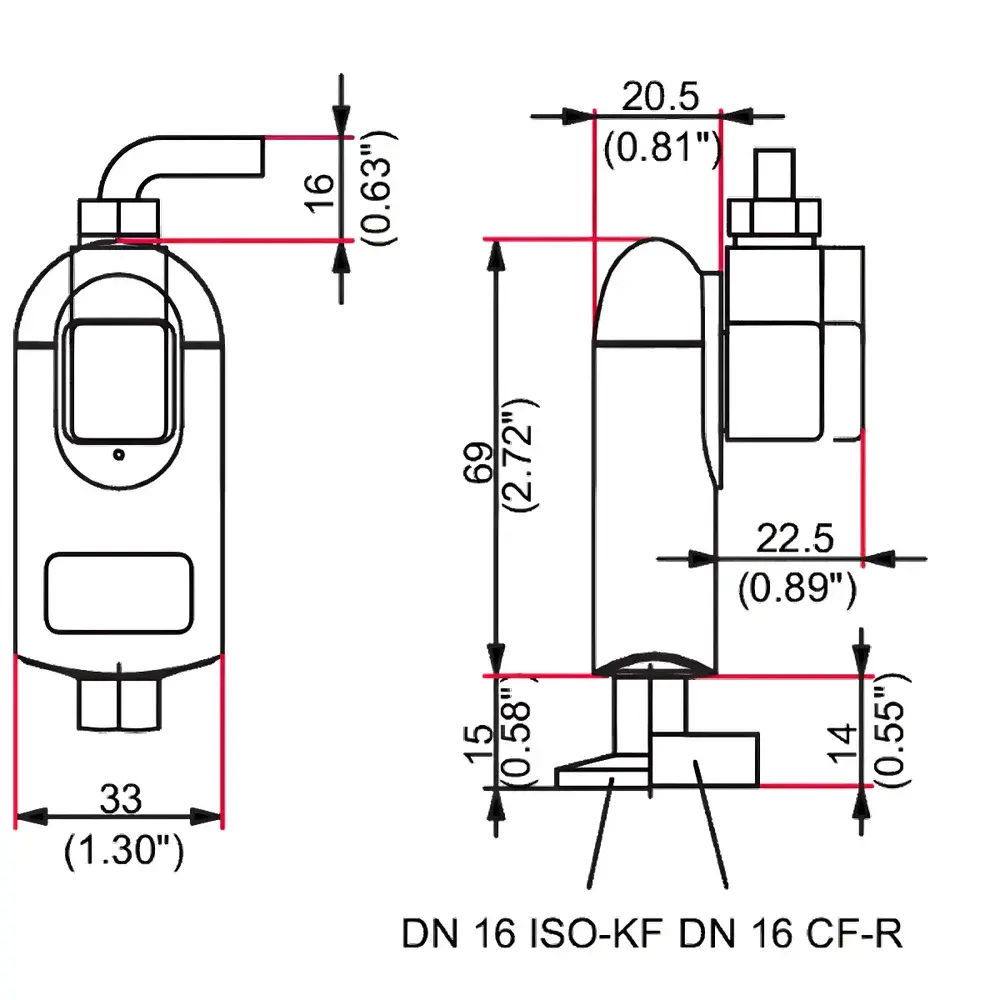
| Dimensions | 480 × 125 × 115 mm |
Overview
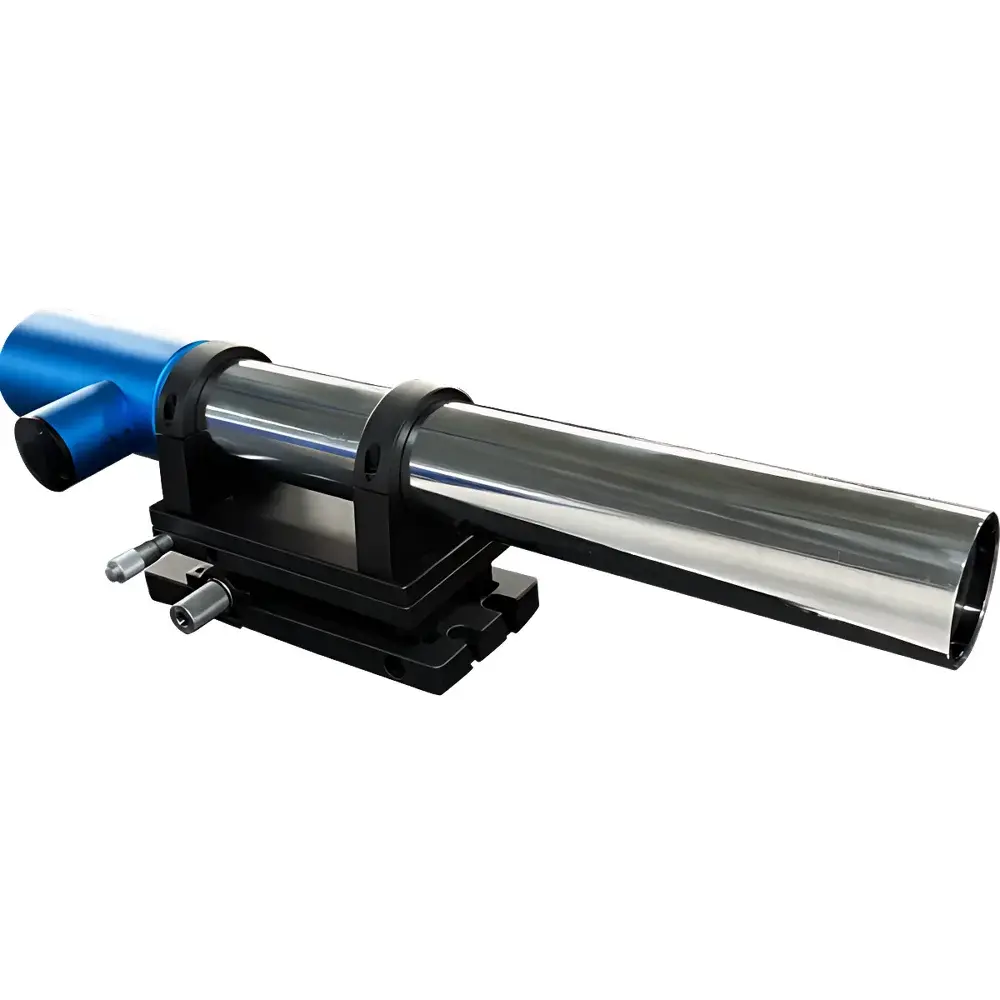
The YANRUN MC030-LD400/68/0.5 is a high-precision photoelectric autocollimator engineered for non-contact angular metrology in industrial metrology, precision assembly, and optical alignment applications. It operates on the fundamental principle of optical autocollimation: a collimated beam—generated by projecting a reticle located at the focal plane of a 400 mm focal-length objective lens—is reflected back from a planar mirror surface. Any angular deviation (α) of the mirror induces a linear displacement (ΔS) of the returned reticle image on a co-focal photodetector array, where ΔS = 4f·α (for small angles in radians). This geometric relationship enables traceable, high-reproducibility angular measurement with sub-arcsecond resolution. Unlike visual autocollimators requiring subjective eye alignment, this instrument replaces the eyepiece with a calibrated photodetector system, eliminating parallax and observer-induced bias while supporting automated data acquisition and real-time feedback.
Key Features
- Simultaneous dual-axis (X and Y) angular measurement within a single optical path, enabling comprehensive evaluation of tilt, yaw, and pitch in one setup.
- Real-time electronic viewfinder with on-screen reticle overlay—reducing human aiming error and accelerating alignment workflows in production and calibration environments.
- High-resolution CMOS-based photodetector optimized for signal-to-noise ratio and linearity across the full dynamic range (±600 arc seconds).
- Stable, long-life imported semiconductor LED light source with consistent spectral output and minimal thermal drift over extended operation cycles.
- Modular architecture supporting interchangeable accessories—including retroreflective targets, rotary stages, translation mounts, and beam splitters—for customized measurement configurations.
- Adjustable display resolution down to 0.0001 arc seconds (0.05 µrad), configurable per application requirements without hardware modification.
- Fully programmable USB 2.0 interface compliant with standard HID and vendor-specific command protocols for integration into automated test systems.
Sample Compatibility & Compliance
The MC030-LD400/68/0.5 is compatible with any optically flat reflective surface (e.g., precision-ground mirrors, kinematic mounts, optical tables, or machined reference surfaces) having reflectivity ≥85% in the visible spectrum (400–700 nm). Its 68 mm clear aperture supports measurement over distances up to 50 meters without beam truncation under typical ambient conditions. The instrument meets mechanical and electromagnetic compatibility requirements per GB/T 18268.1–2010 (IEC 61326-1 equivalent) for laboratory and industrial use. While not certified to ISO/IEC 17025 as a standalone calibration standard, it is routinely employed in GLP-compliant environments for in-process verification of alignment tolerances referenced to NIST-traceable angle standards. Its measurement uncertainty budget—including detector linearity, thermal coefficient of focal length, and air refractivity correction—is documented in the supplied technical manual for uncertainty propagation analysis per GUM (JCGM 100:2008).
Software & Data Management
The included Windows-native software (64-bit, Win7+) provides real-time waveform visualization, statistical process control (SPC) charting, and batch export to native Excel (.xlsx) format with embedded metadata (timestamp, operator ID, instrument serial number, environmental notes). All measurement sessions support audit-trail logging compliant with FDA 21 CFR Part 11 requirements when configured with user authentication and electronic signature modules. Data files retain raw pixel displacement values alongside calculated angular deviations, enabling post-acquisition reprocessing with updated calibration coefficients. The API supports LabVIEW™, Python (via PyUSB), and MATLAB® integration for custom automation scripts—particularly useful in multi-sensor alignment sequences or closed-loop active optics control loops.
Applications
- Precision installation and leveling of CNC machine tools, coordinate measuring machines (CMMs), and large-scale metrology frames.
- Verification of straightness, flatness, perpendicularity, and parallelism per ISO 230-1 and ASME B89.3.13 standards using sequential target positioning.
- Dynamic angular stability assessment of air-bearing rotary stages and piezo-driven goniometers (≤30 Hz bandwidth supports vibration-mode analysis).
- Optical bench alignment in laser interferometry setups, adaptive optics systems, and synchrotron beamline instrumentation.
- Quality assurance of aerospace structural components—including wing spar alignment, fuselage joint flatness, and gimbal mount repeatability.
- Teaching and research in university physics and optical engineering labs, where quantitative demonstration of small-angle approximation and optical lever principles is required.
FAQ
What is the maximum measurable angular range before image loss occurs?
The full field of view supports ±850 arc seconds (±0.236°) in both X and Y axes; however, specified accuracy of ±0.5″ is guaranteed only within ±600″. Beyond this, linearity deviation increases gradually but remains usable for coarse alignment.
Can the instrument measure non-planar or diffusely reflecting surfaces?
No—it requires a specularly reflective surface with surface roughness < λ/10 (sub-50 nm RMS) to maintain coherent return illumination. Diffuse targets require auxiliary retroreflectors.
Is temperature compensation built into the firmware?
Yes—the internal thermal sensor feeds real-time corrections to the focal length model, reducing thermal drift to <0.02″/°C over the operating range (15–30°C).
Does the system support external triggering or synchronization?
Not natively via hardware trigger input; however, precise software-triggered acquisition is achievable using USB command timing with jitter <1 ms.
How often does the instrument require recalibration?
Annual recalibration against a traceable autocollimator standard is recommended for metrology-critical applications; factory calibration certificates include uncertainty statements per ISO/IEC 17025 guidelines.