
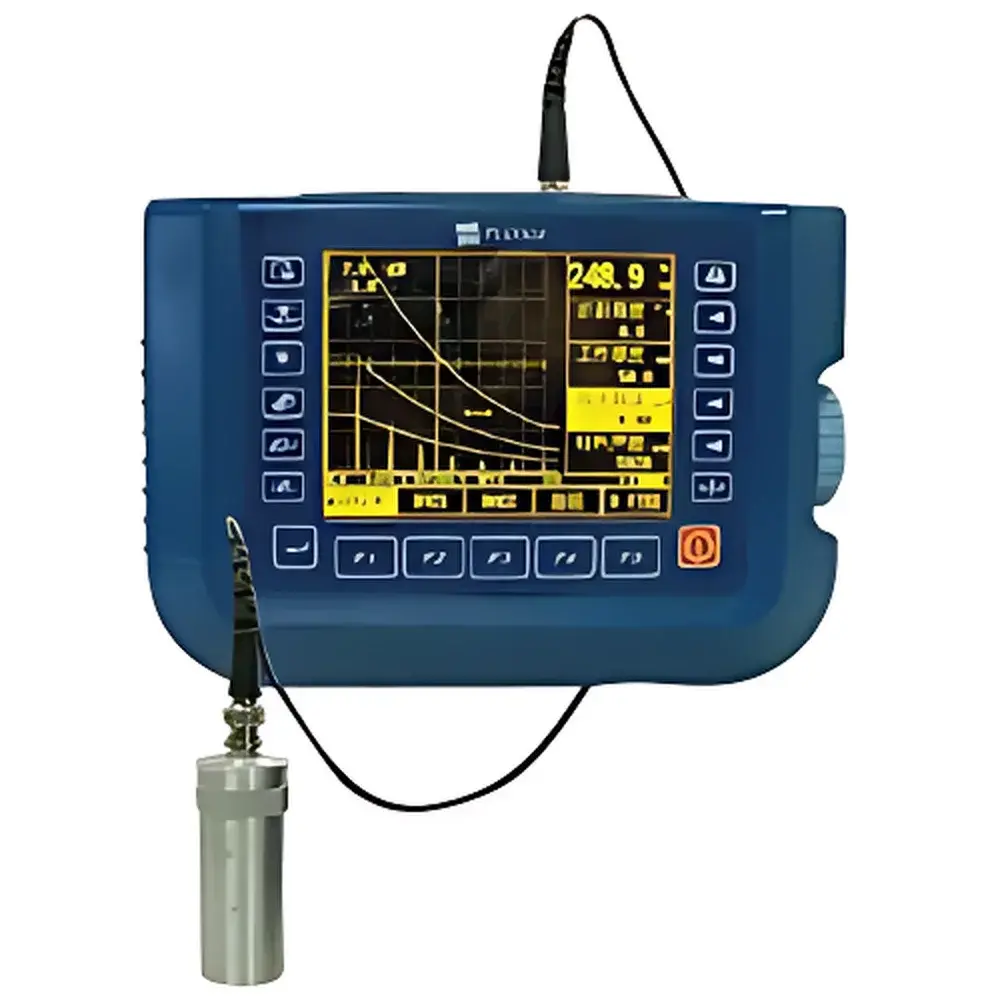
MC015-TUD300 Ultrasonic Flaw Detector
| Origin | Shanghai, China |
|---|---|
| Manufacturer Type | Authorized Distributor |
| Origin Category | Domestic (China) |
| Model | MC015-TUD300 |
| Pricing | Available Upon Request |
Overview
The MC015-TUD300 Ultrasonic Flaw Detector is a portable, microprocessor-controlled pulse-echo ultrasonic testing (UT) instrument engineered for high-reliability non-destructive evaluation of metallic and non-metallic components. It operates on the principle of time-of-flight diffraction (TOFD) and conventional A-scan pulse-echo methodology, transmitting high-frequency acoustic energy (0.2–15 MHz) into materials and analyzing reflected echoes to detect, locate, and characterize internal discontinuities—including cracks, inclusions, porosity, and lack-of-fusion in welds. Designed for field and shop-floor deployment, the device meets foundational requirements for industrial NDT applications under ASTM E114, ASTM E317, ISO 16810, and EN 12668-1 compliance frameworks. Its real-time signal processing architecture supports both time-domain waveform analysis and B-scan imaging, enabling quantitative assessment of flaw depth, height, and lateral extent—critical for structural integrity verification in safety-critical infrastructure.
Key Features
- 10 independent inspection channels with user-configurable parameter sets for rapid setup across multiple material types and geometries
- Dual independent gate monitoring with programmable amplitude threshold and delay logic for precise echo discrimination and alarm triggering
- Automatic gain control (AGC) and peak memory function for consistent signal amplitude normalization across varying surface conditions and coupling efficiency
- High-speed pulser with repetition rate up to 1 kHz and RF waveform sampling at ≥100 MS/s, preserving transient echo fidelity for accurate defect sizing
- 60 Hz display refresh rate with EL graphic dot-matrix screen—ensuring zero motion blur and full visibility under direct sunlight or low-temperature environments (–10°C to +50°C)
- Integrated DAC (Distance-Amplitude Correction) curve generation using standard reference blocks (e.g., IIW, GS, or custom calibration blocks), supporting ASME Section V and EN ISO 17640 compliance workflows
- Probe damping selection (50 Ω / 150 Ω / 400 Ω) and dual probe mode switching (single-element, pitch-catch, through-transmission) for optimized near-field resolution and penetration depth trade-offs
- Linear suppression (0–80% screen height, 1% step) and freeze/unfreeze functionality for detailed waveform annotation and comparative analysis
- Onboard storage for 300 A-scan waveforms with full acquisition parameters and 30,000 thickness measurements, timestamped and tagged with channel ID and operator code
- Firmware upgrade capability via RS232 serial interface; no hardware modification required for feature expansion or regulatory alignment updates
Sample Compatibility & Compliance
The MC015-TUD300 is validated for use on ferrous and non-ferrous alloys, composites, plastics, and ceramics with acoustic impedances compatible with standard piezoelectric transducers. It supports longitudinal (L-wave) and shear (S-wave) inspections in plates, pipes, forgings, castings, and welded joints per ASTM E709 (magnetic particle) cross-reference protocols and ISO 23279 for weld inspection reporting. The instrument’s vertical linearity error (≤3%) and horizontal linearity error (≤0.2%) conform to EN 12668-2 performance verification criteria. Its IP65-rated enclosure ensures operational integrity in humid, dusty, or light-splash industrial environments—meeting IEC 60529 ingress protection standards. While not inherently 21 CFR Part 11 compliant, audit-trail-ready data export (via optional PC software) enables traceable recordkeeping suitable for GLP/GMP-aligned quality systems when paired with controlled user access and electronic signature validation.
Software & Data Management
The included Windows-based PC software provides bidirectional communication via RS232, enabling full waveform download, report generation (PDF/CSV), comparative overlay analysis, and database-driven inspection history tracking. Data files retain raw RF waveform metadata—including time-zero calibration, material velocity, probe angle/K-value, gate positions, and DAC reference points—ensuring full traceability for third-party review or regulatory submission. Exported reports include thickness maps, B-scan reconstructions, and annotated A-scans with measurement cursors and statistical summaries (mean, SD, min/max). Optional serial printer integration supports on-site hardcopy documentation meeting ISO 9712 Level 2 technician reporting conventions.
Applications
This instrument is routinely deployed in aerospace component inspection (turbine disks, landing gear), pressure vessel certification (ASME BPVC Section VIII), rail axle and wheelset testing (EN 13674-1), pipeline girth weld screening (API RP 2X), power generation rotor forging verification, and structural steel fabrication QA/QC (AWS D1.1). Its portability, battery endurance (>8 hours continuous operation), and ruggedized chassis make it suitable for offshore platforms, remote construction sites, and mobile NDT service fleets requiring rapid turnaround without laboratory dependency.
FAQ
What standards does the MC015-TUD300 comply with for calibration and verification?
It satisfies EN 12668-1 (instrument performance) and EN 12668-2 (periodic verification) requirements. Calibration certificate templates align with ISO/IEC 17025-accredited lab practices.
Can the device perform TOFD inspections?
Yes—when configured with dual probes and appropriate wedge assemblies, it supports basic TOFD acquisition with manual scan encoding; advanced TOFD analysis requires optional PC software modules.
Is probe auto-calibration supported for both zero-offset and velocity?
Yes—the instrument executes automated probe zero-point and material sound velocity calibration using single or double back-wall echoes from known-thickness reference blocks.
Does the unit support external encoder input for automated scanning?
Not natively; encoder synchronization requires the optional PC software suite with USB-to-RS232 bridge and custom script configuration.
What file formats are supported for data export?
Native binary (.udf), CSV (thickness & gate data), BMP (screen capture), and XML (full waveform + metadata) formats are available via PC software.



