
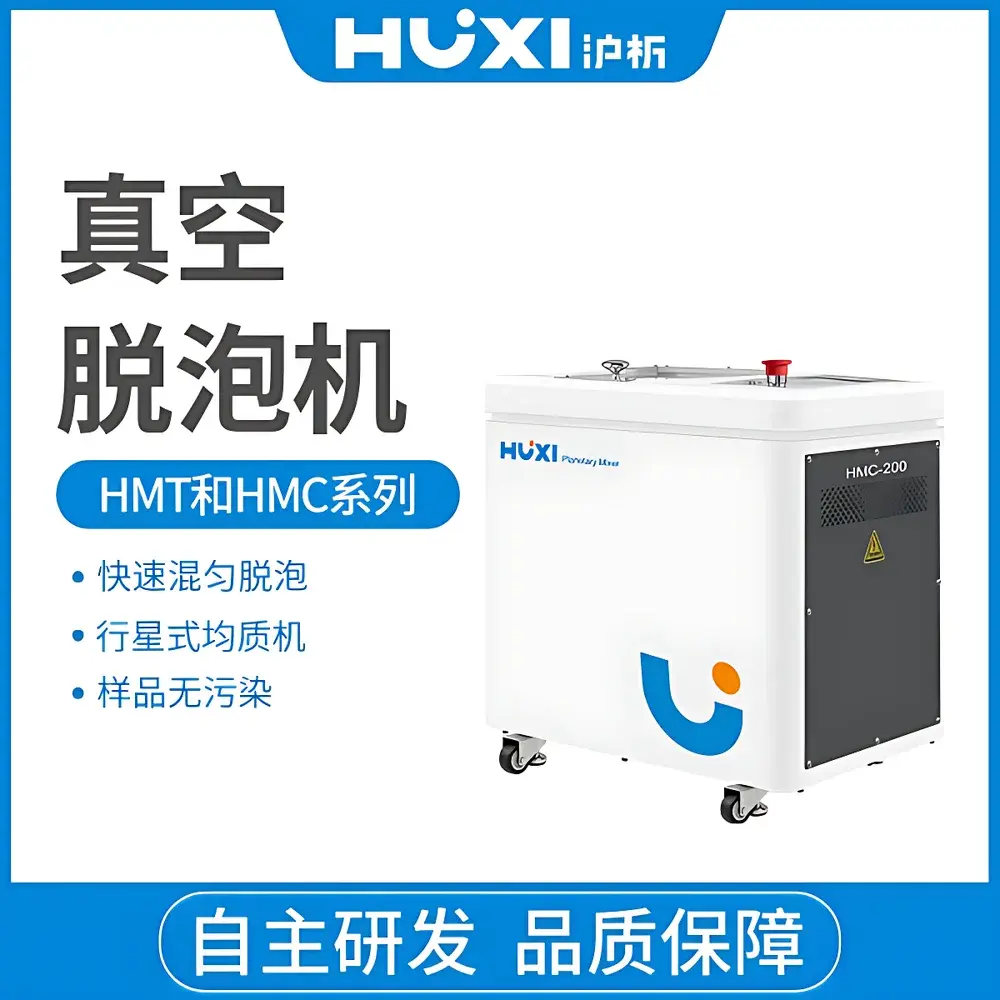
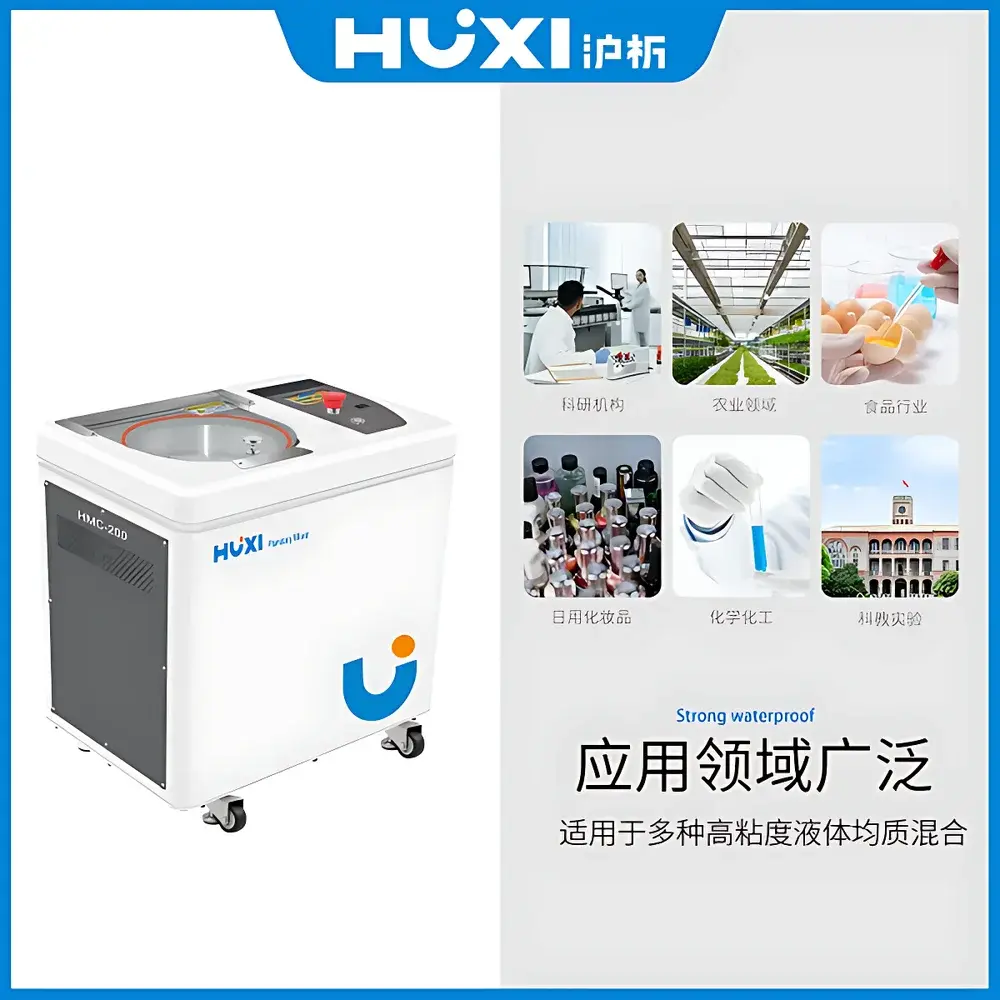
HUXI HMC-200 Benchtop Vacuum Centrifugal Degassing Mixer
| Brand | HUXI |
|---|---|
| Origin | Shanghai, China |
| Manufacturer | Yes |
| Country of Origin | China |
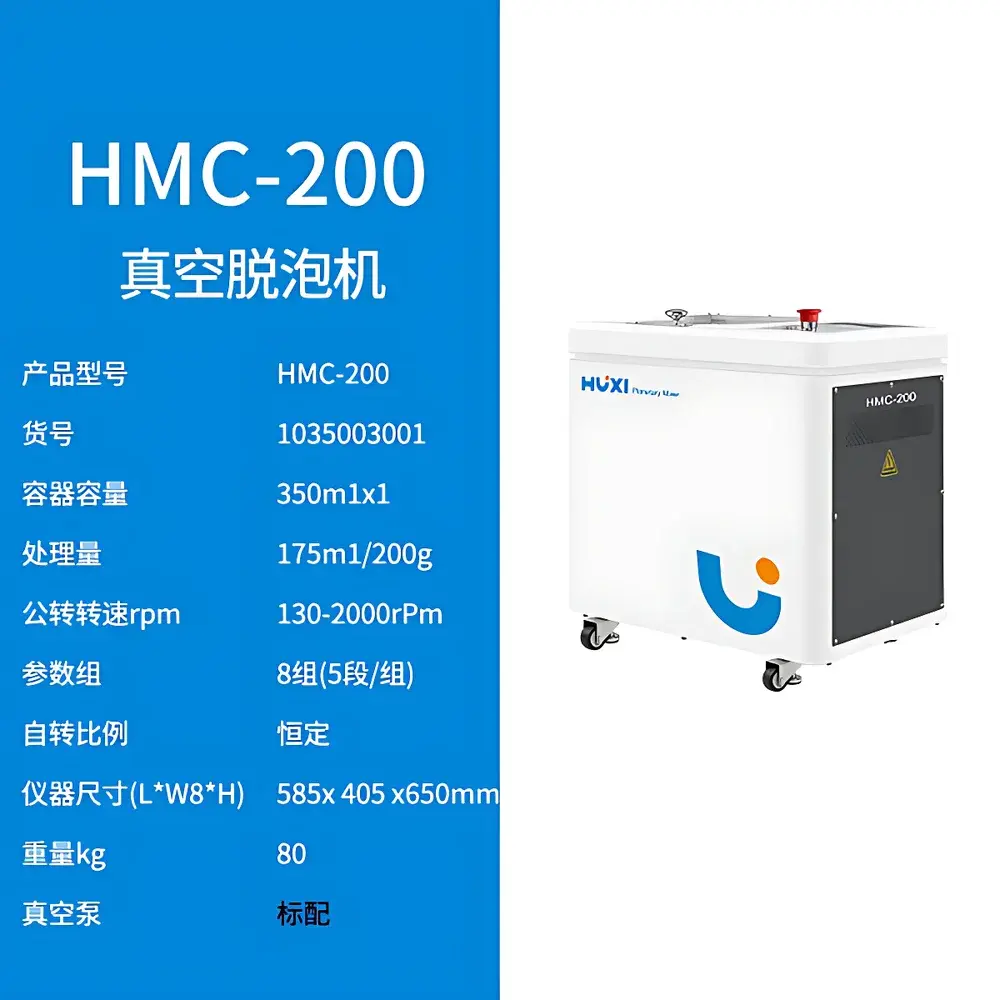
| Model | HMC-200 |
| Price | USD 12,000 (FOB Shanghai) |
| Container Capacity | 350 mL × 1 |
| Max. Processing Volume | 175 mL / 200 g (material-dependent) |
| Orbital Speed | 130–2000 rpm |
| Relative Vacuum | −100 kPa (at sea level) |
| Power Supply | AC 220 V, 50 Hz |
| Rated Power | 1.5 kW |
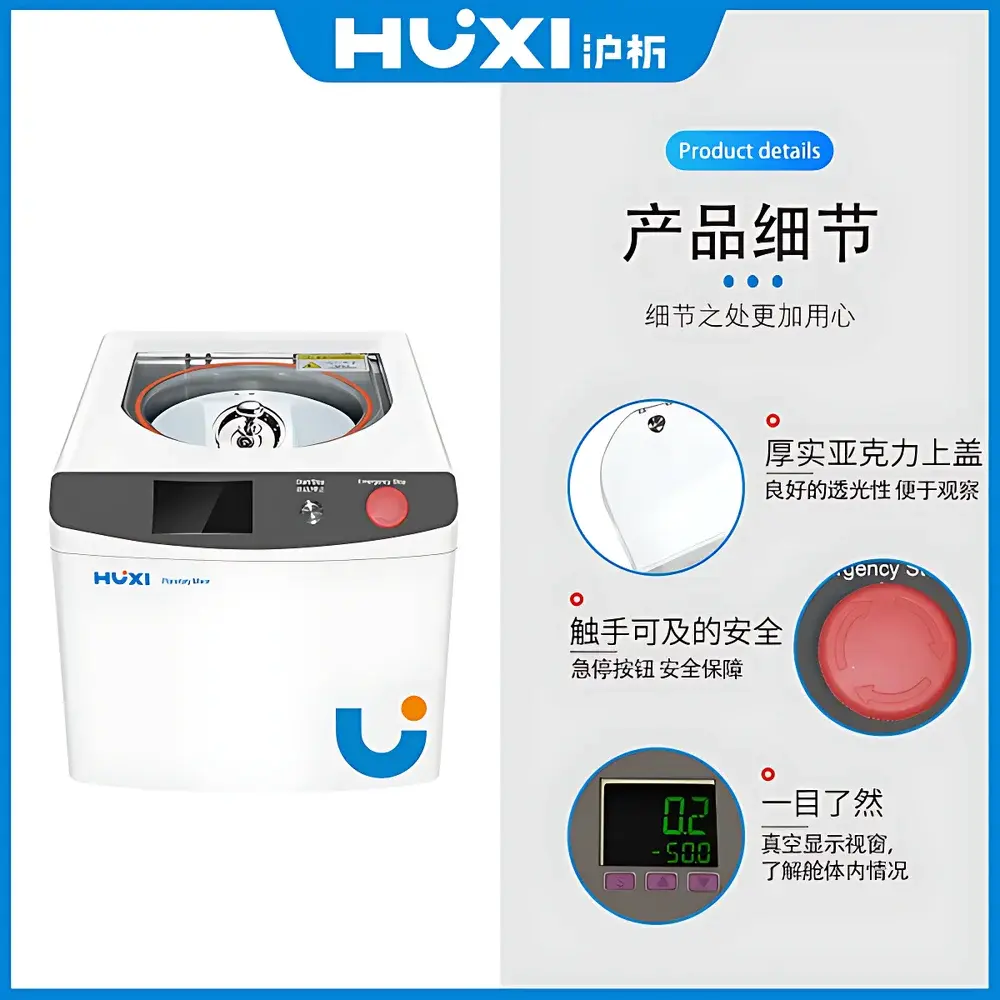
| Vacuum Pump | ST-type, 0.7 kW, digital vacuum gauge (Panasonic) |
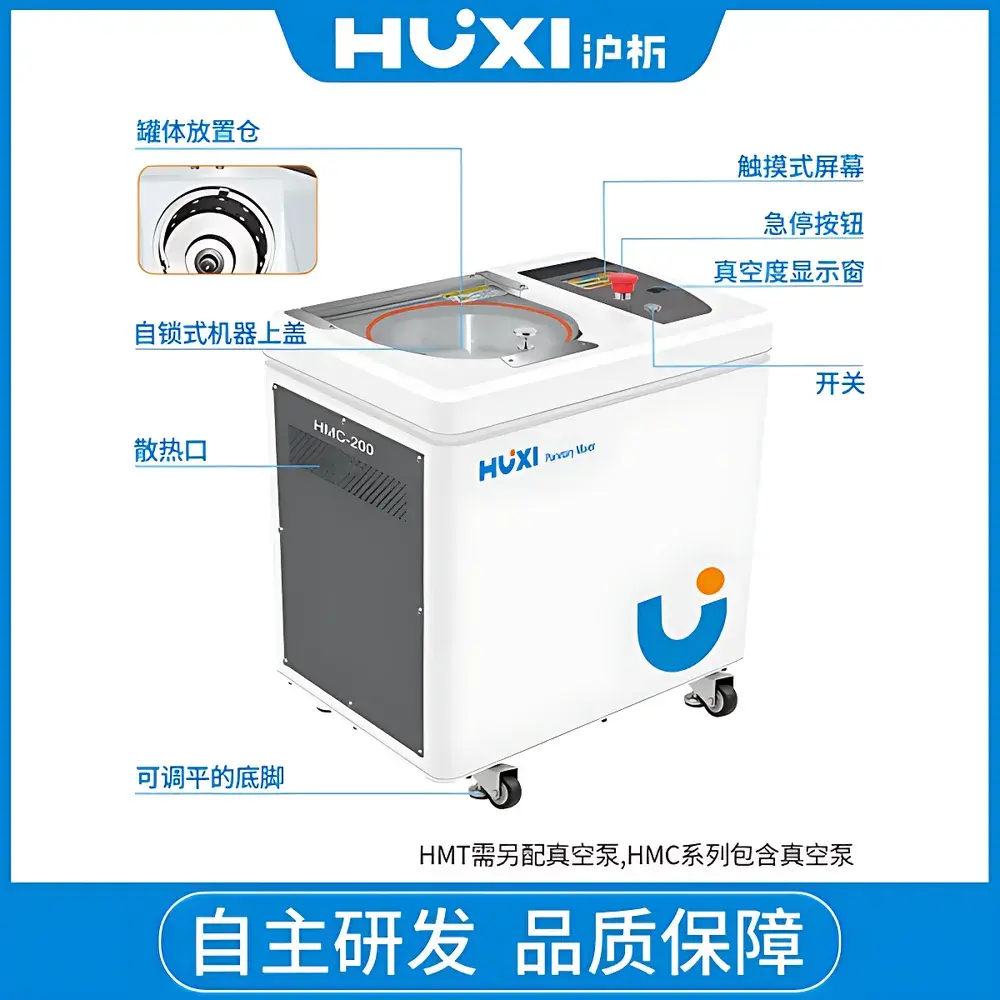
| Control Interface | Touchscreen |
| Preset Programs | 8 groups × 5 segments |
| Transmission | Gear-driven |
| Safety Features | Interlocked door switch, vibration detection, overload protection, vacuum fault monitoring, emergency stop |
| Data Logging | Time-stamped operation logs (parameters, vacuum level, duration) |
| Dimensions (L×W×H) | 585 × 405 × 650 mm |
| Filtration | Removable cylindrical sealed filter cartridge with high gas-permeable surface area |
| Compliance | Designed for GLP-aligned laboratory environments |
Overview
The HUXI HMC-200 Benchtop Vacuum Centrifugal Degassing Mixer is an integrated process instrument engineered for simultaneous high-efficiency mixing and vacuum-assisted degassing of viscous, heterogeneous, or air-sensitive materials. It operates on the principle of combined orbital centrifugation and controlled vacuum application: orbital rotation generates radial acceleration (up to 2000 rpm), forcing entrapped microbubbles toward the liquid surface; concurrent deep vacuum (−100 kPa relative) lowers the partial pressure of dissolved gases, enabling rapid volatilization and removal through a high-surface-area sealed filter cartridge. Unlike static vacuum chambers or ultrasonic degassers, the HMC-200 achieves uniform bubble elimination without thermal degradation or shear-induced phase separation—making it suitable for silicone elastomers, epoxy resins, optical adhesives, battery slurries, dental composites, and encapsulation compounds where void-free homogeneity is critical for mechanical integrity and optical clarity.
Key Features
- Orbital–rotational dual-motion architecture: Independent control of orbital speed (130–2000 rpm) with fixed gear-ratio self-rotation ensures reproducible vortex flow patterns and consistent shear history across batches.
- High-fidelity vacuum system: ST-series vacuum pump (0.7 kW) paired with Panasonic digital vacuum transducer enables precise setpoint adjustment (±0.5 kPa resolution) and real-time monitoring under dynamic load conditions.
- GLP-compliant data traceability: All operational parameters—including timestamped vacuum profile, rotational speed sequence, program group ID, and duration—are logged internally and exportable via USB in CSV format for regulatory documentation.
- Fail-safe mechanical interlocks: Door position sensor prevents initiation or halts operation if lid is unsealed; integrated accelerometers detect excessive vibration (>0.8 g RMS) and trigger immediate shutdown with audible/visual alarm.
- Modular filtration design: Removable cylindrical filter cartridge features PTFE-coated sintered stainless steel media (effective pore size: 0.2 µm), optimized for high gas throughput while retaining particulates and preventing oil-backstreaming from the vacuum pump.
- Touchscreen HMI with 8 programmable protocols: Each protocol supports up to five sequential stages—enabling complex ramp-hold-vacuum-release cycles tailored to material rheology and outgassing kinetics.
Sample Compatibility & Compliance
The HMC-200 accommodates standard 350 mL cylindrical containers (e.g., glass jars, polypropylene vials, or metal cans with O-ring seals), supporting maximum loads of 175 mL volume or 200 g mass—subject to material-specific density and viscosity limits (recommended η < 500,000 mPa·s at 25 °C). It complies with IEC 61000-6-2 (EMC immunity) and IEC 61000-6-4 (EMC emission) standards. While not certified to ISO 13485 or FDA 21 CFR Part 11 out-of-the-box, its audit-ready data logging architecture aligns with GMP/GLP documentation requirements when deployed within validated laboratory workflows. Vacuum performance meets ASTM D2240 Annex A3 criteria for degassing efficacy in polymer processing applications.
Software & Data Management
The embedded firmware provides local parameter storage (non-volatile EEPROM), time-stamped operation logs, and user-accessible USB export functionality. Logs include: start/stop timestamps, selected program ID, per-stage rpm/vacuum setpoints and actuals, total cycle duration, and fault event codes (e.g., “VIB_ERR_03”, “VAC_LOSS”). No cloud connectivity or proprietary software installation is required—data files are natively readable in Excel or LIMS platforms. For regulated environments, laboratories may configure periodic log backups via networked file servers using external USB-to-Ethernet adapters (not supplied).
Applications
- Electronics manufacturing: Degassing conductive epoxies and underfill materials prior to dispensing onto PCB assemblies.
- Medical device R&D: Preparing bubble-free silicone molds for prosthetic component casting and biocompatible hydrogel formulations.
- Advanced battery development: Homogenizing cathode/anode slurries (NMC, LFP, Si-anodes) while eliminating voids that compromise electrode coating uniformity and cell cycle life.
- Optics and photonics: Processing UV-curable optical adhesives and lens potting compounds where sub-micron voids cause scattering losses or delamination under thermal cycling.
- Academic materials science: Studying gas evolution kinetics during polymer crosslinking or solvent evaporation under controlled shear–vacuum coupling.
FAQ
What vacuum level can the HMC-200 achieve under continuous operation with viscous samples?
Under nominal load (150 mL silicone oil, 50,000 mPa·s), the system sustains −98.5 to −99.2 kPa (relative) over 10-minute cycles; performance varies with seal integrity, ambient temperature, and vapor pressure of volatile components.
Is the touchscreen interface compatible with multi-language operating systems?
The HMI firmware supports English and simplified Chinese UI languages only; no third-party OS integration is provided.
Can the HMC-200 be integrated into automated production lines?
It offers dry-contact I/O terminals (start/stop, fault signal, ready status) compliant with 24 VDC industrial logic levels, enabling PLC-level coordination—but lacks EtherNet/IP or Modbus TCP native support.
What maintenance intervals are recommended for the vacuum pump and filter cartridge?
ST pump oil replacement every 500 operating hours; filter cartridge cleaning (isopropanol rinse + N₂ purge) after every 20 cycles or when vacuum draw-down time exceeds 45 seconds from atmosphere to −95 kPa.
Does the unit meet CE or UL safety certification requirements?
The HMC-200 carries CE marking per Machinery Directive 2006/42/EC and Low Voltage Directive 2014/35/EU; UL listing is not held, but design conforms to UL 61010-1 Edition 3 safety principles.



