
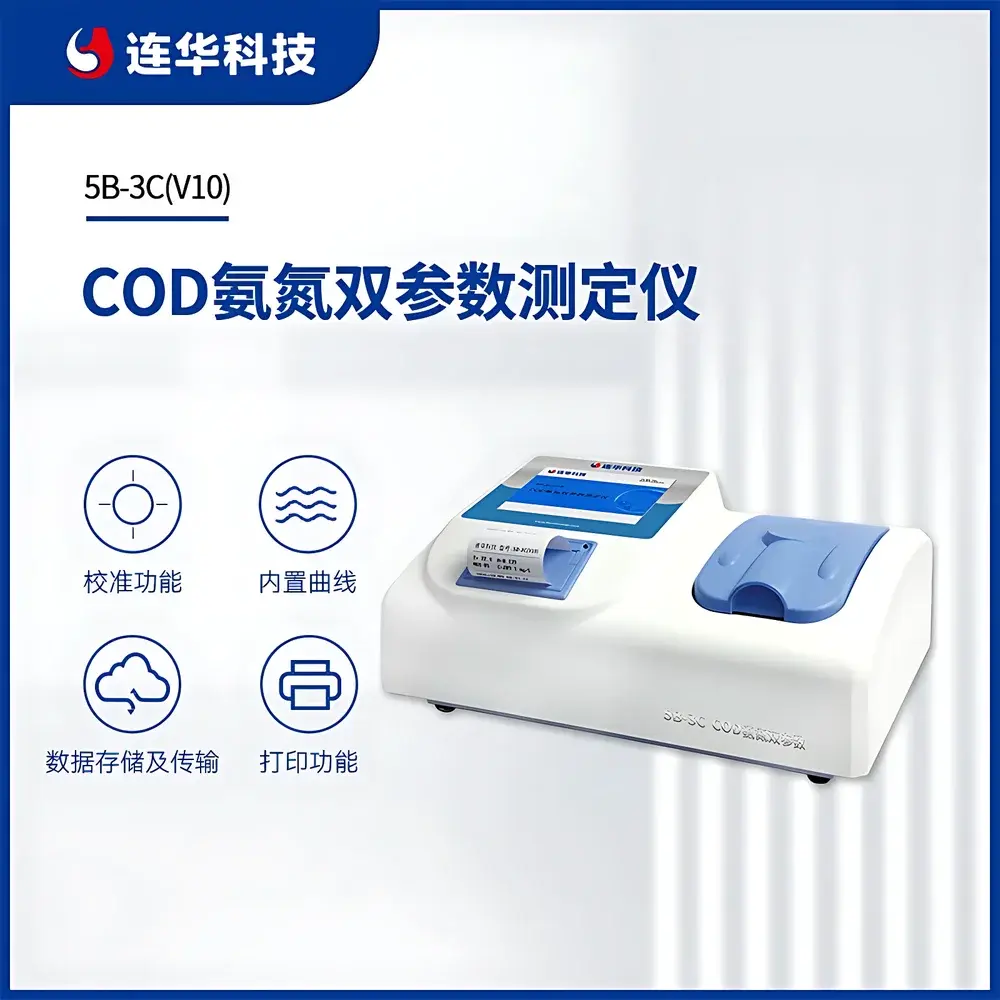
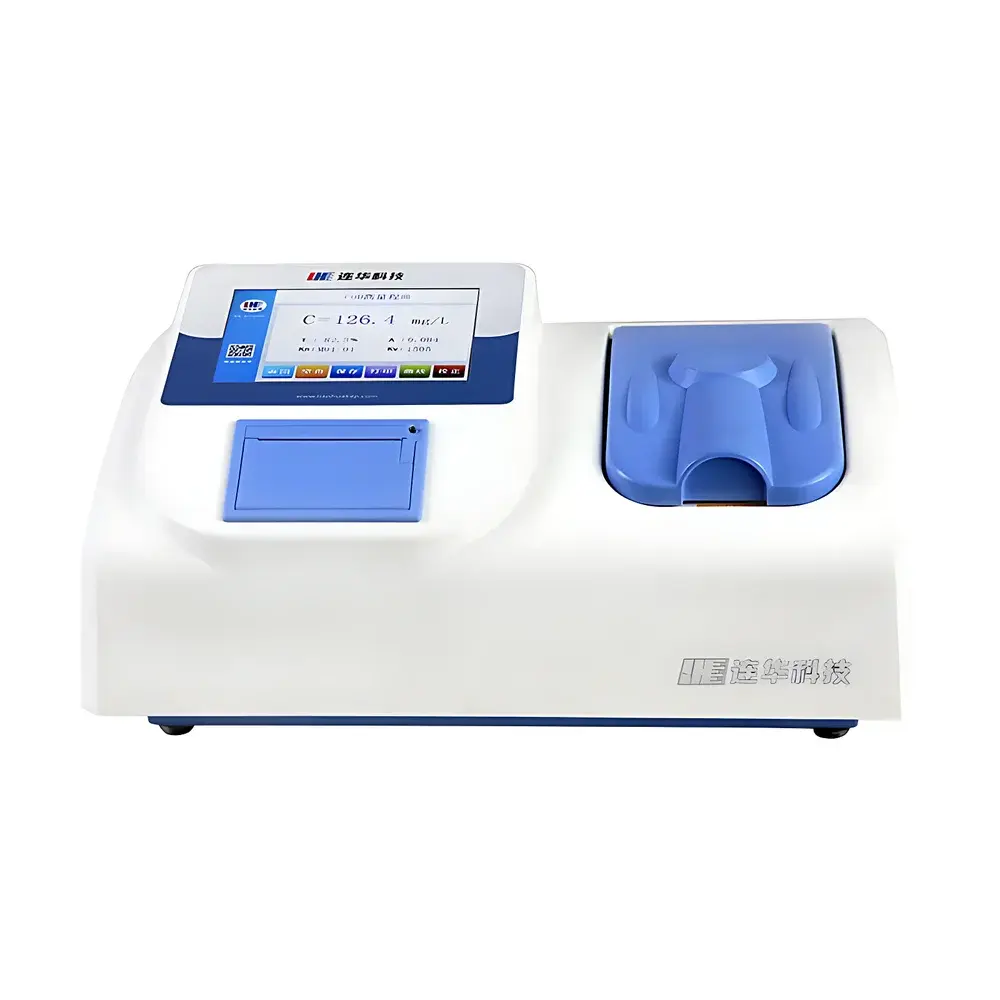
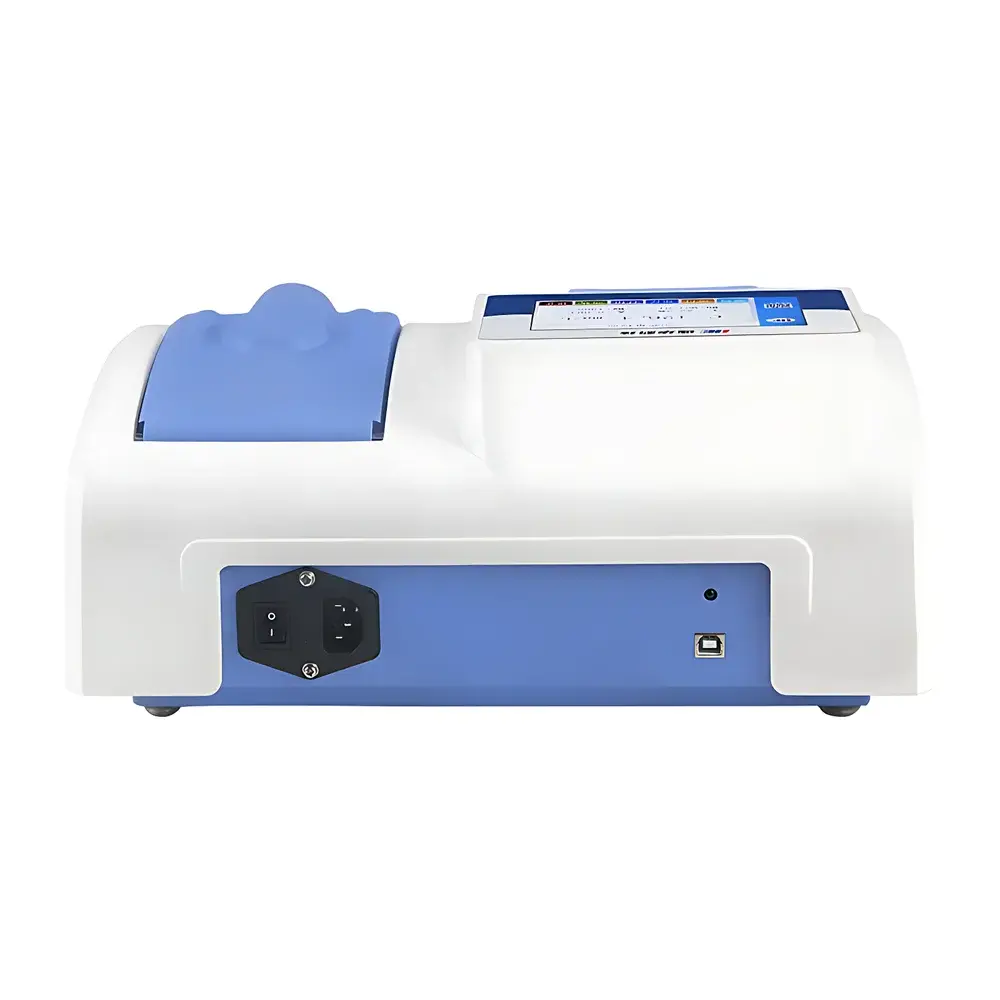
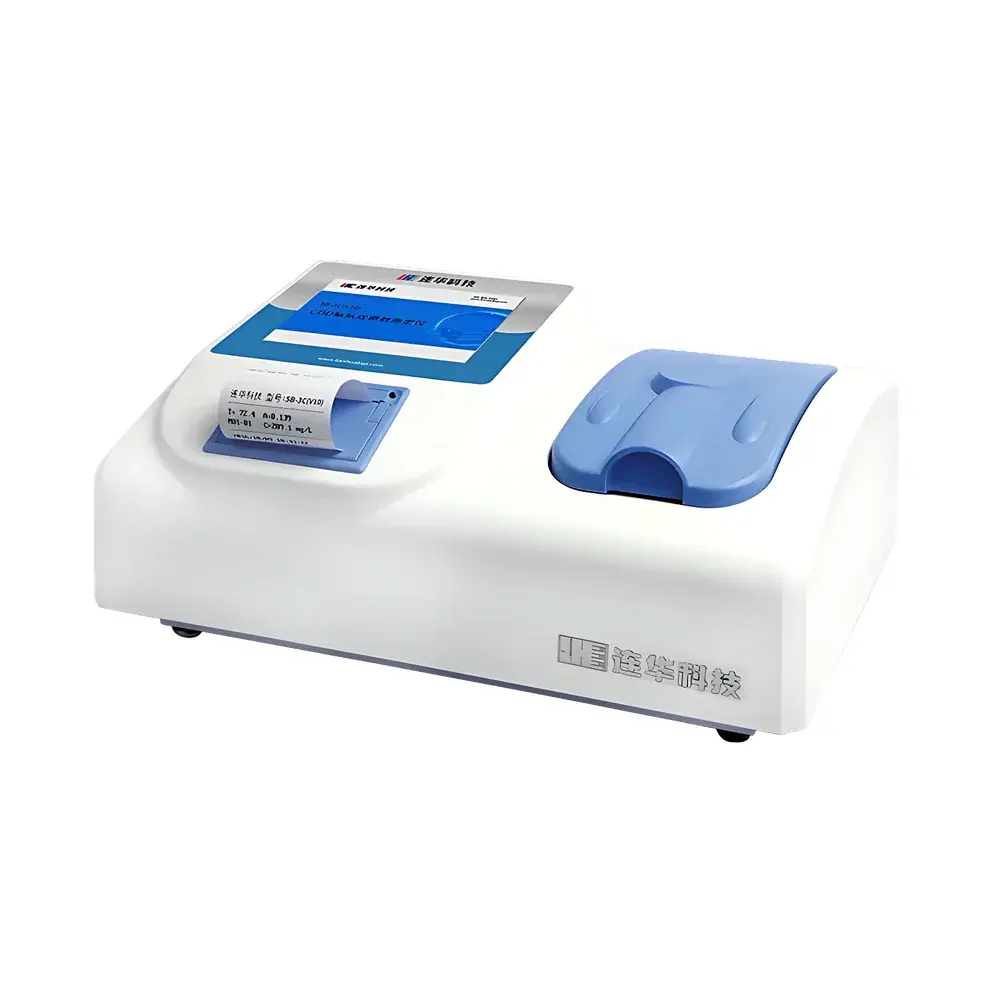
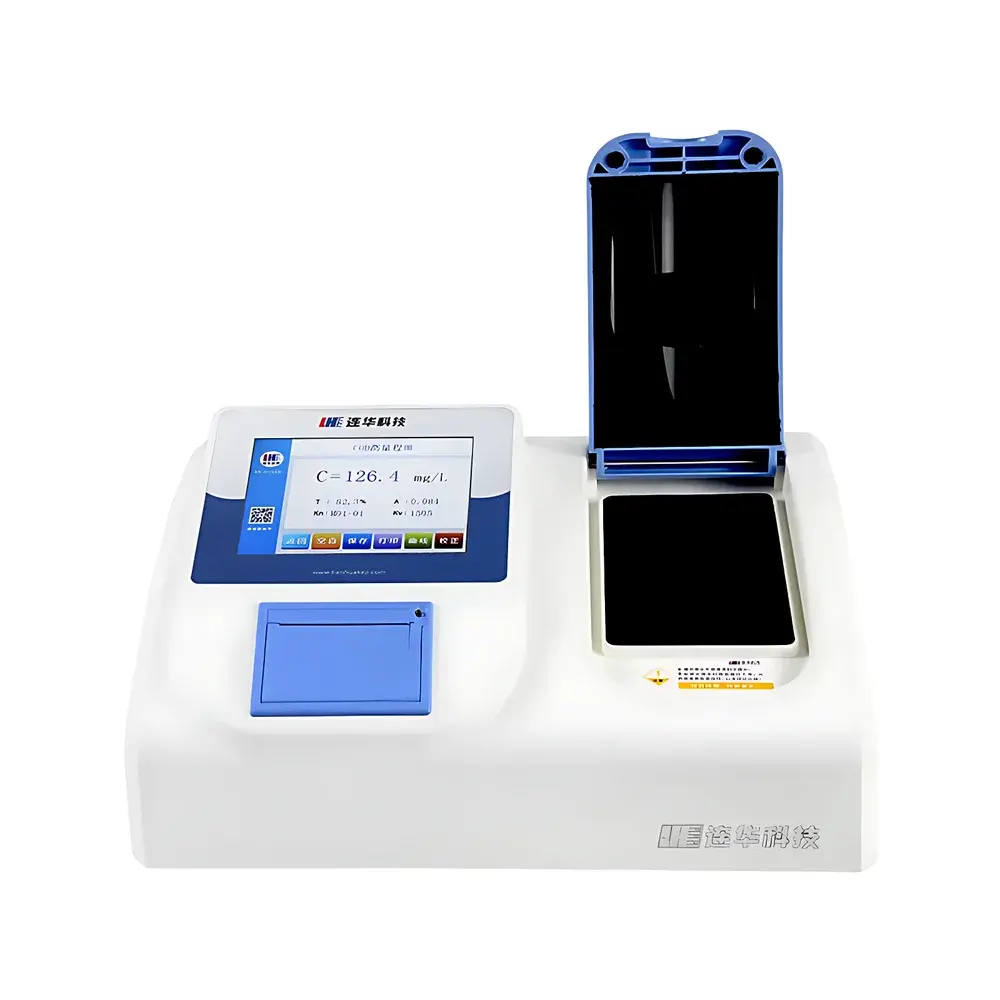
LoHua Tech 5B-3C(V10) Dual-Parameter COD & Ammonia-N Analyzer
| Brand | LoHua Tech |
|---|---|
| Origin | Beijing, China |
| Manufacturer Type | Direct Manufacturer |
| Instrument Type | Benchtop Laboratory Analyzer |
| Measurement Principle | Rapid Digestion Spectrophotometry |
| Wavelength Configuration | Multi-Wavelength (610 nm for COD, 420 nm for Ammonia-N) |
| Measurement Range | COD: 0–15,000 mg/L (multi-range auto-segmentation) |
| Ammonia-N | 0–160 mg/L (multi-range auto-segmentation) |
| Accuracy | ≤ ±5% of reading |
| Repeatability | ≤ ±3% RSD |
| Detection Limit | 0.006 mg/L (Ammonia-N) |
| Analysis Time | <20 min (COD), <15 min (Ammonia-N) |
| Batch Capacity | 16 samples per run |
| Data Storage | 12,000 measurement records with timestamp, instrument parameters, and result metadata |
| Calibration | Onboard curve generation via standard solution input and linear/nonlinear regression |
| Connectivity | USB interface + optional infrared wireless module |
| Thermal Control | Adaptive power modulation for 16-position digestion block with over-temperature and time-delay safety cutoff |
| Built-in Thermal Printer | Supports on-demand printout of current/historical results |
Overview
The LoHua Tech 5B-3C(V10) Dual-Parameter COD & Ammonia-N Analyzer is a benchtop spectrophotometric system engineered for rapid, standardized quantification of Chemical Oxygen Demand (COD) and Ammonia-Nitrogen (NH₃-N) in municipal wastewater, industrial effluents, surface water, and treated discharge streams. It implements the rapid digestion-spectrophotometric method—fully compliant with HJ/T 399–2007 (COD) and HJ 535–2009 (Ammonia-N)—wherein sample oxidation occurs under controlled thermal conditions using pre-formulated reagent vials, followed by absorbance measurement at wavelength-specific optical channels (610 nm for dichromate-based COD detection; 420 nm for indophenol blue complex formation in ammonia analysis). The instrument integrates hardware-level optical stability, temperature-compensated photodiode detection, and firmware-driven auto-ranging to ensure metrological consistency across wide concentration spans without manual dilution or range switching.
Key Features
- Simultaneous dual-parameter capability: Independent, parallel measurement protocols for COD and Ammonia-N within a single operational workflow—no cross-interference due to dedicated optical paths and reagent chemistries.
- Integrated 16-position intelligent digestion module: Features adaptive power regulation that dynamically adjusts heating output based on actual sample load (e.g., 4 vs. 16 vials), maintaining ±0.5 °C thermal uniformity across all positions and reducing energy consumption by up to 35% versus fixed-power systems.
- Comprehensive calibration architecture: Supports both factory-loaded reference curves (153 pre-validated ASTM/ISO-aligned methods) and user-defined regression models (17 slots), including linear, quadratic, and logarithmic fits—each stored with traceable calibration date, operator ID, and standard lot number.
- Regulatory-grade data integrity: All measurements are timestamped (RTC-backed), annotated with real-time environmental parameters (ambient temperature, humidity), and archived with full audit trail—including instrument configuration state (wavelength selection, blank correction mode, digestion timer setting).
- Thermal safety protocol: Incorporates dual-stage protection—hardware-based thermal fuse (cut-off at 200 °C) and software-monitored time-delay shutdown (auto deactivation after 30 min idle or 120 min continuous operation).
Sample Compatibility & Compliance
The 5B-3C(V10) accommodates standard 16 mm × 100 mm glass or quartz digestion vials and accepts liquid samples with turbidity ≤ 50 NTU and chloride interference ≤ 2,000 mg/L (for COD, compensated via Ag₂SO₄ precipitation in reagent formulation). It meets national verification requirements per JJG 975–2012 (Chinese Metrology Verification Regulation for COD Analyzers) and supports GLP-compliant operation through configurable user access levels (admin/operator/auditor), password-protected method editing, and immutable data export logs. While not FDA 21 CFR Part 11 certified out-of-box, its data export structure (CSV/Excel-compatible with SHA-256 hash signatures per batch) enables integration into validated LIMS environments meeting ISO/IEC 17025:2017 clause 7.7 traceability mandates.
Software & Data Management
Data handling is performed via embedded 32-bit ARM Cortex-M7 controller running real-time OS. The onboard memory retains 12,000 full-record entries—including measurement value, digestion temperature profile, blank absorbance baseline, and operator-assigned sample ID. Export options include USB mass-storage mode (direct drag-and-drop CSV files) and optional infrared wireless transmission (IrDA 1.2 compliant, 115.2 kbps, line-of-sight up to 2 m). No proprietary software installation is required: exported datasets conform to EPA Method 410.4 and ISO 6060 tabular formatting, enabling direct ingestion into Microsoft Excel, LabArchives, or Waters Empower platforms without format conversion.
Applications
This analyzer serves routine QC/QA laboratories in municipal water treatment plants (influent/effluent monitoring), electroplating and textile manufacturing facilities (process wastewater compliance), environmental testing service providers (CMA-accredited reporting), and university teaching labs (method validation coursework). Its sub-20-minute COD turnaround supports shift-based operational decision-making, while the ammonia-N sub-15-minute cycle enables real-time nitrification/denitrification assessment in activated sludge basins. Field-deployable via optional 12 V DC adapter, it also functions in mobile labs conducting emergency spill response per GB 3838–2002 Class V surface water criteria.
FAQ
Does the 5B-3C(V10) require external PC software for calibration or data review?
No—full calibration setup, curve management, and historical data browsing are performed directly on the device’s 5.0-inch capacitive touchscreen interface.
Can the digestion block be used independently for other colorimetric assays?
Yes—the 16-position heater operates as a standalone programmable thermal unit (temp range: 30–200 °C, resolution: 0.1 °C, ramp rate: 1–10 °C/min) and accepts third-party vials meeting DIN 12782 geometry standards.
How is chloride interference managed during COD measurement?
The supplied COD reagent kit contains mercuric sulfate (HgSO₄) at optimized stoichiometric ratio to mask Cl⁻ up to 2,000 mg/L; alternative low-chloride protocols (e.g., dichromate-free Mn³⁺ oxidation) are not supported.
Is the built-in thermal printer compatible with continuous label stock?
It accepts only standard 57 mm wide direct-thermal paper rolls (core diameter ≤ 25 mm); adhesive-backed labels are not recommended due to heat-induced adhesive migration risk.
What maintenance intervals are specified for optical path validation?
Photometric drift verification using NIST-traceable neutral density filters is recommended every 90 days or after 500 measurement cycles, per manufacturer’s Maintenance Logbook (Form LH-5B-MNT-REV3).
Related Products







