
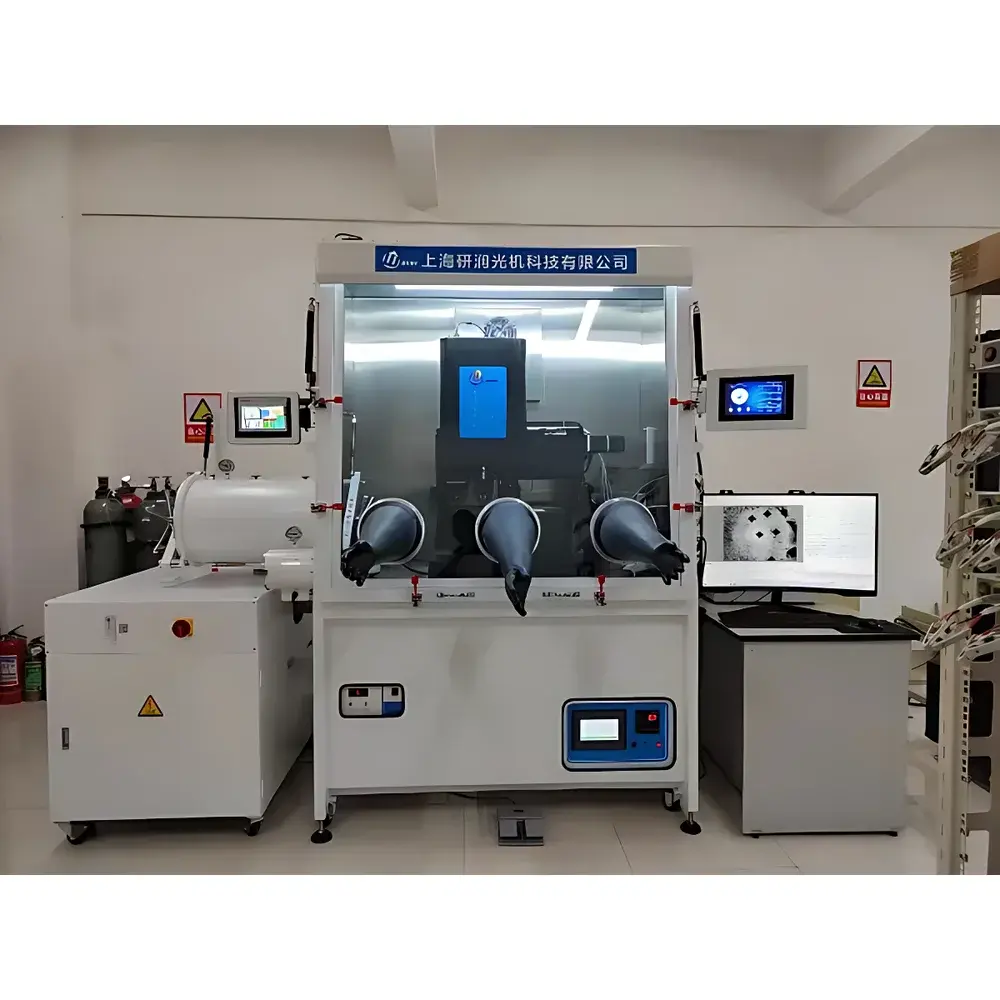
YANRUN HMAS-HT700CM Full-Field High-Temperature Vickers Hardness Tester
| Brand | YANRUN |
|---|---|
| Origin | Shanghai, China |
| Manufacturer Type | Direct Manufacturer |
| Instrument Type | Vickers Hardness Tester |
| Model | HMAS-HT700CM |
| Operating Temperature Range | Ambient to 600 °C |
| Load Range | 0.1–30 kgf (standard), up to 150 kgf (optional) |
| Optical System | 10× objective rated for continuous operation at 600 °C (20× optional) |
| Temperature Uniformity | ≤ ±5 °C across 100 × 80 × 80 mm furnace cavity |
| Temperature Control Accuracy | ±1 °C |
| Maximum Dwell Time | 72 h |
| Multi-Axis Motion Control | Up to 9 axes, positional resolution ≤ 0.1 µm |
| Image Magnification | 1000× (2000× optional) |
| Objective Resolution | 1.44 µm (1.19 µm with 20×) |
| Indenter Material | Cubic Boron Nitride (CBN) pyramid |
| Indenter Shank | Inconel alloy, 110 mm length |
| Sample Size Limit | Ø30 × 30 mm |
| Rapid Sample Exchange | ≤50 s within isothermal field |
| Force-Time Data Acquisition | Real-time, synchronized with thermal and positional feedback |
Overview
The YANRUN HMAS-HT700CM is a full-field high-temperature Vickers hardness tester engineered for in-situ mechanical property evaluation of advanced materials under controlled thermal conditions ranging from ambient to 600 °C. Unlike conventional hardness testers limited to room-temperature operation or partial heating, the HMAS-HT700CM maintains a uniform, stable temperature field across the entire measurement zone—including optical path, indenter, load train, and sample stage—enabling true isothermal indentation and real-time microstructural observation. Its core measurement principle adheres to ASTM E384 and ISO 6507-1 for Vickers microhardness, extended to elevated temperatures via thermally compensated force transduction, high-stability optical imaging, and active thermal management of critical subsystems. The system supports quantitative hardness mapping, crack initiation analysis, creep-induced indentation recovery, and time-dependent plasticity studies—particularly relevant for aerospace superalloys, nuclear cladding materials, ceramic matrix composites, and high-entropy alloys undergoing thermo-mechanical aging.
Key Features
- Full-field isothermal operation up to 600 °C: furnace cavity (100 × 80 × 80 mm), optics, indenter, and motion stages all rated for continuous exposure at target temperature.
- High-fidelity dynamic loading: 0.1–30 kgf standard range (extendable to 150 kgf), with real-time force–time acquisition at ≥1 kHz sampling rate; load accuracy ±2% ≤1 kgf, ±0.5% >1 kgf; resolution 0.01% FS.
- Thermally robust optical path: 10× objective (1.44 µm resolution) qualified for uninterrupted operation at 600 °C; 20× objective (1.19 µm) available as option; total magnification 1000× (2000× with 20×).
- Multi-axis synchronized motion control: up to 9 axes (X/Y/Z/sample lift/indenter Z/focus/optical zoom/cooling nozzle/gas purge), with positional repeatability ≤±1 µm and resolution ≤0.1 µm.
- In-situ dwell capability: programmable hold durations from 1 s to 72 h at constant load and temperature, enabling long-term creep, relaxation, and oxidation-coupled deformation studies.
- Rapid isothermal sample exchange: ≤50 s cycle time without thermal perturbation to the chamber, supported by manual or optional automated transfer mechanism.
- Integrated high-temperature indenter module: CBN pyramidal indenter mounted on Inconel shank (110 mm); compatible with alternative geometries (spherical, conical, cylindrical) for specialized deformation modeling.
Sample Compatibility & Compliance
The HMAS-HT700CM accommodates disk-shaped specimens up to Ø30 × 30 mm and is routinely deployed for metallurgical samples, thin-film coatings, brittle ceramics, and additively manufactured components. Optional glovebox integration (water/oxygen <1 ppm) enables testing under inert (Ar, N₂) or vacuum atmospheres—critical for oxidation-sensitive alloys (e.g., TiAl, Nb–Si-based intermetallics) and reactive refractory metals. All thermal, mechanical, and optical subsystems comply with IEC 61000-6-2 (EMC immunity) and IEC 61000-6-4 (EMC emission) standards. Force calibration traceability follows ISO/IEC 17025-accredited procedures using NIST-traceable deadweight standards. Data integrity conforms to FDA 21 CFR Part 11 requirements when configured with audit-trail-enabled software and electronic signature modules—supporting GLP/GMP-compliant R&D environments.
Software & Data Management
Control and analysis are executed via a wall-mounted industrial PC running YANRUN’s proprietary HT-Measure Suite, a deterministic real-time OS platform supporting synchronized acquisition of force, displacement, temperature, image stream, and motor position data at sub-millisecond intervals. The software provides pre-defined test templates (e.g., ASTM E384 high-temp mode, ISO 6507-2 multi-load series, custom dwell ramps), automated indentation grid generation, and batch processing for statistical hardness distribution mapping. Image-based indenter tip detection and crack-length quantification employ edge-enhanced segmentation algorithms validated per ISO 20502. Raw datasets (HDF5 format) include embedded metadata: timestamp, thermal history, load profile, and environmental log. Export options include CSV, MATLAB .mat, and ASTM E1447-compliant XML for LIMS integration. Optional cloud synchronization enables remote monitoring and collaborative project review across distributed research teams.
Applications
- High-temperature creep resistance characterization of Ni-based single-crystal superalloys used in turbine blades.
- Oxidation-assisted cracking kinetics in Fe–Cr–Al ODS steels under isothermal dwell loading.
- Thermal barrier coating (TBC) delamination onset mapping via progressive-load indentation at 500–600 °C.
- Time–temperature–transformation (TTT) analysis of precipitation-hardened aluminum alloys during artificial aging.
- Interface strength evaluation in metal–ceramic brazed joints subjected to thermal cycling.
- Validation of constitutive models (e.g., Norton–Bailey, Garofalo) using simultaneous force–displacement–temperature response.
FAQ
What temperature uniformity can be achieved across the test volume?
The furnace maintains ≤±5 °C gradient over its 100 × 80 × 80 mm cavity, verified by multi-point S-type thermocouple mapping per ASTM E220.
Is the system suitable for vacuum-compatible testing?
Yes—when integrated with the optional glovebox (vacuum-rated to 10⁻³ Pa) and inert gas purge, the entire measurement zone operates under vacuum or controlled partial pressure.
Can hardness values be correlated to standard room-temperature references?
Yes—calibration curves are generated using reference materials (e.g., NIST SRM 2840, 2841) tested across the full temperature range, enabling correction for thermal drift in modulus and yield behavior.
How is thermal drift in the optical path compensated?
The 10× and 20× objectives are designed with matched thermal expansion coefficients; focus stability is actively maintained via closed-loop piezoelectric z-adjustment synchronized with furnace temperature feedback.
What maintenance intervals are recommended for the high-temperature load cell and indenter?
Force sensor recalibration is advised annually or after 500 high-temperature cycles; CBN indenters undergo post-test visual inspection per ISO 6507-2 Annex B, with replacement recommended after cumulative dwell >200 h at 600 °C.
Related Products



