
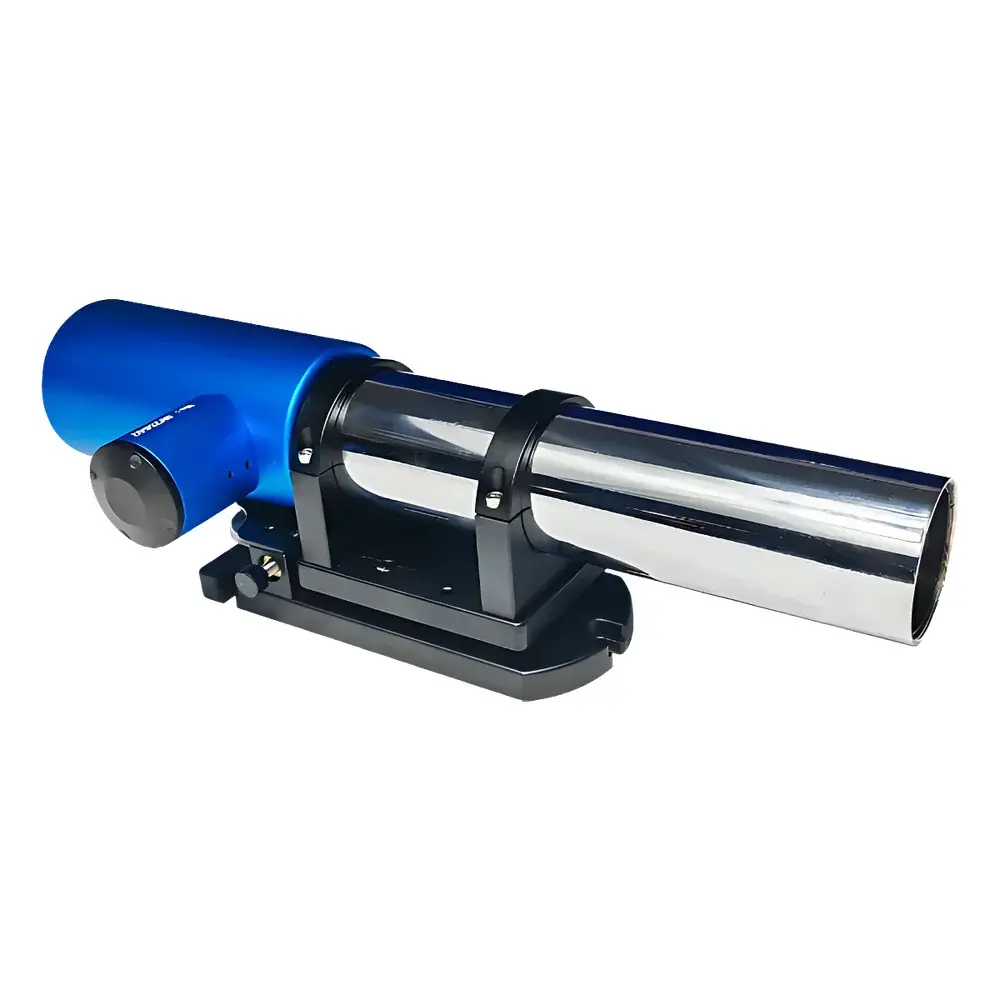
YANRUN MC030-ZJUH3000/0.3 Dual-Axis Electronic Autocollimator
| Brand | YANRUN |
|---|---|
| Origin | Shanghai, China |
| Manufacturer Type | Direct Manufacturer |
| Model | MC030-ZJUH3000/0.3 |
| Angular Resolution | 0.3 arcseconds |
| Measurement Range | ±1500 arcseconds (X & Y axes, simultaneous) |
| Sensor | High-resolution CMOS imaging sensor |
| Output Interface | USB 3.0 / RS-232 / Ethernet |
| Compliance | ISO 10110-5, GB/T 22547-2008, JJG 925-2019 |
| Operating Temperature | 15–25 °C (±1 °C/h stability recommended) |
Overview
The YANRUN MC030-ZJUH3000/0.3 is a dual-axis electronic autocollimator engineered for high-precision angular metrology in controlled laboratory and production environments. It operates on the principle of optical autocollimation: a collimated laser beam is directed onto a reflective target surface; any angular deviation of the surface causes a proportional lateral displacement of the reflected beam’s centroid on a high-sensitivity CMOS image sensor. This displacement is digitized and converted into angular deviation values using calibrated pixel-to-angle mapping algorithms. Unlike traditional visual autocollimators, the MC030-ZJUH3000/0.3 eliminates human parallax error and enables real-time, quantitative, bidirectional angular measurement in both X and Y axes—simultaneously and independently—with traceable resolution down to 0.3 arcseconds. Its design targets applications requiring sub-arcsecond repeatability and long-term thermal stability, such as precision alignment of optical benches, verification of straightness and flatness in coordinate measuring machines (CMMs), and dynamic tilt monitoring during CNC machine tool calibration.
Key Features
- Dual-axis simultaneous measurement capability with independent X/Y angular readouts, eliminating sequential axis switching delays and cross-coupling errors.
- High-stability optical bench incorporating low-expansion borosilicate glass baseplate and kinematic mirror mounts to minimize thermal drift and mechanical hysteresis.
- Integrated CMOS imaging sensor with 12-bit ADC and on-board FPGA-based centroid calculation engine—ensuring sub-pixel resolution and real-time data throughput up to 50 Hz.
- Factory-calibrated angular scale traceable to national metrology institutes (NIM, China); calibration certificate includes uncertainty budget per ISO/IEC 17025 requirements.
- Ruggedized aluminum alloy housing with IP52-rated environmental protection, designed for use in cleanrooms (ISO Class 7) and vibration-isolated optical tables.
- Modular optical path architecture supporting optional accessories: retroreflector targets, wedge prisms for extended range, and motorized rotation stages for automated multi-position alignment.
Sample Compatibility & Compliance
The MC030-ZJUH3000/0.3 is compatible with standard optical flats (λ/20 surface accuracy), precision mirrors (dielectric-coated, R > 99.5% @ 633 nm), and industrial-grade retroreflective targets (corner cubes or spherical reflectors). It meets dimensional metrology requirements defined in ISO 230-1 (machine tool testing) and supports alignment protocols referenced in ISO 10360-2 (CMM acceptance testing). The instrument conforms to Chinese national verification regulation JJG 925–2019 for autocollimators and aligns with optical testing standards GB/T 22547–2008. While not FDA-regulated, its data integrity features—including user-access logs, configurable audit trails, and non-editable raw frame storage—support GLP-compliant documentation workflows in regulated manufacturing settings.
Software & Data Management
The instrument ships with YANRUN AutoAlign Suite v4.2—a Windows-based application supporting real-time visualization, statistical process control (SPC) charting, and batch report generation in PDF/CSV formats. Software implements role-based access control (operator, technician, administrator), password-protected configuration changes, and timestamped measurement history with SHA-256 hash verification of exported datasets. Raw image frames and processed angular data are stored separately to preserve metrological traceability. Export modules support direct integration with MATLAB, LabVIEW, and Python (via documented DLL and REST API interfaces). All software binaries undergo static code analysis and are signed with SHA-256 digital certificates compliant with IEC 62443-4-1 security guidelines.
Applications
- Verification of angular stability in ultra-precision air-bearing spindles and hydrostatic guideways.
- In-process alignment of laser interferometer retroreflectors during large-aperture telescope assembly.
- Calibration of angular encoders and tilt sensors used in semiconductor lithography steppers.
- Dynamic monitoring of thermal deformation in optical breadboards under variable ambient load conditions.
- Validation of pitch/yaw motion profiles in multi-axis robotic manipulators (e.g., for micro-optical component placement).
- Support of ISO 10110-5 surface form certification by measuring local slope deviations across polished optical substrates.
FAQ
What is the maximum working distance for reliable measurements?
The nominal working distance ranges from 0.5 m to 10 m, depending on target reflectivity and ambient lighting. At 5 m, minimum resolvable angle remains ≤0.3″ with ≥80% specular reflectance.
Can the system be integrated into an automated production line?
Yes—Ethernet and RS-232 interfaces support Modbus TCP and SCPI command sets for PLC synchronization and trigger-based acquisition.
Is NIST-traceable calibration available?
Third-party NIST-traceable calibration services are offered through authorized metrology partners; factory calibration uses NIM-certified reference standards.
Does the software comply with FDA 21 CFR Part 11?
While the base software does not include full Part 11 functionality (e.g., biometric login), optional validation packages provide electronic signature support, audit trail export, and 21 CFR Part 11–compliant configuration lockdown upon request.
How often is recalibration recommended?
Annual recalibration is advised under normal use; more frequent verification (e.g., quarterly) is recommended when operating in environments with >2 °C/h temperature fluctuation or after mechanical shock events.





