
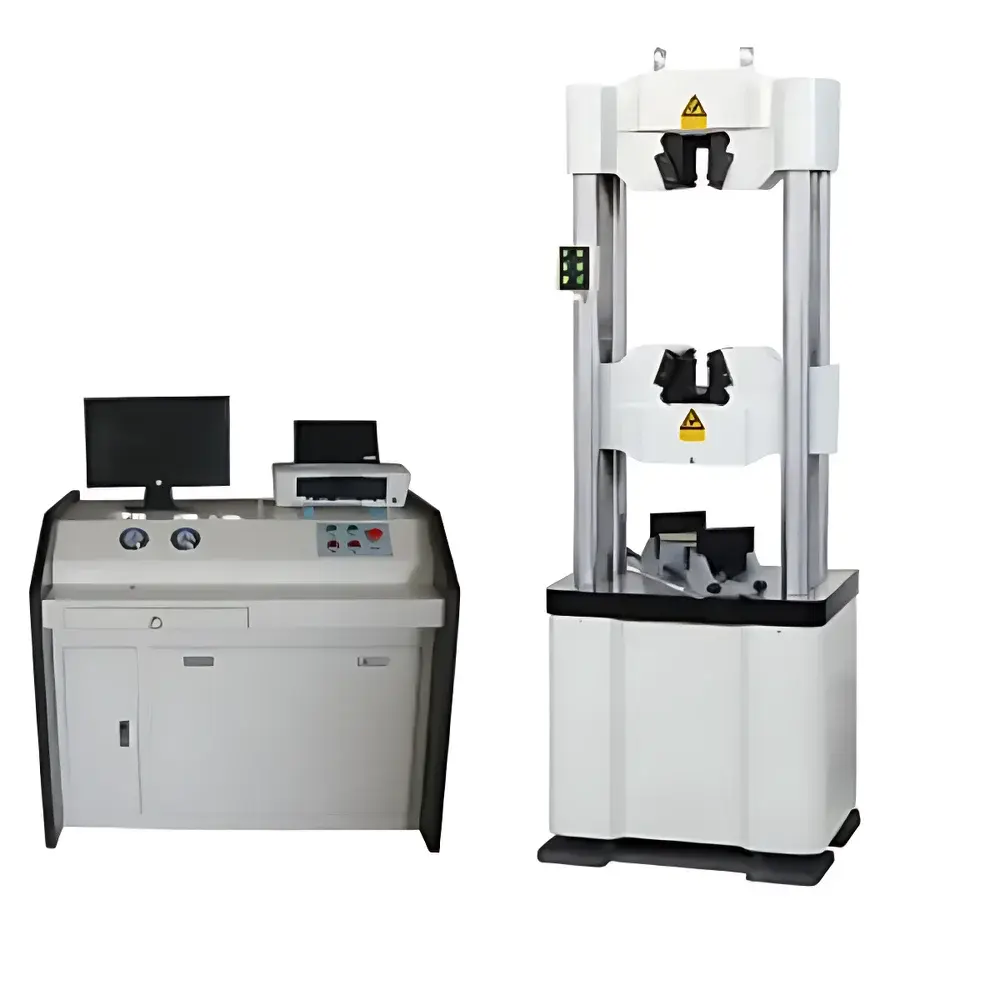
YANRUN WEW-300D Microcomputer-Controlled Electro-Hydraulic Servo Universal Testing Machine
| Brand | YANRUN |
|---|---|
| Origin | Shanghai, China |
| Manufacturer Type | Direct Manufacturer |
| Country of Origin | China |
| Model | WEW-300D |
| Instrument Type | Electro-Hydraulic Servo Testing Machine |
| Max Test Load | 300 kN |
| Load Accuracy | ±1% |
| Max Tensile Space | 600 mm (including piston stroke) |
| Max Compression Space | 550 mm |
| Flat Specimen Clamping Thickness | 0–15 mm |
| Round Specimen Clamping Diameter | Φ6–Φ26 mm |
| Compression Platen Diameter | Φ120 mm |
| Column Spacing | 460 mm |
| Bending Support Roller Spacing | 30–400 mm |
| Piston Stroke | 150 mm |
| Indicated Value Relative Error Limit | ±1% |
| Clamping Method | Hydraulic Clamping |
| Oil Pump Motor Power | 2.2 kW |
| Crosshead Drive Motor Power | 0.37 kW |
| Mainframe Dimensions (W×D×H) | 730×570×1845 mm |
| Oil Source Dimensions (W×D×H) | 1020×620×810 mm |
| Weight | 2100 kg |
Overview
The YANRUN WEW-300D is a microcomputer-controlled electro-hydraulic servo universal testing machine engineered for high-reliability mechanical property evaluation of metallic, polymeric, and composite materials under quasi-static loading conditions. It operates on the principle of closed-loop hydraulic force control, where real-time feedback from a precision oil-pressure transducer enables dynamic regulation of actuator output to maintain programmed load or displacement profiles. Designed in accordance with ISO 7500-1 (Class 1 accuracy), ASTM E4, and GB/T 228.1–2021 standards, the system delivers traceable force measurement up to 300 kN with ±1% accuracy across its full range — suitable for tensile, compression, bending, and shear testing in R&D laboratories, quality control departments, and third-party certification facilities.
Key Features
- Electro-hydraulic servo architecture with dual-motor drive: 2.2 kW oil pump motor ensures stable high-pressure oil supply; 0.37 kW crosshead positioning motor enables precise, low-noise vertical movement.
- Hydraulic wedge-type clamping system with automatic pressure maintenance, eliminating manual torque adjustment and ensuring consistent grip force across specimen geometries (round: Φ6–Φ26 mm; flat: 0–15 mm thickness).
- Dual-column rigid frame with 460 mm column spacing and reinforced base structure, minimizing deflection during high-load compression tests (max 550 mm working height) and enabling stable bending tests over 30–400 mm support span.
- Integrated load cell and piston displacement sensors provide synchronized force-displacement data acquisition at ≥100 Hz sampling rate, supporting standard stress-strain curve generation and modulus calculation per ISO 527 and ASTM D638 protocols.
- Modular accessory set includes three pairs of round-specimen jaws (Φ6–Φ13 mm, Φ13–Φ26 mm, Φ26–Φ40 mm), one flat-specimen jaw set, spherical-seat compression fixtures (Φ120 mm platen), and standardized three-point bending fixtures — all compliant with ISO 178 and ASTM D790 mounting interfaces.
Sample Compatibility & Compliance
The WEW-300D accommodates a broad spectrum of standardized and custom specimens: metallic rods, sheets, castings, welded joints, polymer bars, and cementitious prisms. Its 600 mm maximum tensile space (inclusive of 150 mm piston stroke) supports elongation measurements per ISO 6892-1 Annex A, while the 550 mm compression zone meets requirements for concrete cylinder testing (ASTM C39). All mechanical components conform to GB/T 16825.1–2008 (equivalent to ISO 7500-1 Class 1) for static force calibration. The system’s structural rigidity and thermal stability ensure ≤0.05% drift over 8-hour continuous operation — critical for GLP-compliant long-duration creep or relaxation studies.
Software & Data Management
The bundled test control software runs on an embedded industrial PC (Lenovo-branded) and supports Windows-based operation with intuitive graphical interface for test method configuration, real-time curve monitoring, and automated report generation. Data export is available in CSV, Excel, and PDF formats, with embedded metadata including operator ID, timestamp, environmental temperature, and calibration certificate traceability. Audit trail functionality records all parameter modifications, test start/stop events, and calibration actions — satisfying FDA 21 CFR Part 11 requirements when configured with user authentication and electronic signature modules. Raw sensor data streams are stored locally with timestamped backups, enabling retrospective analysis and third-party validation.
Applications
- Tensile characterization of structural steels (yield strength, ultimate tensile strength, elongation at break) per ASTM A370 and ISO 6892-1.
- Compression testing of aluminum alloys, gray cast iron, and high-strength concrete per ASTM C39, C109, and ISO 13314.
- Three-point flexural evaluation of thermoplastics and fiber-reinforced composites per ASTM D790 and ISO 178.
- Quality assurance of fasteners, welds, and machined components in automotive and aerospace Tier-1 supplier environments.
- Educational use in university materials science labs for hands-on instruction in mechanical behavior fundamentals and standardization principles.
FAQ
What standards does the WEW-300D comply with for force measurement accuracy?
It conforms to ISO 7500-1 Class 1 and GB/T 16825.1–2008, with verified ±1% load accuracy across the full 300 kN range.
Can the system perform cyclic loading or fatigue tests?
No — the WEW-300D is designed exclusively for quasi-static monotonic loading. For dynamic or high-cycle fatigue applications, a dedicated servo-hydraulic fatigue testing system is required.
Is the software compatible with LIMS or enterprise MES platforms?
Yes — via configurable OPC UA or TCP/IP API interfaces, raw test data and summary reports can be integrated into laboratory information management systems or manufacturing execution systems.
What maintenance intervals are recommended for hydraulic oil and filters?
Oil replacement every 2,000 operating hours or biannually (whichever occurs first); suction and pressure filter elements replaced every 500 hours or quarterly.
Does the system support remote diagnostics or firmware updates?
Yes — optional Ethernet-connected remote service module enables secure technician access for troubleshooting, parameter tuning, and version-controlled firmware upgrades.



