
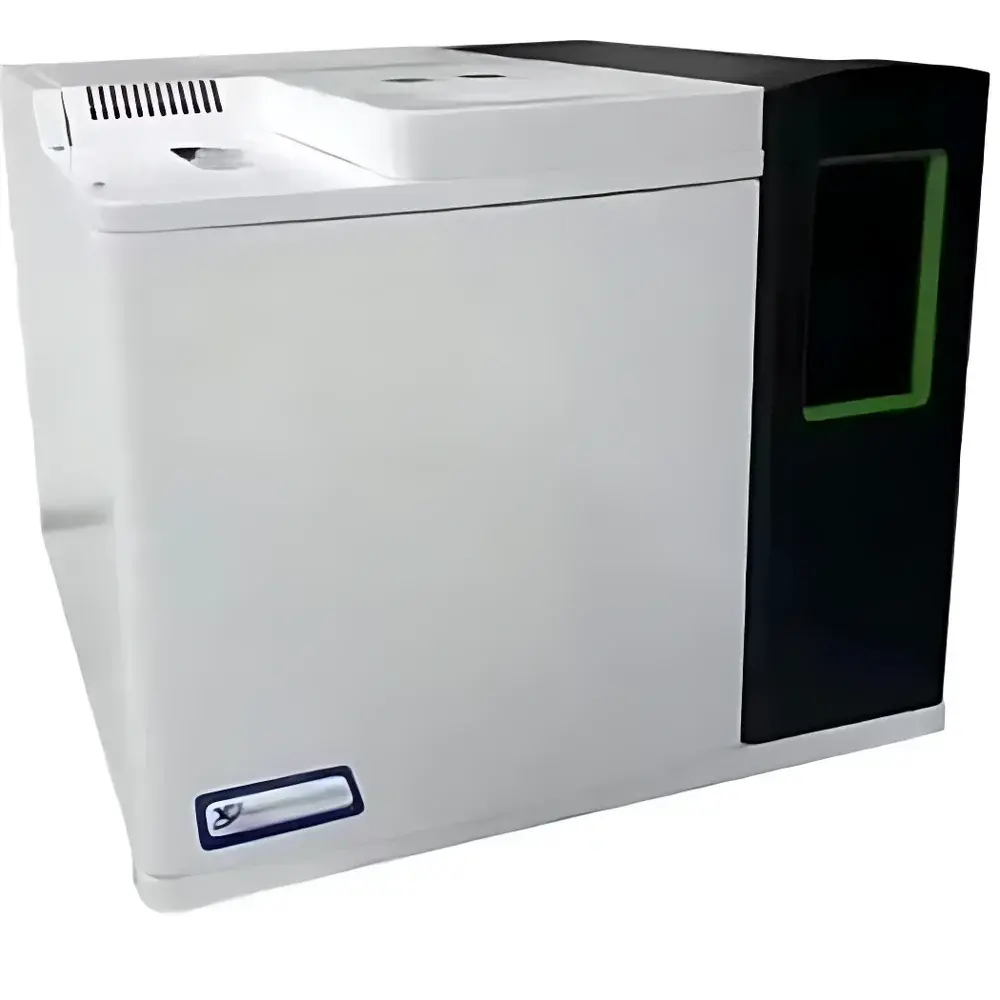
HSPX GC-9900 Laboratory Gas Chromatograph
| Brand | HSPX |
|---|---|
| Origin | Beijing, China |
| Manufacturer Type | Direct Manufacturer |
| Instrument Type | Benchtop Laboratory Gas Chromatograph |
| Application Scope | General-Purpose Analytical Use |
| Oven Temperature Range | Ambient + 20 °C to 400 °C |
| Ramp Rate | 0.1–40 °C/min |
| Cool-Down Time | ≤5 min (from 400 °C to 50 °C) |
| Carrier Gas Flow Range & Control | 0–1000 mL/min |
| Carrier Gas Pressure Range & Control | 0–970 kPa |
| Injector Maximum Operating Temperature | 400 °C |
| Injector Pressure Setting Range | 0–970 kPa |
| Injector Total Flow Setting Range | 0–1200 mL/min |
| Detector Temperature Range | Ambient + 20 °C to 400 °C |
| TCD Sensitivity | ≥5000 mV·mL/mg (n-heptane) |
| FID Detection Limit | <8×10⁻¹² g/s (n-decane) |
| NPD Detection Limits | ≤1×10⁻¹² g/s (N), ≤1×10⁻¹³ g/s (P) |
| FPD Detection Limits | ≤8×10⁻¹¹ g/s (S), ≤4×10⁻¹² g/s (P) |
| Column Compatibility | Packed columns (2–4 mm ID), Capillary columns (0.1–0.53 mm ID), Including Wide-Bore (0.53 mm) Systems |
Overview
The HSPX GC-9900 is a benchtop laboratory gas chromatograph engineered for high reproducibility, method robustness, and operational flexibility in routine and research-grade volatile organic compound (VOC) analysis. Based on classical gas-solid and gas-liquid partition chromatography principles, the system separates analytes via differential partitioning between a mobile phase (inert carrier gas—typically helium, hydrogen, or nitrogen) and a stationary phase coated inside fused-silica or stainless-steel columns. Its modular thermal architecture supports precise temperature programming across multiple zones—including oven, inlet(s), and detector(s)—enabling accurate retention time control and peak resolution for complex matrices. Designed for compliance with ISO/IEC 17025 method validation requirements and compatible with GLP/GMP workflows, the GC-9900 serves as a foundational platform for quantitative and qualitative analysis in regulated and non-regulated environments.
Key Features
- Four independently programmable temperature zones: column oven, dual injectors, and detector compartment—each with real-time digital PID control and ±0.1 °C stability.
- Multi-step oven temperature programming with up to 10 ramp segments per run, supporting complex elution profiles for petrochemicals, residual solvents, or flavor compounds.
- Auto-adjusting rear door mechanism for rapid cool-down (≤5 min from 400 °C to 50 °C), minimizing turnaround time between injections without compromising thermal uniformity.
- Dual-inlet configuration: simultaneous support for two packed-column injection systems plus one split/splitless capillary inlet—compatible with 0.53 mm i.d. wide-bore capillaries for high-capacity applications.
- Electronic pneumatic control (EPC) for carrier gas pressure and flow, delivering consistent linear velocity and retention time repeatability across analytical runs.
- Integrated 320 × 240 pixel LCD display with Chinese/English bilingual interface and full-parameter real-time monitoring (oven temp, inlet pressure, detector signal, flow rates).
Sample Compatibility & Compliance
The GC-9900 accommodates a broad range of sample introduction formats—liquid micro-syringe injection, headspace vials (with optional autosampler integration), and gas-tight loop injection—and supports column chemistries including polyethylene glycol (WAX), cyanopropylphenyl dimethyl polysiloxane (DB-1701), and porous polymer PLOT phases. It meets fundamental performance criteria outlined in ASTM D3606 (benzene/toluene in gasoline), USP (residual solvents), and ISO 11843-2 (detection limit estimation). All detector modules comply with IEC 61000-4 electromagnetic compatibility standards and operate within Class II safety limits per IEC 61010-1. The instrument’s firmware architecture allows audit-trail-enabled operation when paired with 21 CFR Part 11-compliant chromatography data systems (CDS).
Software & Data Management
While the GC-9900 operates autonomously via front-panel controls, it provides analog and digital (RS-232/USB) output interfaces for seamless integration with third-party chromatography data systems—including OpenLab CDS, Chromeleon, and custom LabVIEW-based acquisition platforms. Raw signal outputs (mV) from TCD, FID, NPD, and FPD detectors are calibrated against certified reference standards traceable to NIST SRMs. Peak integration parameters (baseline correction, threshold, width filtering) are user-configurable and stored with each method file. Data export supports CSV, TXT, and AIA (.cdf) formats, ensuring interoperability with LIMS and statistical process control (SPC) tools used in QC laboratories.
Applications
The GC-9900 delivers validated performance across diverse sectors: hydrocarbon profiling in refinery feedstocks (ASTM D5292); pesticide residue screening in food commodities (AOAC 2007.01); ethanol quantification in pharmaceutical excipients (USP ); volatile organic emissions testing in indoor air (EPA TO-17); and fatty acid methyl ester (FAME) analysis in biodiesel (EN 14103). Its configurable detector suite enables selective detection—e.g., phosphorus-specific response via NPD for organophosphate pesticides, or sulfur-selective FPD response for mercaptans in natural gas—without hardware modification. Universities and contract testing labs utilize its dual-inlet capability to parallelize method development (packed vs. capillary) and method transfer studies.
FAQ
What detector configurations are factory-supported?
The GC-9900 ships with TCD and FID as standard; NPD and FPD are available as optional field-installable modules with dedicated power supplies and gas lines.
Is method transfer from legacy GC systems feasible?
Yes—retention time alignment is supported via adjustable oven ramp rates, inlet pressure presets, and customizable carrier gas linear velocity calculations embedded in the method editor.
Can the instrument be integrated into an automated lab environment?
It supports TTL-triggered injection and external start/stop signals; full automation requires an optional 16-position autosampler with temperature-controlled vial storage.
What maintenance intervals are recommended for optimal performance?
Injector liner replacement every 100–200 injections; column trimming every 500 runs; detector cleaning (FID jet, TCD filament inspection) quarterly or after high-boiling matrix exposure.
Does the system include validation documentation?
Factory-installed IQ/OQ protocols are provided; PQ execution requires site-specific test samples and is supported by HSPX application scientists under service agreement.




