
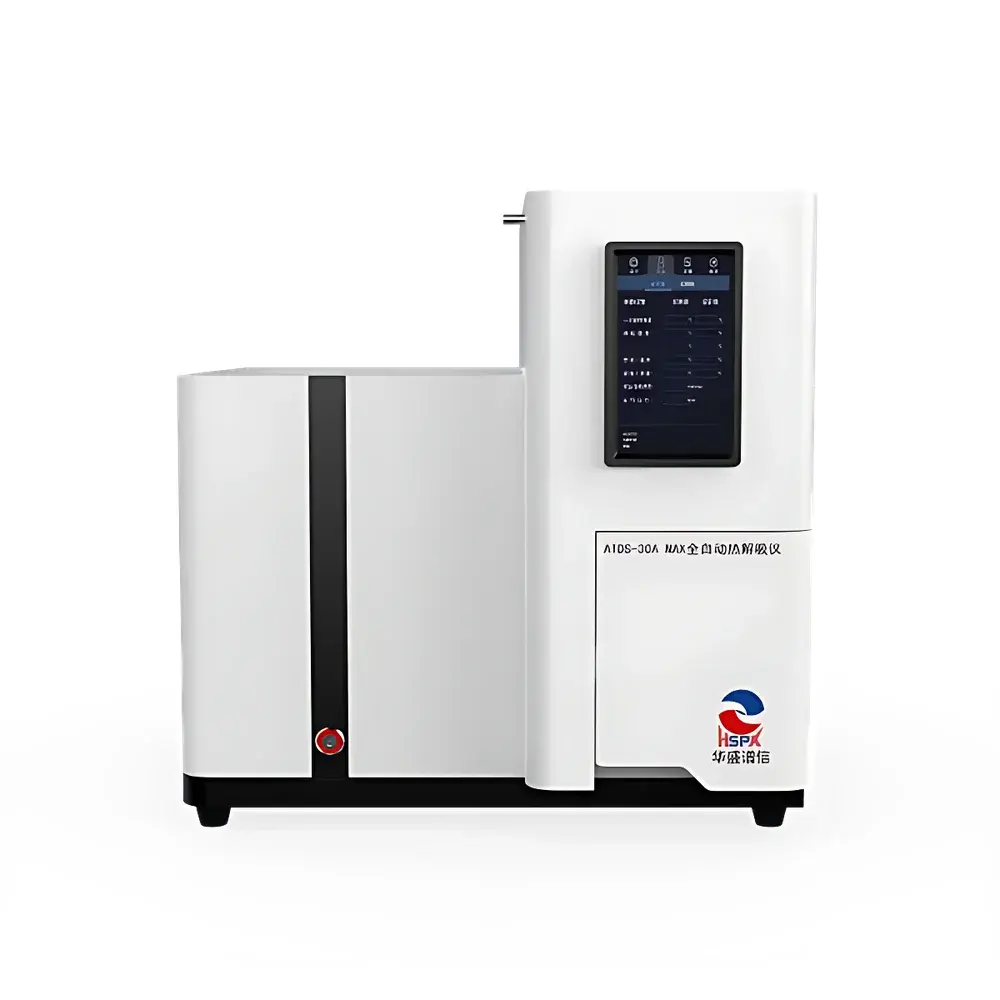
HuaShengPuXin ATDS-30A MAX Fully Automated Two-Stage Thermal Desorber
| Brand | HuaShengPuXin (HSPX) |
|---|---|
| Origin | Beijing, China |
| Manufacturer Type | Direct Manufacturer |
| Instrument Type | Two-Stage Thermal Desorber |
| Automation Level | Fully Automated |
| Primary Desorption Temp Range | Ambient to 350 °C |
| Secondary Desorption Temp Range | Ambient to 350 °C |
| Valve Inlet Temp Range | Ambient to 220 °C |
| Transfer Line Temp Range | Ambient to 200 °C |
| Cryo-Focusing Trap Temp Range | −30 °C to 50 °C |
| Temperature Control Accuracy | ±1 °C |
| Temperature Resolution | 1 °C |
| Sample Capacity | 30 positions |
| Desorption Recovery Rate | >98% (compound-dependent) |
| Cold Trap Cooling Rate | ≥2500 °C/min |
| Purge Flow Rate | 0–500 mL/min (continuously adjustable) |
| Dimensions | 520 × 520 × 500 mm (W × H × D) |
| Weight | ~45 kg |
Overview
The HuaShengPuXin ATDS-30A MAX is a fully automated two-stage thermal desorption system engineered for high-fidelity volatile organic compound (VOC) and semi-volatile organic compound (SVOC) analysis in conjunction with gas chromatography (GC) or gas chromatography–mass spectrometry (GC–MS). It operates on the principle of sequential thermal desorption: first, analytes are thermally released from sorbent tubes under controlled inert gas flow (primary desorption); second, the evolved vapors are cryogenically focused in a narrow-zone cold trap, rapidly heated to achieve sharp, narrow-band injection into the GC column (secondary desorption). This dual-stage architecture significantly enhances sensitivity, peak shape resolution, and quantitative reproducibility—particularly critical for trace-level environmental, occupational hygiene, and indoor air quality applications where regulatory compliance demands sub-ppbv detection limits and robust method validation.
Key Features
- Fully automated 30-position sample carousel with integrated tube identification and positional tracking—enabling unattended overnight operation and batch processing of field-collected sorbent tubes.
- Independent, PID-controlled temperature zones: primary desorption furnace (ambient to 350 °C), secondary cold trap (−30 °C to 50 °C), valve manifold (ambient to 220 °C), and transfer line (ambient to 200 °C), each with 1 °C programmable resolution and ±1 °C stability over time.
- Ultra-rapid secondary desorption heating rate ≥2500 °C/min, minimizing band broadening and ensuring optimal chromatographic efficiency for early-eluting VOCs such as benzene, formaldehyde precursors, and light aldehydes.
- Cryo-focusing capability using Peltier-based cooling—eliminating reliance on liquid nitrogen or external chillers while maintaining consistent low-temperature trapping performance across extended sequences.
- Programmable purge flow (0–500 mL/min) with mass flow control for optimized tube conditioning, blank reduction, and back-flush cleaning between runs—critical for minimizing carryover in high-throughput labs.
- Modular hardware design compliant with ISO/IEC 17025 laboratory infrastructure requirements, featuring EMI-shielded electronics, grounded thermal enclosures, and fail-safe overtemperature cutoffs.
Sample Compatibility & Compliance
The ATDS-30A MAX is validated for use with standard 6 mm OD stainless steel or quartz sorbent tubes packed with common media including Tenax TA, Carbopack B/C, Carboxen 1000, and multi-bed configurations (e.g., Tenax GR + Carbopack B + Carbosieve SIII). Its operational parameters align precisely with the thermal desorption protocols specified in major Chinese environmental and occupational health standards—including HJ 583–2010, HJ 644–2013, HJ 734–2014, and GBZ/T 300.62–2017 through GBZ/T 300.68–2017—as well as building material emission standards (GB 50325–2020, GB 36246–2018) and indoor air quality assessment methods (GB/T 18883–2022, GB/T 18204.2–2014). The system supports full audit trails and parameter locking for GLP/GMP-aligned workflows, and its timing and temperature logs meet minimum data integrity criteria for regulatory submissions under CNAS-accredited laboratories.
Software & Data Management
Controlled via Windows-based HSPX TD-Soft v3.x, the system provides intuitive method development, real-time temperature/flow monitoring, and event-triggered logging (e.g., valve actuation, trap cooldown initiation, desorption start/end timestamps). All method parameters—including ramp rates, hold times, trap focus duration, and purge profiles—are stored with user ID, date/time stamps, and version history. Raw instrument logs export in CSV and XML formats compatible with LIMS integration. While not natively 21 CFR Part 11-compliant, the software architecture supports electronic signature add-ons and configurable access controls—enabling laboratories to implement supplementary procedural controls required for FDA-regulated environments or contract testing services serving pharmaceutical and materials safety clients.
Applications
- Environmental monitoring: ambient air, stack emissions, and fugitive VOC source profiling per HJ-series methodologies.
- Occupational exposure assessment: personal and area sampling in chemical manufacturing, painting, printing, and petrochemical facilities.
- Indoor air quality (IAQ) diagnostics: formaldehyde, benzene, toluene, xylene (BTX), styrene, and terpenes in residential, school, and office settings.
- Building product emissions testing: flooring, adhesives, insulation, and synthetic turf per GB 50325 and GB 36246.
- Automotive cabin air analysis: VOC and carbonyl compound screening per HJ/T 400–2007.
- Method development and validation support for accredited testing laboratories pursuing CNAS ISO/IEC 17025 accreditation.
FAQ
Does the ATDS-30A MAX support both single-stage and two-stage desorption protocols?
Yes—it can be configured for primary-only desorption (e.g., direct transfer to GC inlet) or full two-stage operation with cryo-focusing. Method selection is software-defined and does not require hardware reconfiguration.
What sorbent tube formats are mechanically and thermally compatible?
Standard 6 mm OD × 89 mm length stainless steel or quartz tubes; custom-length tubes up to 110 mm may be accommodated with optional tray adapters.
Is remote monitoring or networked operation supported?
The system includes Ethernet and RS-232 interfaces; remote status polling and basic run initiation are possible via TCP/IP commands. Full remote GUI access requires local network configuration and is not enabled by default for security reasons.
How is carryover mitigated during high-concentration sample analysis?
Through programmable post-desorption tube bake-out (up to 350 °C), inert gas purge (0–500 mL/min), and automated valve/line hot-backflush—each step independently timed and logged.
Can the cold trap temperature be held below −20 °C continuously during sequence runs?
Yes—the Peltier cooling system maintains stable operation at −30 °C for ≥4 hours per cycle without degradation in cooling capacity or thermal uniformity.





