
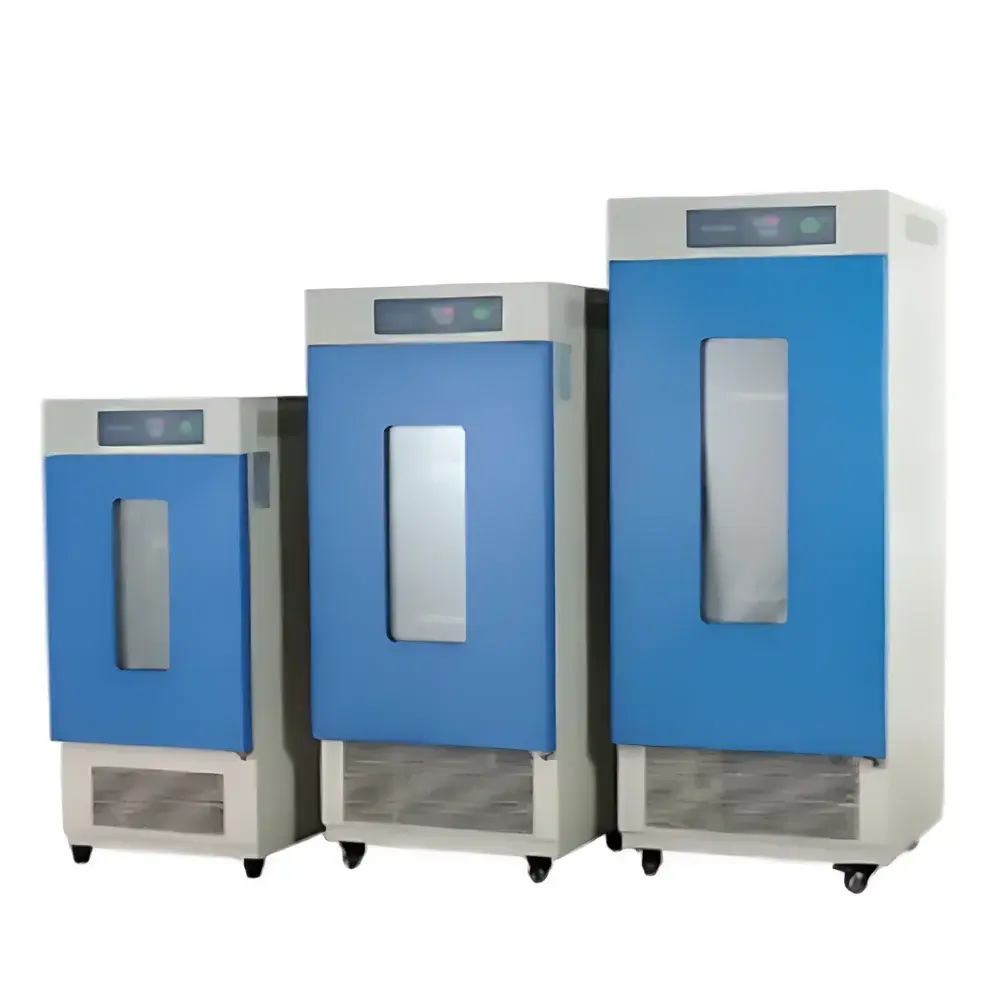
Shanghai Yiheng LRH-150 Biochemical Incubator
| Brand | Shanghai Yiheng |
|---|---|
| Origin | Shanghai, China |
| Model | LRH-150 |
| Heating Method | Air-jacketed |
| Cooling Method | Compressor-based refrigeration |
| Air Circulation | Natural convection |
| Temperature Range | 0–60 °C |
| Temperature Accuracy | ±1.5 °C (at 25 °C reference point) |
| Temperature Fluctuation | ±0.5 °C (high-temp range), ±1.0 °C (low-temp range) |
| Temperature Uniformity | ±1.5 °C (at 25 °C reference point) |
| Interior Dimensions | 400 × 350 × 500 mm (W × D × H) |
| Exterior Dimensions | 530 × 560 × 1080 mm (W × D × H) |
| Standard Shelf Quantity | 2 adjustable stainless-steel shelves |
| Timer Range | 0–9999 minutes |
| Temperature Resolution | 0.1 °C |
| Power Supply | AC 220 V, 50 Hz |
| Rated Power Input | 450 W |
| Operating Ambient Temperature | +5 to +30 °C |
| Compliance | Designed and manufactured in accordance with GB/T 23794–2009 (Chinese National Standard for Biochemical Incubators) |
Overview
The Shanghai Yiheng LRH-150 Biochemical Incubator is a precision-engineered, air-jacketed temperature-controlled chamber designed for stable, long-term cultivation of microorganisms, cell lines, enzymatic assays, and biochemical reaction monitoring under non-humidified conditions. Unlike forced-air or fan-assisted incubators, the LRH-150 employs natural convection to maintain thermal homogeneity—minimizing mechanical stress on sensitive biological samples while eliminating airflow-induced desiccation risks. Its compressor-based cooling system enables reliable sub-ambient operation down to 0 °C, supporting low-temperature fermentation studies, psychrophilic organism growth, and cold-chain validation protocols. The unit is constructed with a high-grade stainless-steel interior and insulated double-wall housing, delivering consistent thermal performance across its full 0–60 °C operating range. Calibration traceability follows internal quality control procedures aligned with ISO/IEC 17025 principles, and the device is intended for use in academic research laboratories, QC environments, and GLP-compliant facilities where reproducible, non-humidified thermal conditioning is required.
Key Features
- Air-jacketed heating architecture ensures rapid thermal response and reduced overshoot during setpoint transitions
- Compressor-driven refrigeration system provides precise sub-ambient control without reliance on Peltier elements or external coolant loops
- Natural convection design eliminates fan-induced vibration and laminar disturbance—critical for suspension cultures and agar-based colony development
- Digital PID controller with 0.1 °C resolution and real-time display supports fine-grained process parameter definition
- Two adjustable, load-rated stainless-steel shelves (standard configuration) accommodate standard petri dishes, flasks, and multi-well plates
- Programmable timer (0–9999 min) enables unattended operation for timed incubation cycles, including overnight and weekend runs
- Robust thermal insulation and sealed door gasket minimize ambient interference and energy consumption (rated input: 450 W)
Sample Compatibility & Compliance
The LRH-150 accommodates common life science sample formats—including 90 mm and 150 mm Petri dishes, 250 mL and 1 L Erlenmeyer flasks, T-25/T-75 tissue culture flasks (without CO₂ requirement), and enzyme assay cuvettes—within its 70 L usable volume (400 × 350 × 500 mm interior). It is not designed for humidification, making it suitable for applications where moisture accumulation may compromise sterility or promote condensation-related contamination. While not certified to IEC 61010-1 or UL 61010B out-of-the-box, the unit conforms to GB/T 23794–2009, the People’s Republic of China national standard governing performance, safety, and testing methods for biochemical incubators. Users deploying this instrument in regulated environments should perform IQ/OQ validation per their internal SOPs and document calibration against NIST-traceable references.
Software & Data Management
The LRH-150 operates via an integrated digital control panel with no embedded software stack or network interface. All operational parameters—including setpoint, actual chamber temperature, elapsed time, and timer status—are displayed locally on a high-contrast LED screen. Data logging requires external recording via calibrated thermistor probes connected to standalone data acquisition systems (e.g., Omega OM-DAQ, Testo 176 T4). For auditability, users are advised to maintain manual logbooks or electronic records compliant with 21 CFR Part 11 requirements when used in GMP/QSR contexts. Firmware updates are not supported; hardware-level calibration adjustments must be performed by authorized service personnel using factory-specified reference standards.
Applications
- Bacterial and fungal cultivation under defined thermal regimes (e.g., E. coli at 37 °C, Aspergillus niger at 28 °C)
- Enzyme kinetics studies requiring stable temperature maintenance over extended durations (e.g., amylase, protease, phosphatase assays)
- Seed germination screening and plant tissue culture pre-incubation (non-photoperiodic)
- Quality control testing of pharmaceutical excipients and raw materials per USP & EP thermal stability guidelines
- Environmental simulation for biodegradation rate assessment of polymers and surfactants
- Pre-incubation of ELISA plates and lateral flow assay components prior to detection steps
FAQ
Is the LRH-150 suitable for mammalian cell culture?
No—it lacks CO₂ regulation, humidity control, and HEPA filtration; therefore, it is not appropriate for adherent or suspension mammalian cell work.
Can the temperature uniformity specification be verified independently?
Yes—users may perform mapping per ISO 14644-3 or ASTM E2297 using a minimum of nine calibrated thermistors distributed across the working volume.
Does the unit support external data export or RS-232 connectivity?
No—there is no communication port or analog output; all monitoring must be conducted externally.
What is the recommended calibration frequency for routine laboratory use?
Annual calibration is advised; more frequent verification (e.g., quarterly) is recommended if used in GLP/GMP workflows or following equipment relocation.
Are replacement shelves or custom interior configurations available?
Shelves are standardized stainless-steel units; third-party accessories compatible with 400 × 350 mm footprint may be sourced separately, though Yiheng does not supply OEM variants beyond the included pair.





