
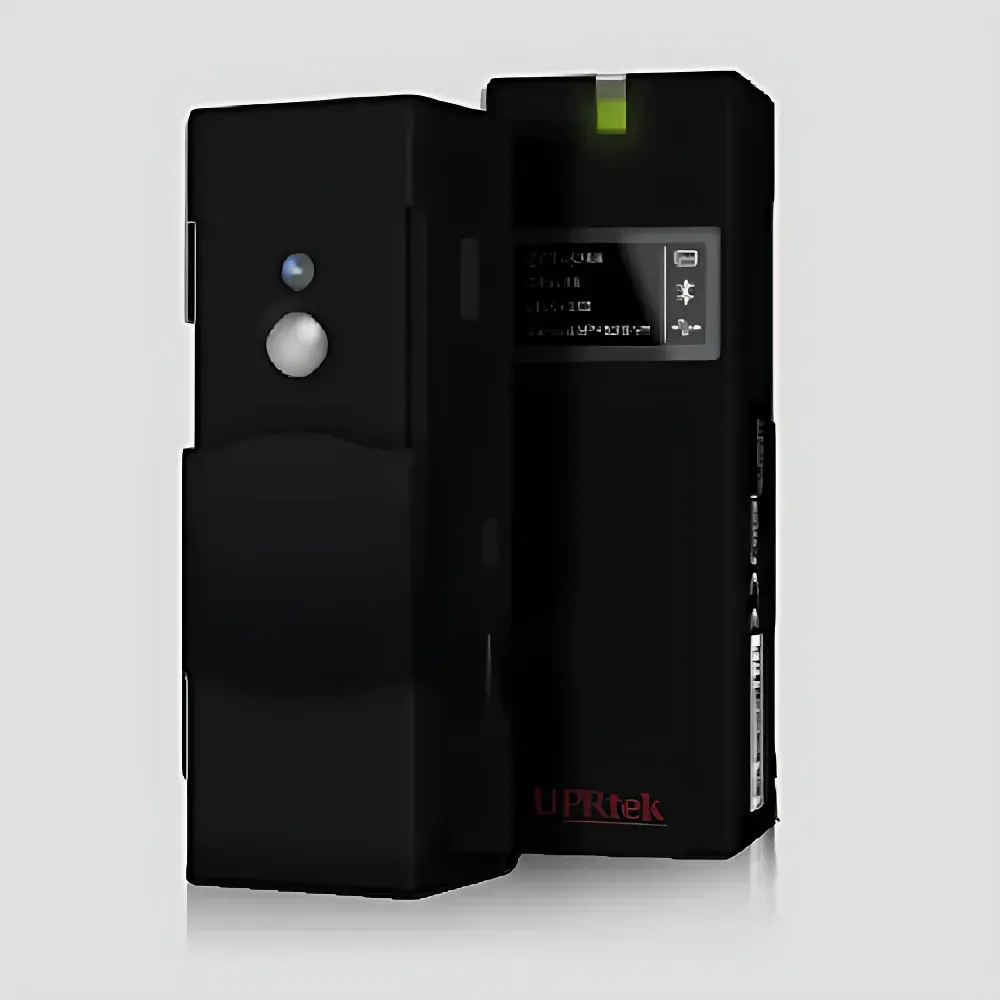
UPRTek MK350D Handheld Spectroradiometer and Illuminance Meter
| Origin | Taiwan |
|---|---|
| Manufacturer Type | Authorized Distributor |
| Domestic Product Classification | Yes |
| Model | MK350D |
| Pricing | Available Upon Request |
| Instrument Type | Silicon CMOS Linear Array Spectrometer (Not Selenium Cell) |
| Spectral Bandwidth (FWHM) | ~12 nm |
| Spectral Range | 380–780 nm |
| Illuminance Range | 70–70,000 lx |
| Cosine Correction Aperture | Ø6.6 ± 0.1 mm |
| Wavelength Sampling Interval | 1 nm |
| Wavelength Repeatability | ±1 nm |
| CCT Accuracy | ±2% (vs. Standard Illuminant A at 2856 K) |
| CIE x,y Chromaticity Accuracy | ±0.0025 |
| Repeatability | ±0.0005 |
| CRI (R1–R15) Accuracy | ±1.5% |
| Flicker Measurement Range | 1–100%, Frequency: 10–165 Hz, Accuracy: ±5% |
| Display | 0.96" 128×64 monochrome OLED |
| Battery | 700 mAh rechargeable Li-ion, ≤3 h operation |
| Dimensions | 33 × 33 × 90 mm |
| Weight (incl. battery) | 70 ± 5 g |
| Operating Temp. | 0–35 °C |
| Storage Temp. | −10–40 °C |
| Data Storage | MicroSD (up to 2 GB, ~2000 records) |
| Connectivity | Bluetooth 3.0/4.0 (iOS/Android), Mini USB 2.0 |
| Software | uSPECTRUM PC Suite |
| Output Format | CSV/Excel-compatible |
| Resolution | 16-bit ADC |
| Stray Light Rejection | ≤−25 dB (at ±40 nm from 550 nm) |
| Measurement Modes | Single / Continuous |
| Supported Color Spaces | CIE 1931 xy, CIE 1976 u'v' |
| Metrics | CCT, CRI (R1–R15, R9), λP, Illuminance (lx, fc), Flicker %, Flicker Index, Pst, SVM |
Overview
The UPRTek MK350D is a portable, high-fidelity spectroradiometer engineered for field-deployable photometric and colorimetric analysis of LED and broadband light sources. Unlike traditional illuminance meters based on silicon photodiodes or selenium cells, the MK350D employs a linear CMOS image sensor coupled with a precision diffraction grating to perform true spectral acquisition across the visible range (380–780 nm) at 1 nm resolution. Its optical architecture incorporates a calibrated cosine-corrected input aperture (Ø6.6 ± 0.1 mm) to ensure angular response compliance with CIE S 023/E:2013 and IES LM-79-19 requirements for spatially uniform irradiance measurement. The instrument operates on fundamental principles of dispersive spectroscopy—capturing raw spectral power distribution (SPD) data, then computing photometric (illuminance, luminous flux), chromatic (CCT, CIE coordinates, CRI), and temporal metrics (flicker percentage, frequency, Pst, SVM) via embedded firmware algorithms traceable to NIST-traceable calibration standards. Designed for laboratory verification, lighting quality audits, LED manufacturing QC, and energy efficiency compliance testing, the MK350D delivers metrological-grade data without requiring benchtop instrumentation.
Key Features
- True spectral acquisition using a 16-bit linear CMOS sensor with 12 nm FWHM spectral bandwidth and ±1 nm wavelength repeatability under stable illumination
- Cosine-corrected optical input meeting CIE 13.3-1995 and ISO/CIE 19476:2014 angular response specifications
- Comprehensive photometric output: illuminance (lx, fc), correlated color temperature (CCT), dominant wavelength (λP), and peak wavelength
- Full CIE-compliant colorimetry: CIE 1931 xy and CIE 1976 u’v’ chromaticity coordinates, with accuracy of ±0.0025 in xy space and repeatability of ±0.0005
- Extended color rendering evaluation: CRI (R1–R15), special CRI (R9), and TM-30-15–derived metrics (optional via uSPECTRUM software)
- Flicker analysis compliant with IEEE 1789-2015 and ENERGY STAR V2.0: measurement of percent flicker, flicker index, Pst (short-term flicker indicator), and SVM (stroboscopic visibility measure) across 10–165 Hz
- Triple operational modes: standalone (real-time display), Bluetooth 3.0/4.0 wireless streaming (iOS/Android), and USB 2.0 tethering for synchronized data logging
- On-device storage via MicroSD card (supports up to 2 GB, ~2000 spectra) with CSV/Excel-exportable datasets compatible with third-party analysis tools
- Compact ergonomic form factor (33 × 33 × 90 mm, 70 g) optimized for handheld use in confined spaces, production lines, and site surveys
Sample Compatibility & Compliance
The MK350D is validated for quantitative characterization of solid-state lighting (SSL) sources—including white LEDs, tunable RGB systems, OLED panels, and fluorescent lamps—as well as ambient daylight and architectural lighting installations. Its spectral range (380–780 nm) covers the full photopic luminosity function (V(λ)), enabling accurate lux calculation per CIE 191:2010. Calibration is performed against NIST-traceable standard lamps (Illuminant A, 2856 K) and verified per ISO/IEC 17025–accredited procedures. The device supports GLP-compliant workflows through audit-trail-capable uSPECTRUM software, which logs operator ID, timestamp, instrument serial number, calibration certificate ID, and environmental metadata. It meets essential requirements of IEC 62471 (photobiological safety), ENERGY STAR Lamps V2.0, DLC Qualified Products List (QPL), and EU Ecodesign Regulation (EU) 2019/2020 for lighting products. While not FDA 21 CFR Part 11–certified out-of-the-box, its data export structure and software audit trail facilitate validation in regulated environments under internal SOPs.
Software & Data Management
The MK350D integrates seamlessly with uSPECTRUM PC software—a Windows-based application supporting real-time spectral visualization, comparative analysis, batch reporting, and export to CSV, Excel (.xlsx), and XML formats. The software enables advanced post-processing: spectral smoothing, SPD normalization, chromaticity vector plotting, CRI decomposition (R1–R15 contribution analysis), and flicker waveform reconstruction. All measurements include embedded metadata (exposure time, integration settings, sensor temperature, calibration date). Data files are digitally signed and timestamped, supporting traceability in ISO 9001 or ISO/IEC 17025 quality management systems. Firmware updates are delivered via secure HTTPS download and installed through USB or MicroSD, preserving calibration integrity through checksum-verified binaries. No cloud dependency or vendor lock-in is required—raw spectral data remains fully accessible and interoperable with MATLAB, Python (NumPy/Pandas), or LabVIEW environments.
Applications
- LED product development: SPD validation, binning consistency checks, thermal drift monitoring during burn-in tests
- Lighting design verification: on-site illuminance mapping, CCT uniformity assessment across luminaire arrays, glare analysis support
- Manufacturing QA/QC: incoming material inspection of LED modules, outgoing test reports for customer documentation (per IES LM-79 or EN 13032-4)
- Energy efficiency auditing: compliance verification against Title 24, ASHRAE 90.1, or LEED v4.1 lighting power density (LPD) thresholds
- Human-centric lighting (HCL) validation: circadian stimulus (CS) calculation, melanopic EDI estimation using CIE S 026:2018 spectral weighting functions
- Academic research: spectral characterization of novel phosphors, OLED degradation studies, daylight harvesting system performance evaluation
- Regulatory testing: flicker compliance for medical devices (IEC 60601-2-57), educational lighting (IES RP-27.2), and entertainment lighting (ETC DMX512-A Annex D)
FAQ
Is the MK350D calibrated to NIST-traceable standards?
Yes. Each unit ships with a factory calibration certificate referencing NIST-traceable standard lamps (Illuminant A) and includes spectral responsivity correction data stored in onboard memory.
Does the MK350D meet IES LM-79-19 requirements for total luminous flux measurement?
No—it is a directional spectroradiometer, not an integrating sphere system. It measures illuminance and SPD at a point; total flux requires goniophotometric or sphere-based methods.
Can the MK350D measure UV or IR radiation?
No. Its spectral response is limited to 380–780 nm and does not extend into ultraviolet (780 nm) bands.
What is the recommended recalibration interval?
UPRTek recommends annual recalibration under normal usage conditions, or after any mechanical shock, extreme thermal exposure, or suspected optical contamination.
Is Bluetooth connectivity compatible with Android tablets running Android 12+?
Yes—firmware v3.2.1 and later support Bluetooth 4.0 LE profiles on Android 9.0 and above, including background scanning and persistent connection handling.
Can uSPECTRUM software generate PDF reports compliant with ISO/IEC 17025?
The software exports all raw and processed data in open formats; final report generation and signature integration must be implemented via your organization’s accredited QMS platform.





