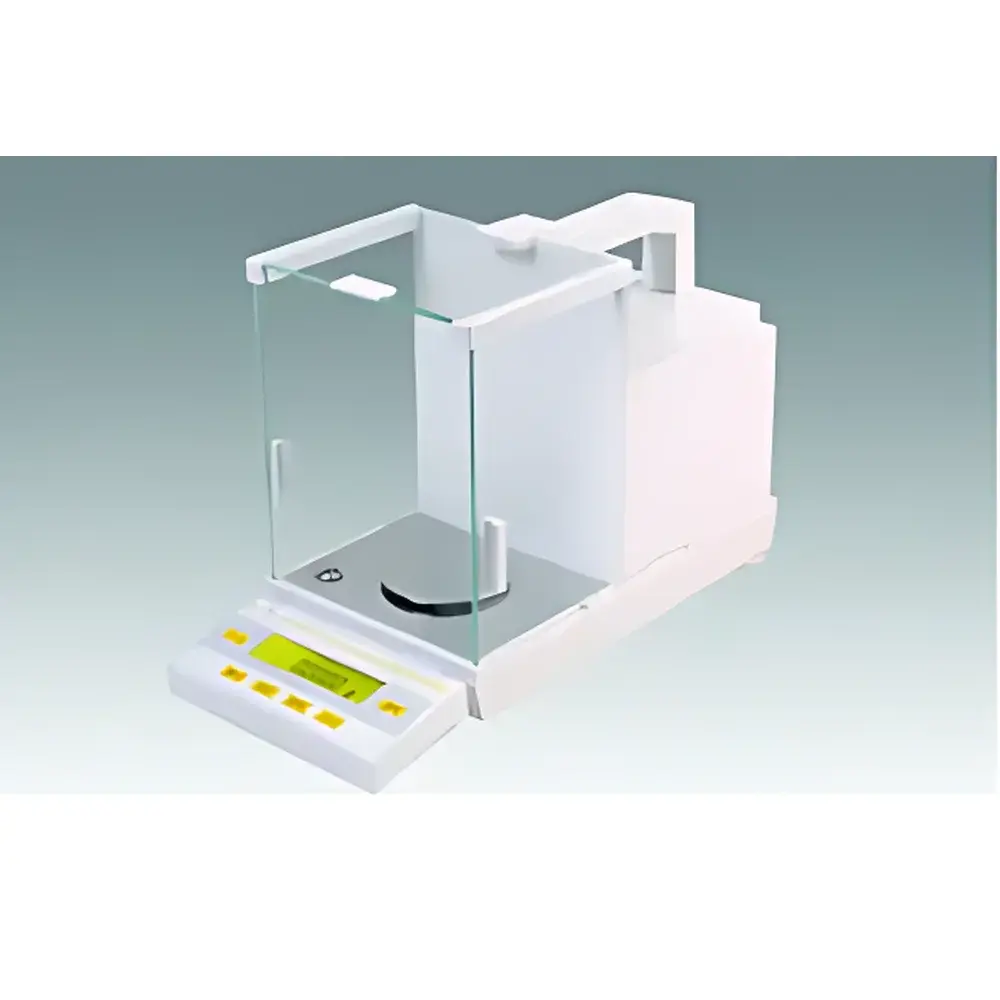
FA Series Precision Analytical Balance
| Key | Origin: Beijing, China |
|---|---|
| Manufacturer Type | Authorized Distributor |
| Product Origin | Domestic (PRC) |
| Model | FA Series |
| Price Range | USD 420–560 (FOB) |
| Instrument Type | Analytical Balance |
| Maximum Capacity | 200 g |
| Readability | 0.1 mg |
| Repeatability | ±0.1 mg |
| Linearity Error | ±0.2 mg |
| Pan Diameter | Ø90 mm |
| Draft Shield Dimensions | 190 × 155 × 235 mm (W×D×H) |
| Overall Dimensions | 200 × 440 × 290 mm (W×D×H) |
| Interface | RS-232 |
| Environmental Compensation | Dynamic Temperature Compensation |
| Calibration | Internal Auto-Calibration (motor-driven) |
| Protection | Overload Alarm & Mechanical Overload Protection |
| Weighing Modes | Counting, Percentage Weighing, Unit Conversion (g, oz, ct, etc.) |
Overview
The FA Series Precision Analytical Balance is an entry-level yet rigorously engineered analytical balance designed for routine laboratory weighing tasks requiring high repeatability and traceable metrological performance. Based on electromagnetic force compensation (EMFC) technology, it delivers stable, drift-resistant measurements under standard ambient conditions (20 ± 5 °C, RH < 80 %, non-condensing). The rear-mounted EMFC sensor ensures minimal thermal interference from operator proximity and enables rapid stabilization—typically ≤3 seconds to final reading at full capacity. Engineered for ISO/IEC 17025-compliant environments, the FA Series meets the essential metrological requirements of general QC labs, academic teaching laboratories, and pharmaceutical R&D support workflows where Class II or III weighing applications are common (per USP and OIML R 76).
Key Features
- Rear-mounted electromagnetic force compensation (EMFC) transducer with integrated temperature compensation circuitry, minimizing thermal drift and enhancing long-term stability.
- High-contrast backlit LCD display with adjustable brightness; intuitive menu navigation via tactile keypad with dedicated function keys (TARE, UNIT, COUNT, CAL).
- Four-stage shock absorption system mitigates mechanical vibration impact from bench surfaces—critical in shared lab spaces or near centrifuges and HVAC units.
- Adjustable weighing speed setting (Fast/Medium/Slow) allows optimization for volatile samples or draft-sensitive operations.
- Dynamic temperature compensation algorithm continuously adjusts zero and sensitivity based on internal thermal gradient monitoring—no manual recalibration required during minor ambient fluctuations.
- Built-in RS-232 serial interface supports direct data export to LIMS, Excel, or custom QA databases; compatible with standard ASCII protocol (9600 baud, 8N1).
- Full-capacity tare function, auto-zero tracking (adjustable threshold), and automatic fault diagnostics—including sensor saturation, draft shield open detection, and calibration error logging.
- Integrated below-balance hook enables density determination, magnetic susceptibility measurement, and buoyancy-corrected weighing per ASTM E1154 and ISO 8655-6.
Sample Compatibility & Compliance
The FA Series accommodates standard laboratory vessels including weighing boats, crucibles, volumetric flasks (up to 100 mL), and small reaction vials. Its Ø90 mm stainless-steel pan and fully enclosed draft shield (190 × 155 × 235 mm) provide reliable containment for low-mass powders, hygroscopic compounds, and fine particulates. The balance conforms to OIML R 76-1 (2006) Class II accuracy requirements and satisfies the minimum performance criteria outlined in ISO 9001:2015 clause 7.1.5 for monitoring and measuring resources. While not certified for GLP/GMP production environments without additional validation, it supports audit-ready documentation when used with validated SOPs and periodic external verification per ISO/IEC 17025 Annex A.3.
Software & Data Management
No proprietary software is bundled; however, the RS-232 interface supports seamless integration with third-party data acquisition platforms compliant with FDA 21 CFR Part 11 (when paired with appropriate audit-trail-enabled middleware). Raw weighing data output includes timestamp (if host system provides), net weight, unit code, and status flags (e.g., “STABLE”, “OVERLOAD”). Optional PC-based utilities—such as BalanceLink™ or LabX Lite—enable automated report generation, statistical process control (SPC) charting, and electronic signature capture for regulated workflows. All internal calibration events are logged with date/time stamps and deviation values, accessible via service mode for internal QA review.
Applications
- Preparation of standard solutions and reference materials in environmental testing labs (EPA Method 502.2, ISO 11843).
- Weighing active pharmaceutical ingredients (APIs) during formulation development and stability study sample preparation (ICH Q5C).
- Gravimetric analysis of ash content, moisture loss on drying (LOD), and residue on ignition (ROI) per USP .
- Counting small components (e.g., tablets, microbeads, SMD resistors) using built-in piece-counting mode with user-defined sample weight averaging.
- Educational use in undergraduate chemistry and materials science labs for stoichiometric calculations and density experiments.
- Supporting ISO/IEC 17025 internal audits through documented calibration history and repeatability verification records.
FAQ
What is the recommended calibration frequency for the FA Series in a regulated environment?
For ISO/IEC 17025 or GxP-aligned use, perform daily zero verification and full internal calibration before first use and after significant ambient shifts. External calibration with traceable weights (Class E2 or better) is advised weekly or per risk-based assessment.
Does the FA Series support GLP-compliant electronic records?
Yes—when connected to validated data capture software that enforces 21 CFR Part 11 controls (audit trail, electronic signatures, role-based access), raw RS-232 output can form part of a compliant record.
Can the draft shield be removed for oversized samples?
No—the shield is integral to metrological integrity; removal invalidates calibration and repeatability specifications. For larger items, consider a precision top-loading balance with comparable readability.
Is the internal calibration motor self-diagnosing?
Yes—the system performs real-time motor position verification and reports anomalies (e.g., jammed drive gear, encoder fault) via error code display and RS-232 status packet.
What environmental conditions must be maintained for optimal performance?
Operate within 15–30 °C ambient temperature, ≤75% non-condensing relative humidity, and on a vibration-isolated, level surface free from air currents and electromagnetic fields (>30 cm from monitors or motors).