
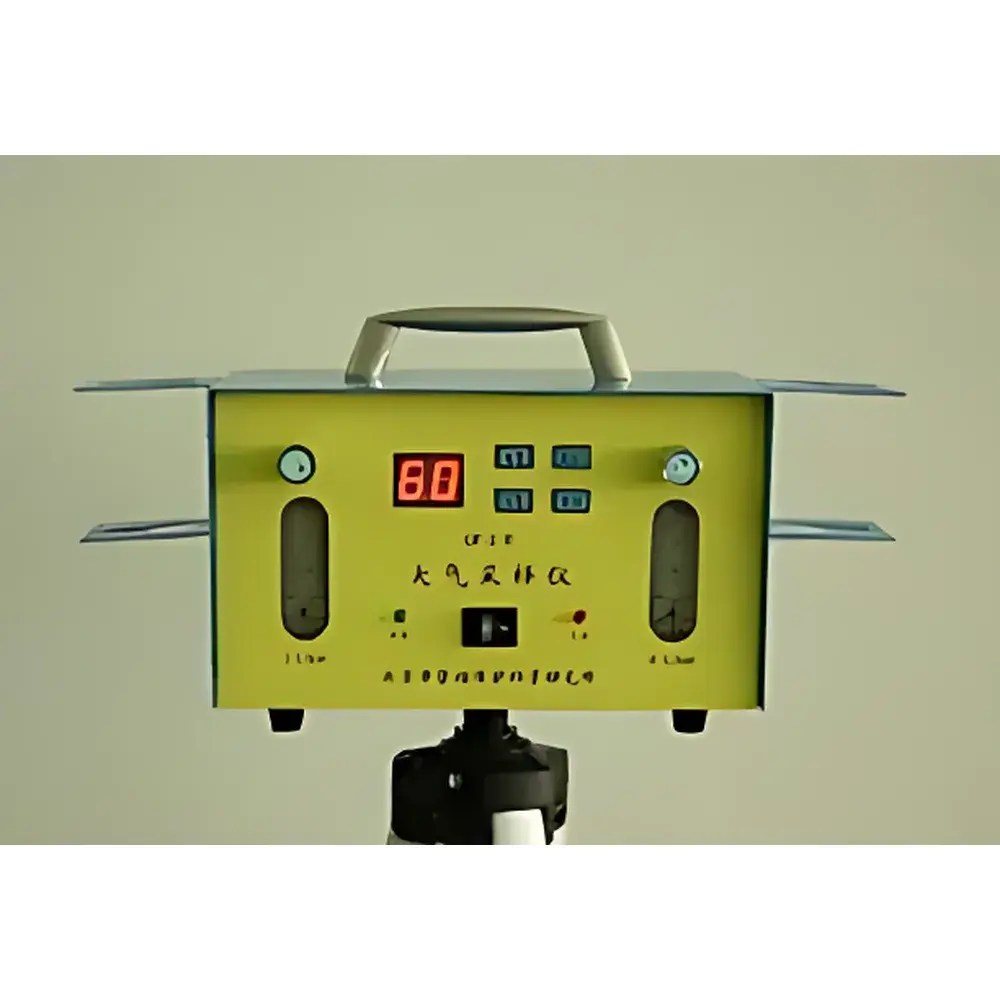
QC-2/QC-2A Dual-Channel Ambient Air Sampler
| Origin | Beijing, China |
|---|---|
| Manufacturer Type | Authorized Distributor |
| Origin Category | Domestic (PRC) |
| Model | QC-2 / QC-2A |
| Price Range | USD 140–700 |
| Instrument Type | Conventional Gas Sampler |
| Configuration | Dual-Channel Portable Sampler |
| Flow Rate Range | 0.1–1.5 L/min |
| Maximum Vacuum Pressure | >26 kPa |
| Flow Stability | ≤5% fluctuation (under load) |
| Flowmeter Accuracy | Class 2.5 (per GB/T 1226–2017 / equivalent to ISO 5167 Class 2.5) |
| Service Life (at max flow & resistance) | 5–10 years |
| Continuous Operation Duration (at max flow & 4.5 kPa backpressure) | 2–8 h |
| Timer Range | 1–99 min, timing error <0.1% |
| Power Supply | AC/DC dual-mode |
| Dimensions | 210 × 125 × 95 mm |
| Weight | 2.9 kg |
| Pump Type | Diaphragm vacuum pump (QC-2A variant features high-torque diaphragm pump optimized for VOC sampling with elevated backpressure tolerance) |
Overview
The QC-2 and QC-2A Dual-Channel Ambient Air Samplers are precision-engineered portable instruments designed for time-integrated collection of gaseous environmental samples in field-based air quality monitoring, occupational hygiene assessment, and regulatory compliance programs. These samplers operate on the principle of constant-flow volumetric aspiration, utilizing two independent, simultaneously controllable sampling channels—each equipped with a calibrated rotameter and electromechanical timer—to enable parallel collection of discrete samples (e.g., target analyte vs. blank, or multiple compounds requiring different sorbent tubes). The core pumping mechanism employs a brushless DC-driven diaphragm pump, engineered for high vacuum generation (>26 kPa), stable volumetric delivery across variable system resistance (up to 4.5 kPa at ≥1.0 L/min), and low acoustic emission (<55 dB(A)), ensuring reliable performance in both indoor and outdoor deployment scenarios.
Key Features
- Dual independent sampling channels with fully adjustable, synchronized or asynchronous timing (1–99 min per channel, timing accuracy <0.1%)
- High-stability diaphragm pump architecture—standard QC-2 model delivers robust flow control under moderate resistance; QC-2A variant integrates an enhanced-torque pump specifically validated for volatile organic compound (VOC) sampling using thermal desorption tubes or multi-sorbent cartridges under elevated backpressure conditions
- Class 2.5 precision flowmeters (conforming to GB/T 1226–2017, aligned with ISO 5167 metrological traceability requirements) with linear 0.1–1.5 L/min range and ≤5% flow deviation over full operating load spectrum
- Integrated AC/DC power management: operates from 100–240 VAC 50/60 Hz mains or internal rechargeable Ni-MH battery pack (≥6 h runtime at 1.0 L/min, 4.5 kPa)
- Compact ergonomic housing (210 × 125 × 95 mm), IP54-rated enclosure, and lightweight aluminum-magnesium alloy chassis (2.9 kg) optimized for handheld use or tripod-mounted stability (included rugged aluminum tripod)
- Real-time low-voltage warning circuitry with LED indicator and automatic shutdown to protect battery integrity and ensure data continuity
Sample Compatibility & Compliance
The QC-2/QC-2A is compatible with standard 37-mm and 47-mm filter cassettes, stainless steel or glass sorbent tubes (e.g., Tenax TA, Carbopack B/C, silica gel), and impingers for formaldehyde or sulfur dioxide analysis. Its dual-channel design supports co-sampling protocols required by EPA Method TO-17 (VOCs), NIOSH Methods 1501/1600 (organic vapors), and ISO 16000-6 (indoor air VOC measurement). While the instrument itself does not carry CE, UKCA, or UL certification, its electrical safety and electromagnetic compatibility align with IEC 61010-1:2010 (Measurement, Control and Laboratory Equipment) standards. Data logging capability is not embedded; however, manual timer records satisfy GLP documentation requirements when paired with chain-of-custody forms and calibrated flow verification logs prior to and after each sampling event.
Software & Data Management
The QC-2/QC-2A is a hardware-only, non-networked sampling platform with no onboard microprocessor, USB interface, or proprietary software dependency. All operational parameters—including start/stop time, flow rate setting, and channel activation—are configured manually via tactile push-button controls and analog flowmeter readouts. This architecture eliminates firmware vulnerabilities, ensures long-term calibration stability, and simplifies audit readiness: users maintain traceable records through paper-based sampling logs, pre- and post-calibration certificates (using primary-standard dry calibrators such as Bios International Defender or Mesa Labs Gilian Gilibrator), and documented flow verification procedures compliant with ISO/IEC 17025–accredited laboratory practices.
Applications
- Ambient air monitoring networks (PM2.5/PM10 precursor gas fractionation, ozone precursor speciation)
- Workplace exposure assessment per OSHA 29 CFR 1910.1200 and EU Directive 2004/37/EC (carcinogens/mutagens)
- Indoor air quality surveys targeting formaldehyde, benzene, toluene, xylene (BTX), and other priority VOCs
- Stack emission screening support (when coupled with inert sampling trains and adsorbent media)
- Educational and research field campaigns requiring cost-effective, dual-stream sample acquisition under resource-constrained conditions
FAQ
Is the QC-2A suitable for EPA TO-17-compliant sampling?
Yes—the QC-2A’s reinforced diaphragm pump maintains ≥1.0 L/min flow against 4.5 kPa resistance, meeting the minimum performance threshold specified in Section 6.2 of EPA Method TO-17 for thermal desorption tube sampling.
Can I use rechargeable lithium-ion batteries instead of the supplied Ni-MH pack?
No—only the original equipment manufacturer (OEM)-specified Ni-MH battery module is electrically and thermally validated for safe integration with the built-in charge management and low-voltage cutoff circuitry.
Does the instrument include NIST-traceable calibration documentation?
The unit ships with a factory verification report (flow accuracy ±2.5% at three points: 0.2, 0.5, and 1.2 L/min); end-user laboratories must perform periodic recalibration using a NIST-traceable primary standard per ISO/IEC 17025 requirements.
What maintenance intervals are recommended for sustained accuracy?
Diaphragm pump inspection and flowmeter cleaning are advised every 500 operating hours or annually—whichever occurs first—using isopropyl alcohol and lint-free swabs; replacement diaphragms and valves are available as service kits (Part No. QC-PUMP-KIT-01).







