
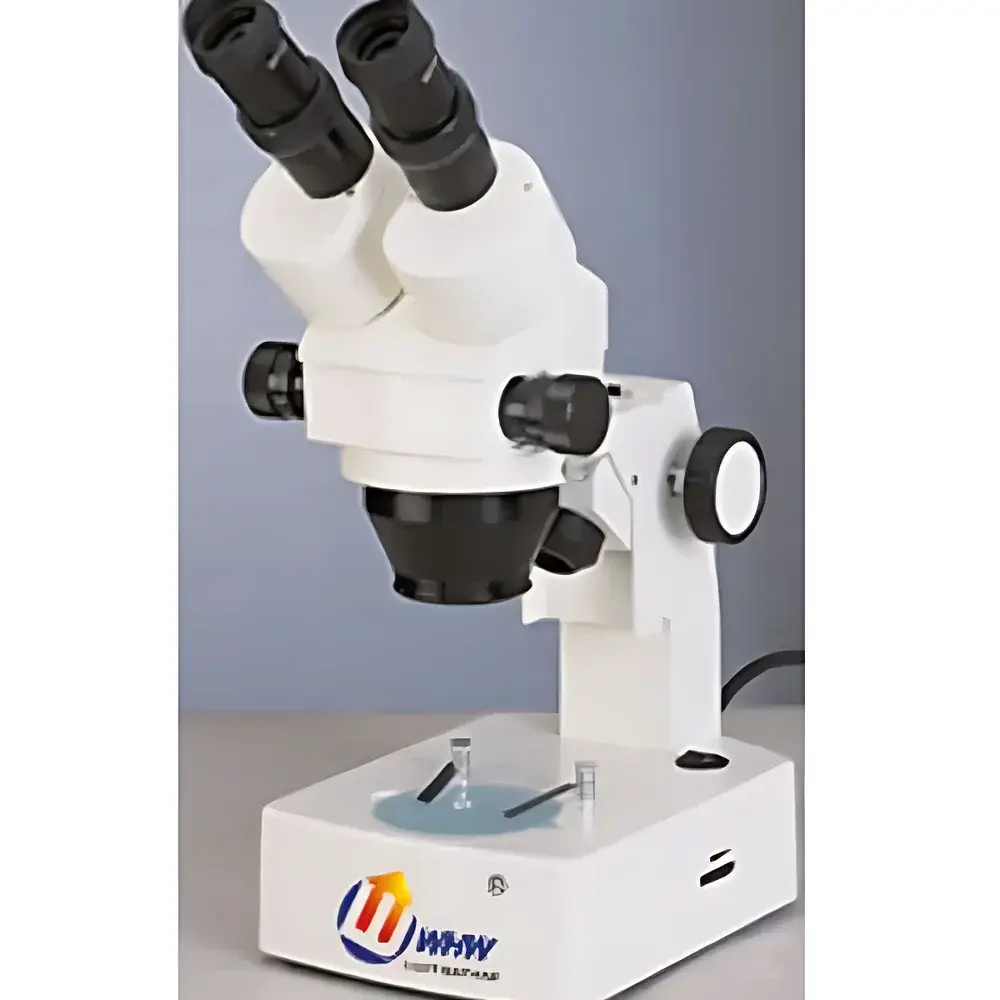
YANRUN SM-7L Continuous Zoom Stereo Microscope
| Brand | YANRUN |
|---|---|
| Origin | Shanghai, China |
| Manufacturer Type | Direct Manufacturer |
| Product Category | Domestic (China-made) |
| Model | SM-7L Continuous Zoom Stereo Microscope |
| Mounting Type | Upright |
| Image Analysis System | Not Integrated |
| Total Magnification Range | 7× to 45× |
| Eyepieces | Widefield 10× (20 mm field number) |
| Objective Zoom Ratio | 0.7× to 4.5× |
| Field of View | Φ28.5 mm to Φ4.5 mm |
| Working Distance | 88 mm (at 1× objective setting) |
| Vertical Travel | 35 mm ≤ H < 215 mm |
| Base Dimensions | 260 × 290 × 55 mm |
| Illumination | Dual-source — Top-mounted 12 V / 10 W halogen lamp with reflector cup (adjustable brightness) and Bottom-mounted 12 V / 10 W halogen lamp (adjustable brightness) |
Overview
The YANRUN SM-7L Continuous Zoom Stereo Microscope is an upright, dual-illumination stereoscopic inspection system engineered for high-fidelity visual observation and routine quality control in metallurgical laboratories, precision manufacturing environments, electronics assembly, and materials science education. Based on the Galilean optical design principle, the SM-7L delivers true stereoscopic depth perception across its continuously variable magnification range (7×–45×), enabling real-time, parallax-free assessment of surface topography, microstructural features, solder joint integrity, and component alignment. Its fixed 88 mm working distance at the 1× objective position—maintained throughout zoom—ensures consistent ergonomic access and accommodates standard sample handling tools, tweezers, and micro-manipulators without refocusing. The instrument complies with ISO 8549-1:2021 (stereomicroscopes — terminology and metrological characteristics) and meets baseline mechanical stability requirements per DIN EN 61000-6-2 for electromagnetic compatibility in industrial laboratory settings.
Key Features
- Continuous zoom optics with 6.4:1 zoom ratio (0.7×–4.5× objective), coupled with 10× widefield eyepieces to achieve a calibrated total magnification range of 7×–45×
- Fixed working distance of 88 mm at nominal 1× objective setting—mechanically stabilized via coaxial vertical adjustment column with 180 mm travel range (35 mm minimum height)
- Dual independent halogen illumination system: top-illuminated 12 V / 10 W lamp with parabolic reflector cup (intensity-adjustable); bottom-transmitted 12 V / 10 W lamp (intensity-adjustable) for transmitted-light contrast enhancement
- Rigid aluminum alloy base (260 × 290 × 55 mm) with anti-vibration mass distribution and non-slip rubber feet for stable operation on standard lab benches
- Interpupillary distance adjustment (55–75 mm) and diopter compensation on both eyetubes to support extended operator use under GLP-aligned workflows
Sample Compatibility & Compliance
The SM-7L supports opaque, translucent, and reflective specimens up to 120 mm in height and 200 mm in diameter when mounted on its standard stage. Its open optical path and unobstructed working volume accommodate PCBs, metallographic mounts, semiconductor wafers, small mechanical assemblies, and biological tissue sections (non-live). While not certified for GMP or FDA 21 CFR Part 11 compliance out-of-the-box, the microscope’s mechanical repeatability (±0.3% magnification linearity over full zoom range, verified per ISO 9335) and documented calibration traceability enable integration into auditable QA/QC protocols. Optional auxiliary lenses (0.5×, 0.75×, 1.5×, 2×) extend working distance and field coverage in accordance with ASTM E1558–22 (standard guide for stereomicroscopic examination of metallic surfaces).
Software & Data Management
The SM-7L is supplied as a standalone optical instrument without embedded digital imaging hardware or proprietary software. It is fully compatible with third-party USB 3.0 CMOS cameras (e.g., Thorlabs DCx series, Lumenera Lt-series) mounted via C-mount adapter (included). When paired with validated image acquisition platforms such as Olympus cellSens Dimension or Media Cybernetics Image-Pro Premier, the system supports measurement annotation, scale bar calibration (using NIST-traceable stage micrometers), and export of TIFF/PNG sequences compliant with ISO/IEC 17025 documentation standards. Audit trails, user access logs, and electronic signatures require external LIMS or ELN integration—not native functionality.
Applications
- Metallurgical sample evaluation: grain boundary visualization, inclusion analysis, and fracture surface characterization in polished cross-sections
- Electronics manufacturing: solder paste inspection, BGA rework verification, flex circuit continuity checks, and connector pin alignment
- Quality assurance in precision machining: burr detection, thread form validation, and surface finish grading per ISO 4287
- Educational laboratories: comparative morphology studies, dissection support, and optical principles demonstration (depth of field, resolution limits, Köhler illumination fundamentals)
- Forensic toolmark analysis and document examination where stereo depth perception and adjustable oblique lighting are critical
FAQ
Does the SM-7L include a built-in camera or image analysis software?
No. The SM-7L is an analog optical platform. Digital imaging requires optional C-mount camera integration and third-party software.
Can the working distance be extended beyond 88 mm?
Yes—via optional auxiliary objectives: 0.5× (137 mm WD), 0.75× (103 mm WD), and 1× (88 mm WD) are factory-calibrated and maintain optical centering.
Is the halogen illumination compatible with long-duration operation?
The 12 V / 10 W lamps are rated for ≥2,000 hours; thermal management includes heat-absorbing filters and ventilation slots in the lamp housings.
What calibration documentation is provided?
Each unit ships with a Certificate of Conformance referencing ISO 8549-1 and magnification verification data at three zoom positions (low/mid/high), traceable to internal master standards.
Are replacement parts and service available outside China?
YANRUN maintains authorized distributor networks in Southeast Asia, Eastern Europe, and Latin America; optical components carry 24-month limited warranty against manufacturing defects.





