
HORIBA FluoroMax+ Research-Grade Molecular Fluorescence Spectrometer
| Brand | HORIBA |
|---|---|
| Origin | USA |
| Manufacturer Type | Authorized Distributor |
| Product Category | Imported Instrument |
| Model | FluoroMax+ |
| Dispersion Element | Holographic Grating |
| Instrument Type | Steady-State & Time-Resolved Fluorescence Spectrometer |
| Slit Width (Spectral Bandpass) | 0.05–30 nm |
| Spectral Resolution | ≤0.2 nm |
| Sensitivity (S/N Ratio) | >16,000:1 (water Raman, 5 nm bandwidth, 1 s integration, no order-sorting filters) |
| Wavelength Accuracy | ±0.5 nm |
| Excitation Sources | 150 W Ozone-Free Xenon Lamp, Flash Xenon Lamp, Pulsed Laser Options |
Overview
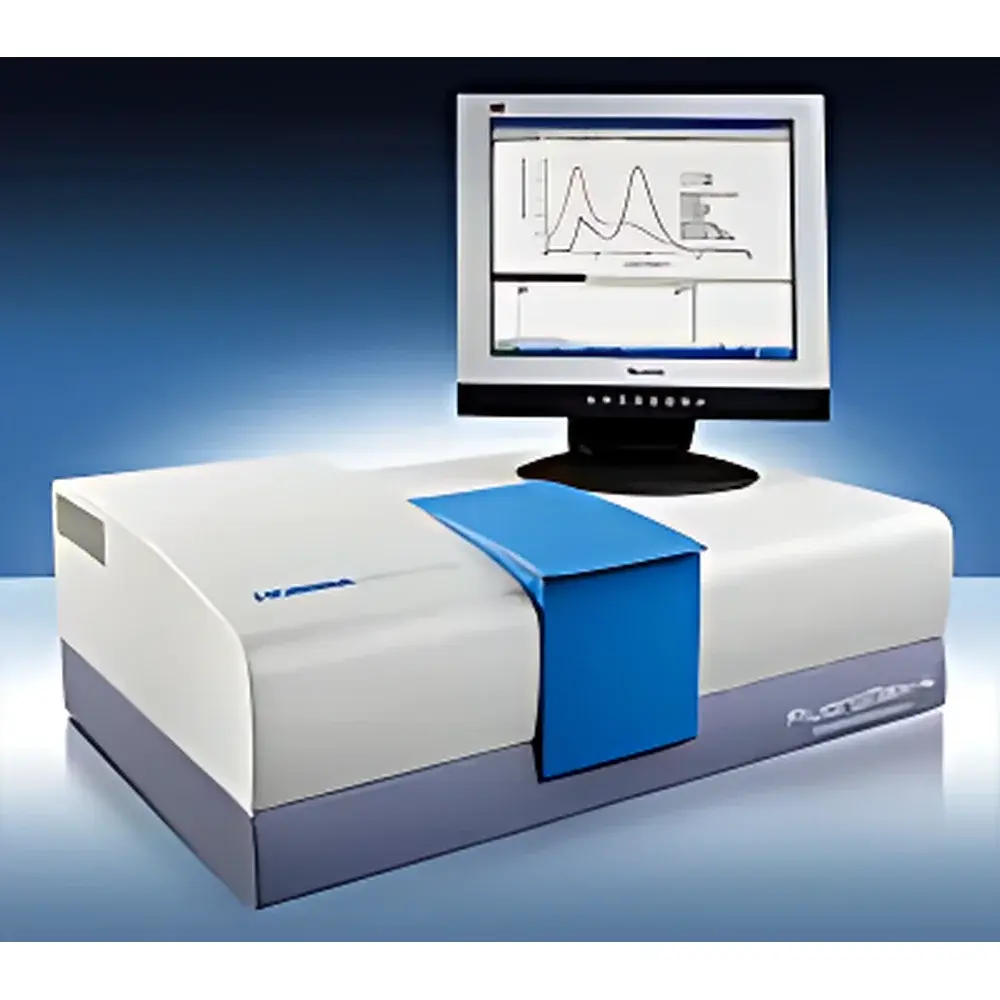
The HORIBA FluoroMax+ is a research-grade molecular fluorescence spectrometer engineered for high-fidelity steady-state and time-resolved photoluminescence characterization across academia and industrial R&D laboratories. Based on a fully reflective optical architecture—free of chromatic aberration-inducing lenses—the system delivers exceptional wavelength fidelity and signal integrity from 200 nm to 870 nm (extendable to 980 nm or 2100 nm with optional detectors). Its core measurement principle relies on photon-counting detection coupled with double monochromators (excitation and emission), enabling precise isolation of excitation and emission bands while minimizing stray light and higher-order diffraction artifacts. The instrument supports quantitative spectral correction per ASTM E1358 and ISO 17025-compliant workflows, ensuring traceable, publication-ready data. As the fifth-generation evolution of HORIBA’s compact modular spectroscopy platform—first introduced in 1989—the FluoroMax+ integrates decades of refinement in optical design, thermal stability, and electronic synchronization, making it a benchmark instrument cited extensively in high-impact journals including Nature Photonics, Journal of the American Chemical Society, and Advanced Materials.
Key Features
- Fully reflective Czerny–Turner optical path with SPEX-grade holographic gratings for zero chromatic distortion and optimal throughput across UV-Vis-NIR
- Photon-counting R928P photomultiplier tube (PMT) detector with >16,000:1 signal-to-noise ratio (measured under ASTM-defined water Raman conditions: 5 nm slit, 1 s integration, no order-sorting filters)
- Continuously adjustable slit width from 0.05 nm to 30 nm, enabling fine control over spectral resolution and radiant flux
- Wavelength accuracy ±0.5 nm (verified at three NIST-traceable reference lines) and repeatability ±0.1 nm over 24 h
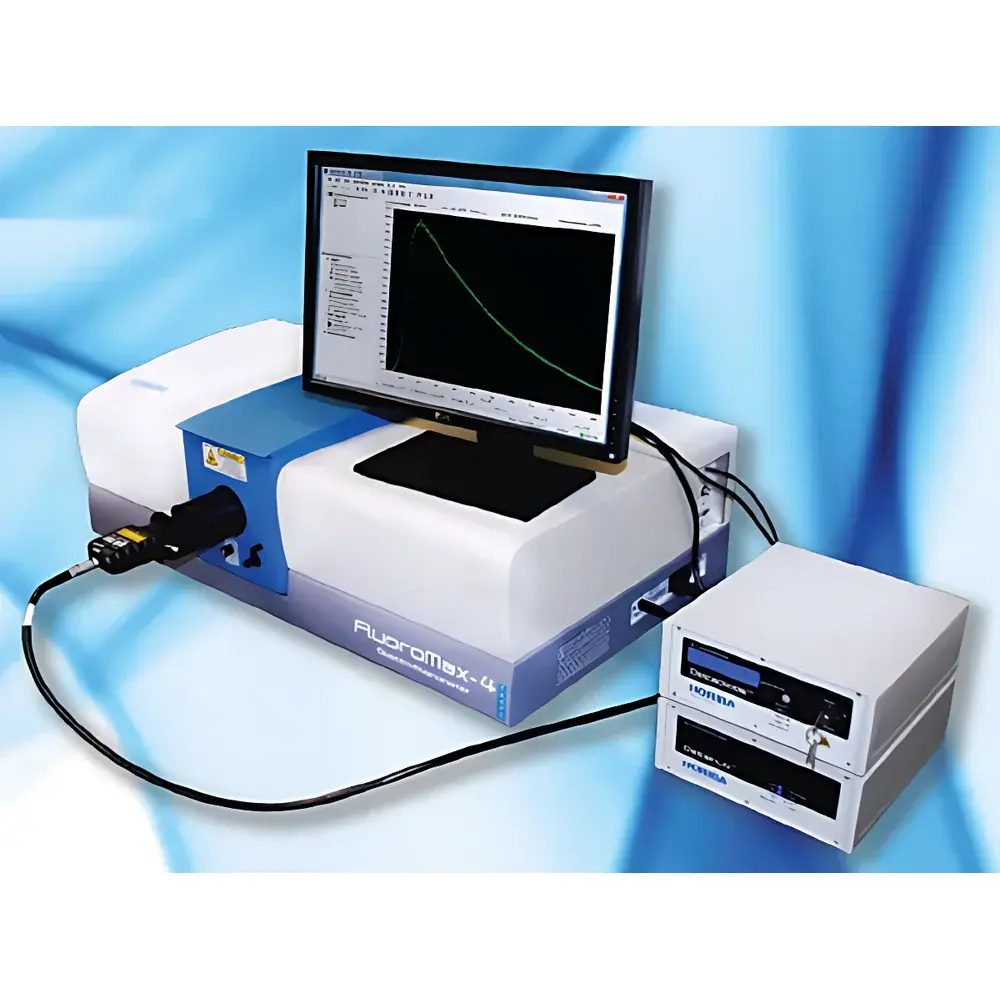
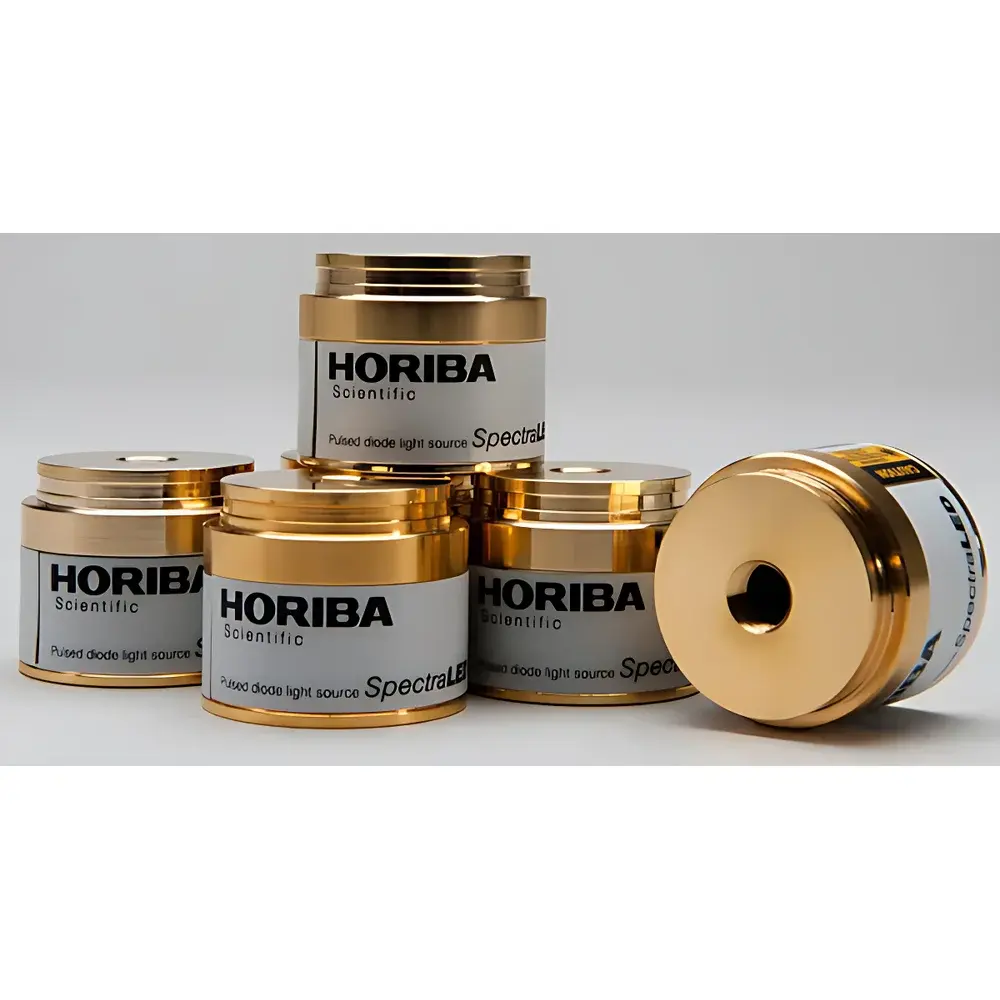
- Integrated dual-source capability: 150 W ozone-free xenon lamp (steady-state) + flash xenon or pulsed laser options (for lifetime and phosphorescence studies)
- Automated scatter rejection during 3D excitation–emission matrix (EEM) acquisition, eliminating first- and second-order Rayleigh and Raman scatter interference
- Method-based operation: test parameters saved as executable .mth files, supporting batch execution, scheduled runs, and GLP-compliant audit trails
Sample Compatibility & Compliance
The FluoroMax+ accommodates diverse sample formats—including cuvettes (standard and micro-volume), thin films, powders (via dedicated low-mass powder holders), and solid substrates—without requiring optical realignment. Its modular sample compartment accepts OEM and third-party accessories such as integrating spheres (for absolute quantum yield), temperature-controlled stages (77 K–500 K with liquid nitrogen or gas-flow cryostats), stopped-flow units, multi-well plate readers, and motorized polarizers. All factory-installed calibration files are NIST-traceable and conform to ASTM E1358 (fluorescence quantum yield) and ASTM E275 (spectral bandpass verification). Data output complies with ASTM E1421 and ISO/IEC 17025 documentation requirements, supporting FDA 21 CFR Part 11–compliant electronic records when used with validated Origin software configurations.
Software & Data Management
Controlled via HORIBA’s Origin-based acquisition interface, the FluoroMax+ provides native integration with OriginLab Pro v9.1+ for advanced curve fitting, multivariate analysis, and publication-quality graphing. The software includes built-in algorithms for spectral correction (instrument response function deconvolution), quantum yield calculation (using certified standards), lifetime decay modeling (mono-/bi-/tri-exponential, distributed lifetime analysis), and time-resolved emission spectra (TRES) reconstruction. Raw data are stored in HDF5 format with embedded metadata (wavelengths, integration times, slit settings, detector HV, lamp status), ensuring full FAIR (Findable, Accessible, Interoperable, Reusable) compliance. Audit logs record all user actions, parameter changes, and calibration events—essential for GxP environments and regulatory submissions.
Applications
- Quantitative determination of fluorescence quantum yields (including phosphorescence and thermally activated delayed fluorescence, TADF)
- Time-resolved luminescence mapping of organic semiconductors, perovskites, and lanthanide-doped nanomaterials
- Protein folding/unfolding kinetics via intrinsic tryptophan emission monitoring
- Environmental analysis of polycyclic aromatic hydrocarbons (PAHs) and dissolved organic matter (DOM) using EEM-PARAFAC decomposition
- Quality control of OLED emitters and phosphor materials under variable temperature and atmospheric conditions
- High-throughput screening of catalysts and photocatalytic systems using multi-well plate compatibility
FAQ
What is the maximum spectral range achievable with the FluoroMax+?
The base configuration covers 200–870 nm. With optional extended-range PMT (R955) and NIR-enhanced gratings, detection extends to 980 nm; with InGaAs detector upgrade, the system supports full 200–2100 nm coverage.
Can the FluoroMax+ perform absolute quantum yield measurements?
Yes—when equipped with an integrating sphere accessory and calibrated reference standards, it meets ASTM E1358 requirements for both fluorescence and phosphorescence quantum yield quantification.
Is the instrument compatible with GLP or GMP laboratory workflows?
Yes—software audit trails, electronic signatures, method locking, and calibration history tracking support compliance with 21 CFR Part 11 and ISO/IEC 17025 quality management systems.
How is stray light managed during deep-UV measurements?
The double monochromator design, combined with order-sorting filters (optional) and software-based scatter modeling, reduces stray light to <1×10⁻⁶ of incident intensity below 220 nm.
What lifetime ranges can be resolved with optional time-resolved modules?
With TCSPC electronics and pulsed laser excitation, lifetimes from 25 ps to 10 s are accessible; the standard flash-xenon module supports 150 ps–10 s, optimized for room-temperature phosphorescence and TADF studies.





