
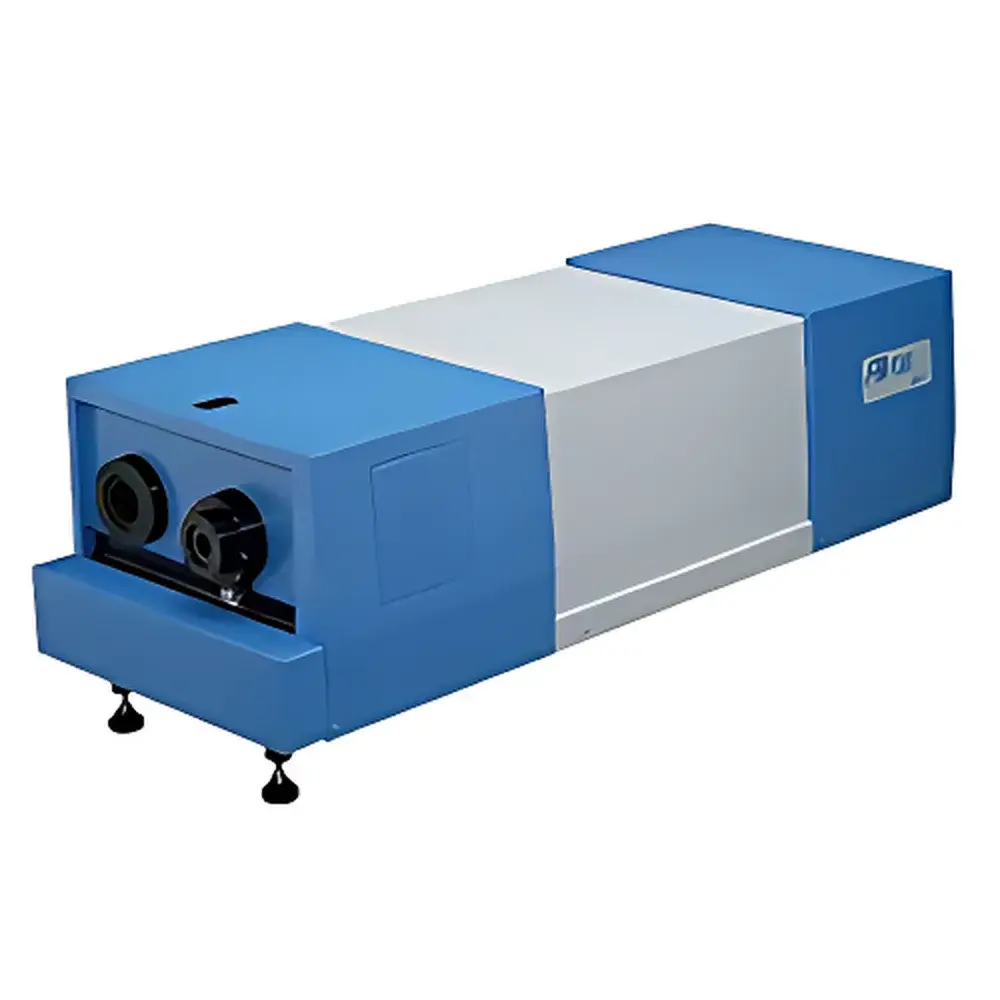
HORIBA FHR640 and FHR1000 High-Resolution Grating Spectrometers
| Brand | HORIBA |
|---|---|
| Origin | France |
| Model | FHR640 / FHR1000 |
| Focal Length | 640 mm (FHR640) / 1000 mm (FHR1000) |
| f-number | f/5.4 (FHR640) / f/9.0 (FHR1000) |
| Spectral Resolution | 0.016 nm (FHR640) / 0.010 nm (FHR1000) |
| Spectral Dispersion | 1.2 nm/mm (FHR640) / 0.8 nm/mm (FHR1000) |
| Grating Size | 110 × 110 mm (single) / 80 × 110 mm (dual) |
| Wavelength Accuracy | ±0.05 nm |
| Wavelength Repeatability | ±0.015 nm |
| Scan Speed | >300 nm/s |
| Optical Design | Monolithic cast aluminum body with in-axis grating scanning mechanism |
Overview
The HORIBA FHR640 and FHR1000 are high-performance, long-focal-length grating spectrometers engineered for demanding spectroscopic applications requiring exceptional wavelength resolution, photometric stability, and rapid spectral acquisition. Based on Czerny–Turner optical architecture with precision-machined monolithic aluminum chassis, these instruments eliminate thermally induced mechanical drift—ensuring long-term wavelength calibration integrity and signal fidelity without active recalibration. Unlike modular or bolted-frame spectrometers, the FHR series employs a single-piece cast body that minimizes differential thermal expansion across optical mounts, directly addressing a key source of spectral instability in high-resolution Raman, photoluminescence, and atomic emission measurements. The in-axis grating scanning mechanism maintains constant beam geometry during wavelength tuning, preserving throughput and resolution across the full spectral range—critical for quantitative intensity-based analysis under GLP/GMP or ISO/IEC 17025-compliant workflows.
Key Features
- Monolithic aluminum optical bench: Eliminates wavelength drift caused by thermal expansion mismatch between discrete components; enables <15 pm short-term repeatability and <50 pm absolute accuracy over 8-hour continuous operation.
- In-axis grating scanning technology: Patented rotation mechanism keeps the grating optic centered on the optical axis throughout scan motion—preserving f-number, spectral line shape, and stray-light rejection without realignment.
- Dual-grating turret compatibility: Supports up to two large-format gratings (110 × 110 mm standard; 80 × 110 mm in dual configuration), enabling seamless switching between UV-VIS and NIR dispersion regimes without manual reconfiguration.
- Simultaneous dual-output ports: Independent exit slits allow concurrent coupling to CCD/CMOS array detectors and single-channel PMTs or InGaAs modules—facilitating synchronous multi-detector acquisition for time-resolved or polarization-resolved experiments.
- Flexible mounting orientation: Instrument can be operated in standard horizontal configuration or inverted (side-flip) mode to accommodate space-constrained vacuum chambers, cryostats, or confocal microscope integration.
- Full HORIBA ecosystem compatibility: Native interface with Synapse CCDs, iHR series imaging spectrographs, LabSpec 8 software suite, and all Jobin Yvon accessories—including fiber-optic couplers, motorized filter wheels, and automated sample stages.
Sample Compatibility & Compliance
The FHR640 and FHR1000 are designed for use with solid-state, liquid, and gaseous samples across research, industrial QA/QC, and regulatory testing environments. Their high optical throughput and low stray-light design (<10−5 at 500 nm from 300 nm) support low-light applications such as micro-Raman spectroscopy of 2D materials, trace metal analysis via ICP-OES, and quantum dot photoluminescence mapping. Both models comply with CE marking requirements for electromagnetic compatibility (EMC Directive 2014/30/EU) and low-voltage safety (LVD Directive 2014/35/EU). When operated with validated LabSpec 8 software and audit-trail-enabled hardware controllers, the systems meet data integrity requirements outlined in FDA 21 CFR Part 11 and EU Annex 11 for electronic records and signatures in regulated laboratories.
Software & Data Management
Control and data acquisition are managed through HORIBA’s LabSpec 8 platform—a Windows-based application supporting instrument configuration, automated acquisition sequences, real-time spectral processing, and metadata-rich file export (SPC, CSV, HDF5). The software includes built-in wavelength calibration routines traceable to NIST-certified Hg/Ar/Ne emission lines, automatic dark-current subtraction, and pixel binning options optimized for signal-to-noise ratio versus resolution trade-offs. All acquisition parameters—including grating selection, slit width, detector gain, and scan velocity—are logged with timestamps and user identifiers, fulfilling ALCOA+ principles (Attributable, Legible, Contemporaneous, Original, Accurate, Complete, Consistent, Enduring, Available) for analytical data governance.
Applications
- High-resolution Raman spectroscopy of graphene, transition metal dichalcogenides (TMDs), and perovskite thin films
- Photoluminescence quantum yield (PLQY) and lifetime mapping of semiconductor nanostructures
- Atomic emission spectroscopy (AES) for metallurgical grade verification per ASTM E1479 and ISO 11573
- UV-Vis-NIR absorbance and reflectance measurements of optical coatings and photonic crystals
- Time-resolved fluorescence decay analysis using TCSPC-compatible detector synchronization
- Plasma diagnostics and laser-induced breakdown spectroscopy (LIBS) in fusion and aerospace R&D
FAQ
What is the difference between the FHR640 and FHR1000 in terms of optical performance?
The FHR1000 offers higher spectral resolution (0.010 nm vs. 0.016 nm) and lower spectral dispersion (0.8 nm/mm vs. 1.2 nm/mm) due to its longer 1000 mm focal length, making it optimal for narrow-line applications such as isotopic shift analysis or high-finesse cavity ring-down spectroscopy. The FHR640 provides greater throughput and faster scanning over broader ranges—ideal for dynamic processes requiring sub-second spectral snapshots.
Can the FHR spectrometers be used under vacuum or inert gas purge?
Yes—the monolithic housing includes sealed optical path options and dedicated purge ports compatible with dry nitrogen or argon purging to eliminate atmospheric water vapor and CO2 absorption bands below 2 µm. Vacuum-compatible versions (≤10−5 mbar) are available upon request with modified O-ring seals and non-outgassing adhesives.
Is remote control and automation supported?
Fully supported via TCP/IP and RS-232 interfaces; LabSpec 8 exposes COM and .NET APIs for integration into custom LabVIEW, Python (PyVISA), or MATLAB control frameworks—enabling fully unattended batch acquisition and trigger-synchronized multi-instrument experiments.
How often does wavelength calibration need to be performed?
Under stable ambient conditions (±0.5 °C/h), recalibration is recommended every 24 hours for metrology-grade work; however, the monolithic design typically maintains ±0.03 nm drift over 8 hours, allowing extended calibration intervals in production QC settings where statistical process control (SPC) charts confirm stability.
Related Products





