
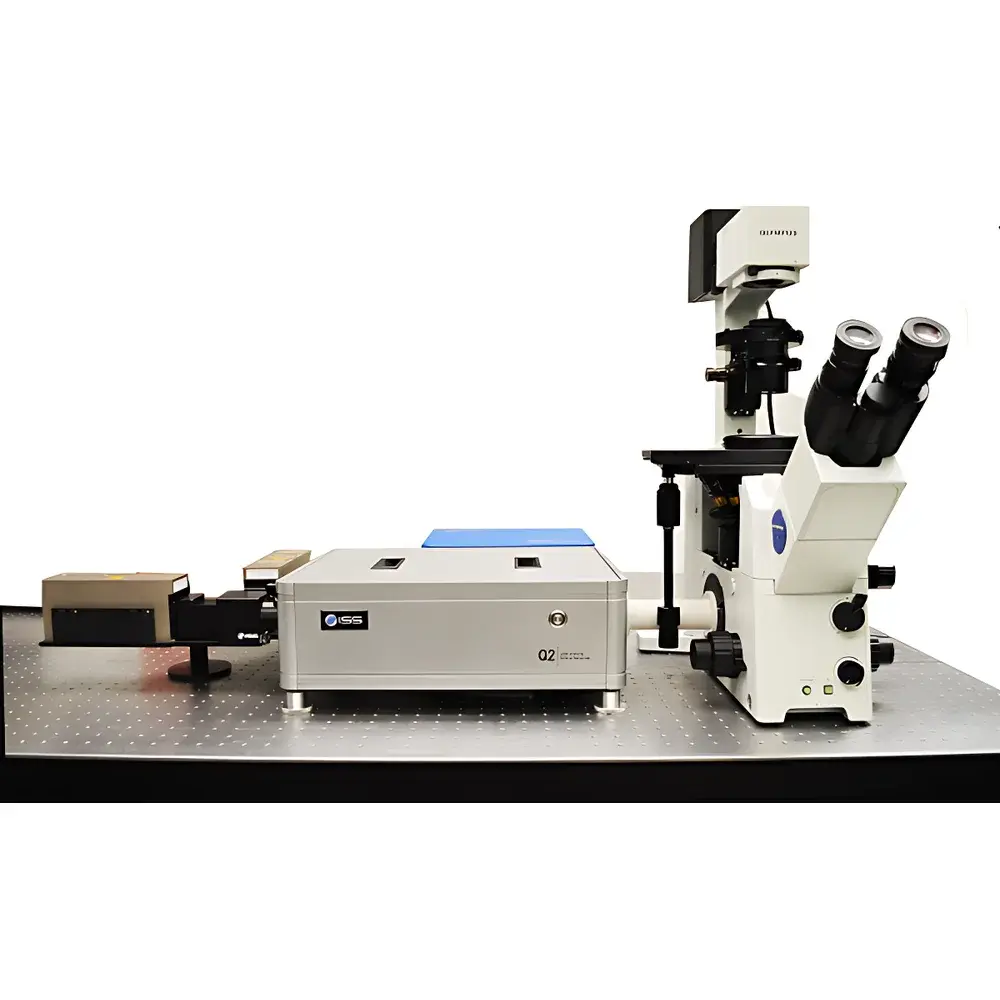
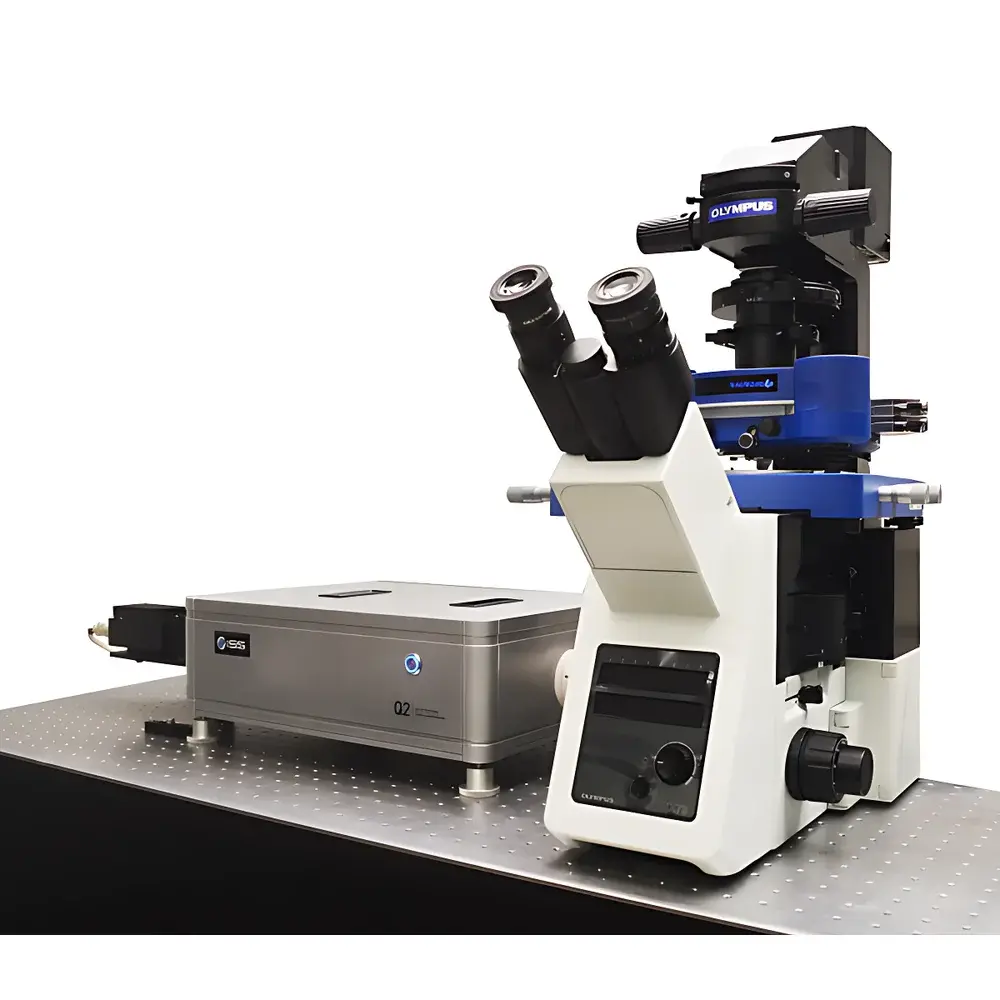
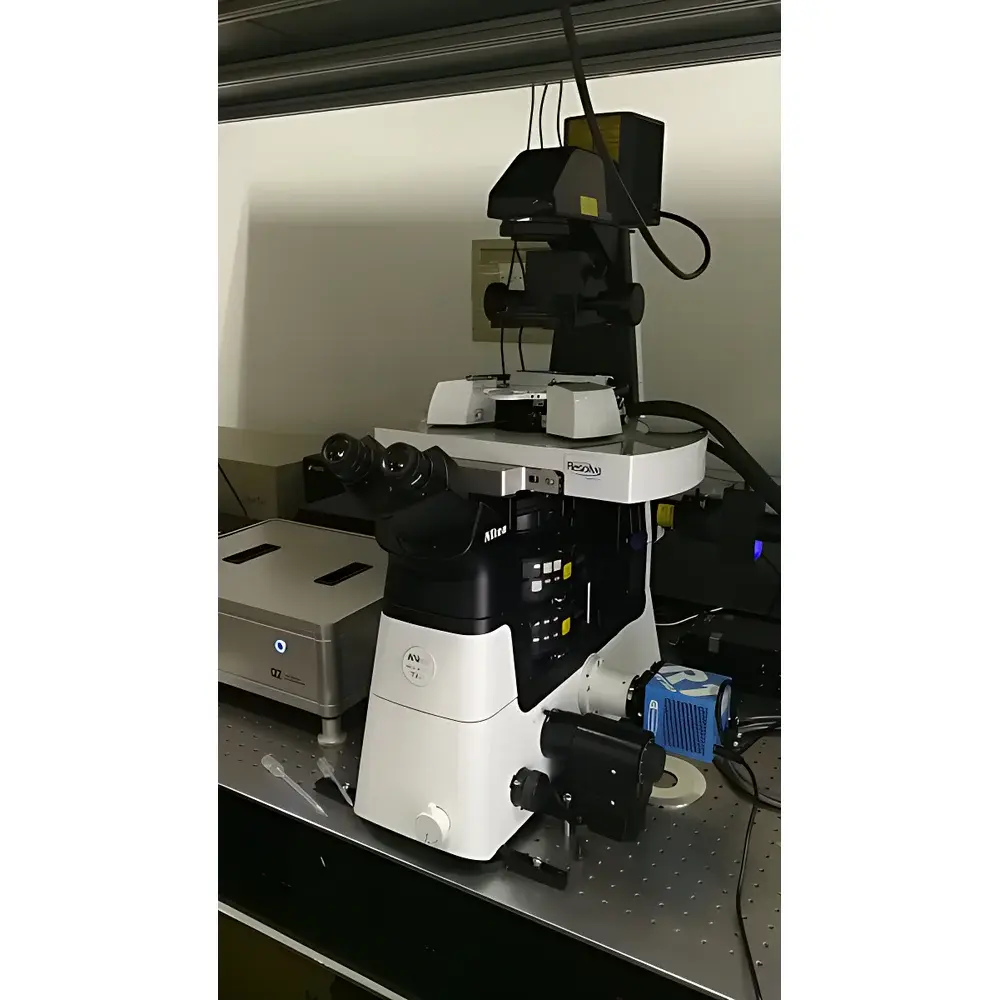
ISS Q2 FastFLIM Laser Scanning Confocal Fluorescence Lifetime Imaging Microscope
| Brand | ISS |
|---|---|
| Origin | USA |
| Model | Q2 |
| Instrument Type | Point-Scanning Confocal Microscope |
| Resolution | 1×1 to 4096×4096 pixels |
| Excitation Sources | 266 nm, 355 nm, 405 nm lasers, white-light supercontinuum laser, two-photon laser |
| Detectors | High-speed hybrid detectors, extended-Infrared avalanche photodiodes (eIR-APDs), cryogenically cooled sCMOS spectrometers |
| Scanning Modules | 2D galvanometric mirrors, piezo Z-stage, closed-loop motorized XY stage |
| Scanning Mode | Galvo-based XY scanning + piezo-driven Z-axis scanning |
| Optical Zoom | 0.25×–2.5× |
| Microscope Host | Upright or inverted configuration |
| Illumination | Tungsten-halogen lamp or white LED |
| Software Suite | Dedicated FLIM acquisition software with Phasor Plot analysis module |
| Vibration Isolation Platform | 1200 mm × 1500 mm optical table |
Overview
The ISS Q2 FastFLIM is a high-performance, modular laser scanning confocal fluorescence lifetime imaging microscope engineered for quantitative, time-resolved spatial mapping of fluorophore dynamics at subcellular and nanoscale resolution. Based on time-correlated single-photon counting (TCSPC) architecture, the system delivers full temporal fidelity across an ultra-broad lifetime range—from sub-100 ps to 100 ms—enabling rigorous characterization of complex decay kinetics in heterogeneous biological and material systems. Unlike intensity-only confocal platforms, FastFLIM integrates synchronized point-scanning optics with picosecond-resolution timing electronics and multi-channel photon detection to extract lifetime parameters without spectral crosstalk or intensity bias. Its dual-capability design supports both single-photon excitation (SPE) and two-photon excitation (TPE), making it uniquely suited for deep-tissue FLIM, upconversion nanoparticle imaging, rare-earth doped materials, and red/NIR-II window applications (900–1700 nm). The system is built around a robust, research-grade upright or inverted microscope host, fully compatible with advanced environmental control modules including cryogenic (77 K) and heating stages (up to 500 K), ensuring operational stability under physiologically or materially relevant conditions.
Key Features
- Ultrafast FLIM acquisition: Up to 20 fps at 256×256 pixel resolution with <1 ps timing resolution and 65 MHz maximum count rate per channel
- Multi-wavelength excitation flexibility: Integrated 266 nm, 355 nm, 405 nm diode lasers; tunable supercontinuum source (350–1100 nm); optional two-photon laser (680–1300 nm)
- Modular detector architecture: Configurable with hybrid PMTs, eIR-APDs (900–1700 nm), and cryo-cooled sCMOS spectrometers for simultaneous spectral and lifetime acquisition
- High-fidelity scanning: 5 kHz resonant galvo XY scan engine coupled with closed-loop piezo Z-stage for true 3D volumetric FLIM
- Phasor-based analysis framework: Real-time, calibration-free lifetime visualization via Fourier-transformed phasor plots—enabling intuitive discrimination of multi-exponential decays and FRET efficiency mapping
- Multi-modal expansion readiness: Native support for AFM co-localization (non-interfering optical path), live-cell incubation chambers, multi-well plate scanning, and time-resolved polarization imaging
Sample Compatibility & Compliance
The Q2 FastFLIM accommodates diverse sample formats—from single-molecule immobilized substrates and thin tissue sections to intact organoids and live zebrafish embryos. Its open optical architecture permits integration with commercial and custom environmental chambers (CO2, humidity, temperature), electrophysiology rigs, and microfluidic devices. All hardware and software components comply with international standards for scientific instrumentation: mechanical design adheres to ISO 14644-1 Class 5 cleanroom compatibility guidelines; electronic subsystems meet IEC 61000-6-3 EMC emission requirements; data acquisition and storage protocols support audit trails aligned with GLP and FDA 21 CFR Part 11 principles when deployed in regulated environments. Lifetime data export formats (e.g., .ptu, .sdt, HDF5) are compatible with third-party analysis tools used in academic and industrial R&D workflows.
Software & Data Management
The proprietary ISS FLIM Studio software provides end-to-end control—from hardware synchronization and real-time photon stream acquisition to advanced post-processing. Core capabilities include global and pixel-wise bi-/tri-exponential decay fitting, phasor plot generation with interactive gating, FLIM-FRET efficiency calculation using donor-only reference or acceptor photobleaching methods, and correlation spectroscopy modules (FCS, FCCS, N&B, RICS). Spectral data are processed using integrated spectral unmixing algorithms (linear least-squares, non-negative matrix factorization) across 400–1100 nm. All processing steps are scriptable via Python API, enabling reproducible batch analysis and integration into automated pipelines. Raw TCSPC datasets retain full timestamp and detector-channel metadata, ensuring traceability for peer-reviewed publication and regulatory submission.
Applications
- Quantitative metabolic imaging: NAD(P)H and FAD autofluorescence lifetime mapping in live cells and tissues for redox state assessment
- Nanomaterial photophysics: Spatially resolved lifetime analysis of upconversion nanoparticles, quantum dots, perovskite emitters, and lanthanide-doped phosphors
- Protein interaction dynamics: FLIM-FRET quantification of conformational changes, oligomerization, and ligand binding in fixed and live-cell contexts
- Energy transfer mechanisms: Discrimination of Förster resonance, Dexter exchange, and plasmon-coupled decay pathways in hybrid nanostructures
- Time-gated super-resolution: Integration with STED or RESOLFT modalities leveraging lifetime contrast for background suppression
- Photostability benchmarking: Multi-frame lifetime tracking under controlled irradiance to assess photobleaching kinetics and triplet-state accumulation
FAQ
What lifetime range does the Q2 FastFLIM cover?
The system measures fluorescence lifetimes from <100 ps to 100 ms with continuous, gap-free coverage across the entire dynamic range.
Can the system perform simultaneous spectral and lifetime imaging?
Yes—via optional cryo-cooled sCMOS spectrometer integration, enabling hyperspectral FLIM with 0.5 nm spectral resolution and full temporal binning per wavelength channel.
Is two-photon FLIM supported natively?
Yes—the Q2 platform includes dedicated TPE beam path routing, dispersion compensation optics, and synchronized pulsed laser triggering for depth-resolved FLIM in scattering media.
How is data integrity ensured during long-term acquisitions?
Hardware-level timestamping, detector saturation monitoring, and real-time photon loss correction algorithms ensure quantitative consistency over multi-hour sessions.
Does the system support third-party microscope hosts?
While optimized for ISS-integrated upright/inverted hosts, the scanning and timing modules can be adapted to select Nikon, Olympus, and Zeiss platforms via OEM interface licensing and optical coupling validation.





