
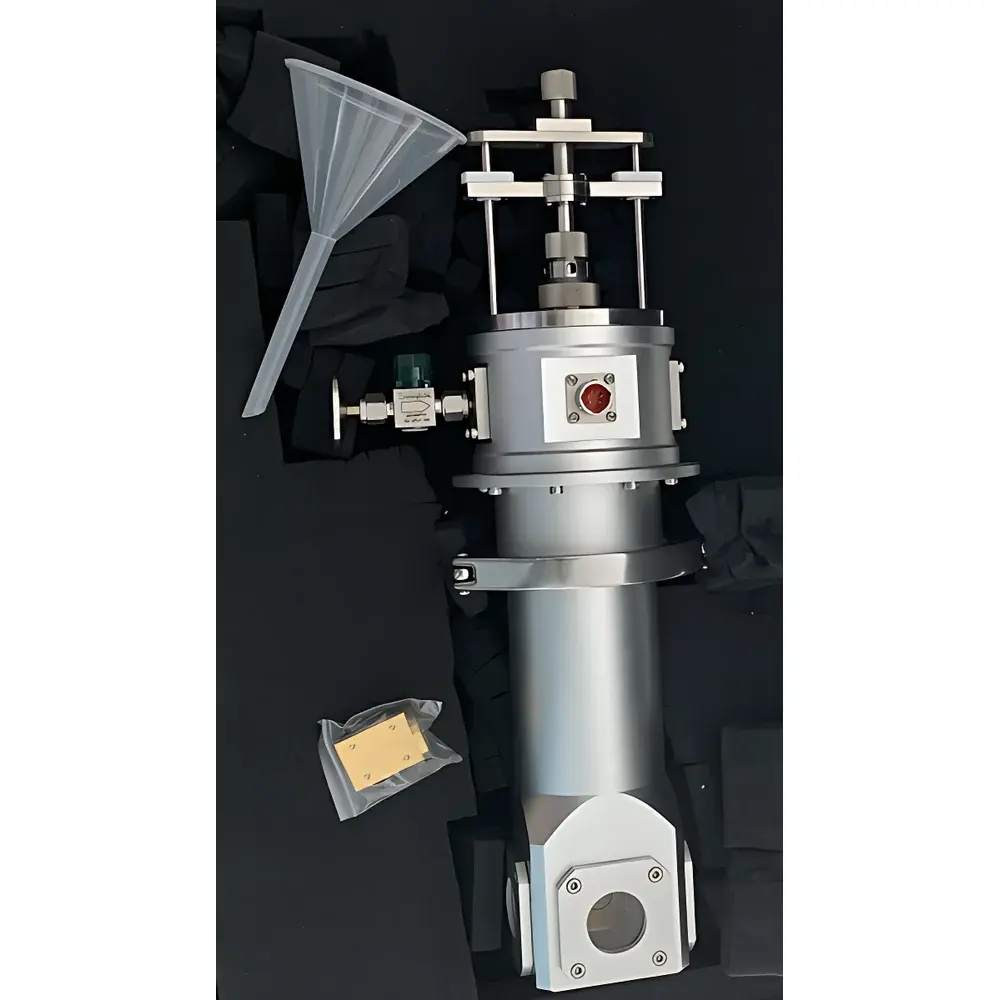
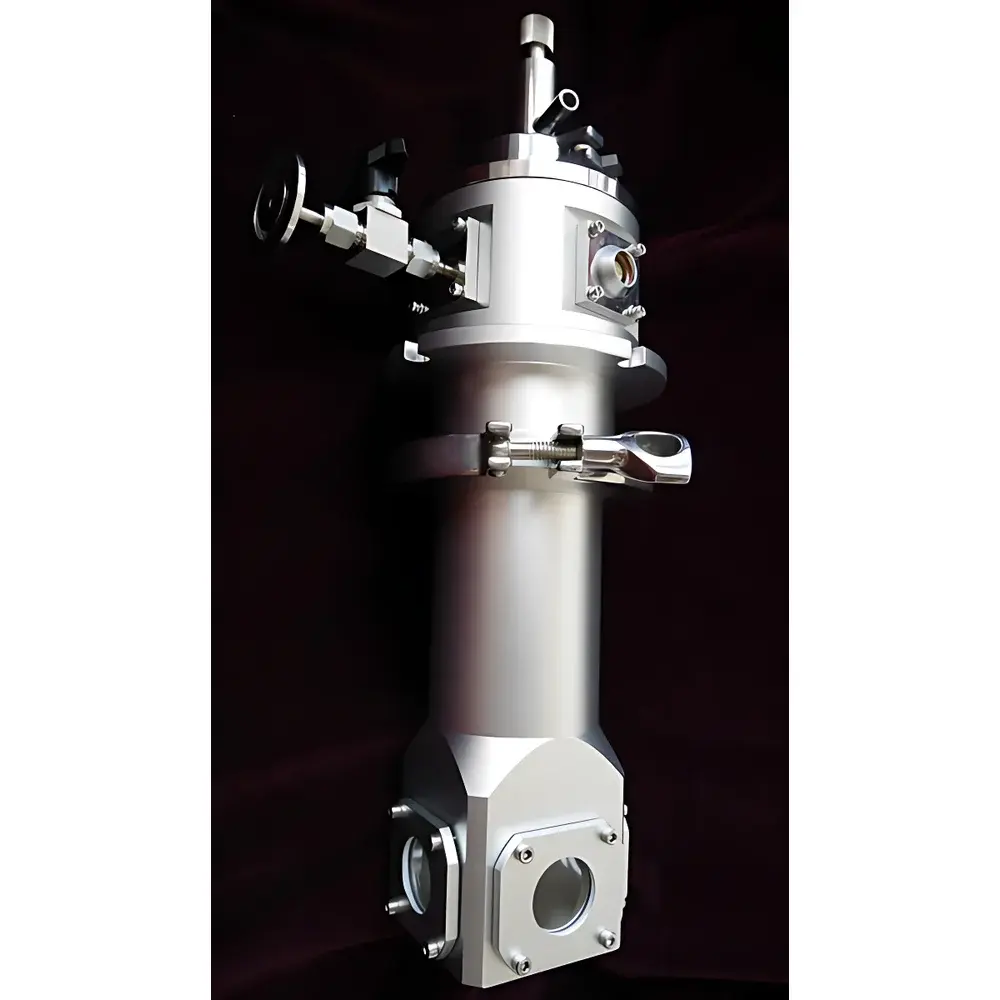
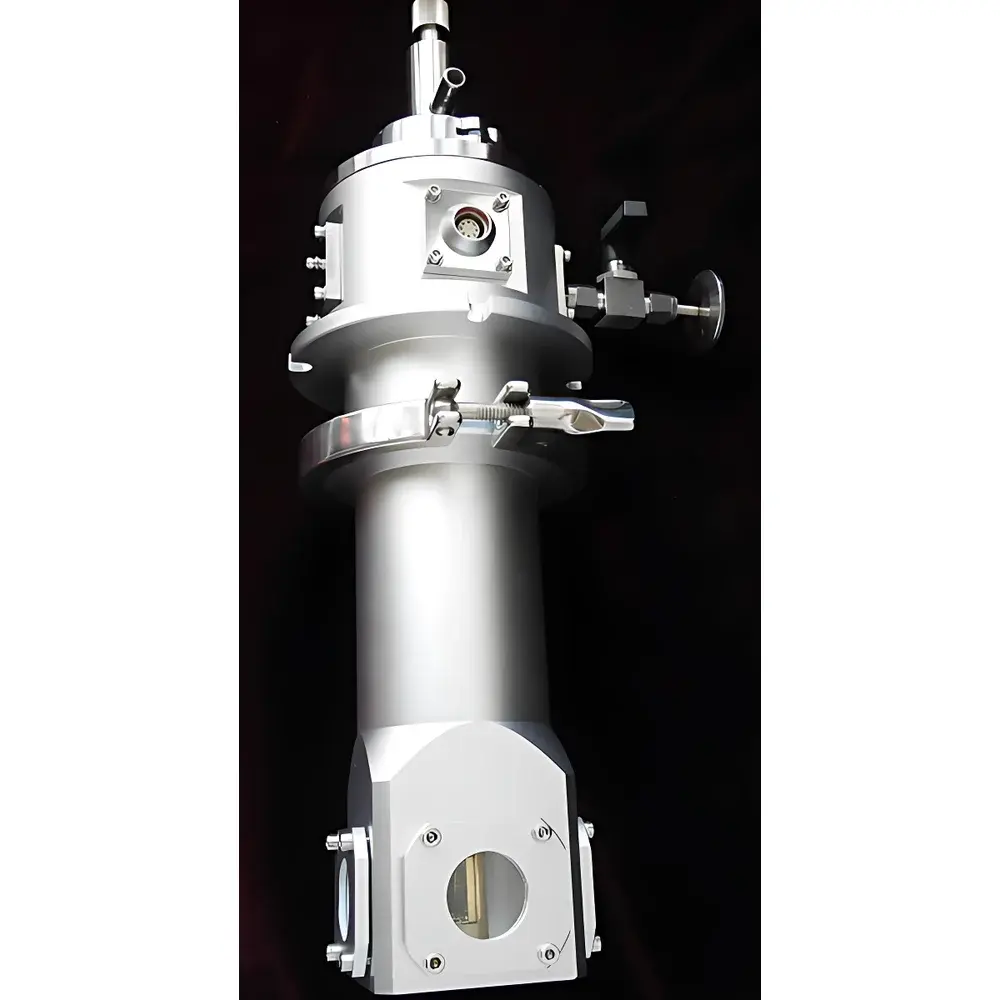
Orient KOJI Cryo-77 Liquid Nitrogen Cryogenic Thermostat
| Brand | Orient KOJI |
|---|---|
| Origin | Tianjin, China |
| Model | Cryo-77 |
| Temperature Range | 77 K to 500 K |
| Cooling Medium | Liquid Nitrogen |
| Optical Access | Quadruple Windows (NA = 3.0) |
| Standard Window Material | Fused Silica (UV–NIR Transmission) |
| Vacuum Chamber Diameter | 76 mm (3-inch) |
| Temperature Sensor | PT100 Platinum Resistance Thermometer |
| Control Method | Thermal Impedance Modulation + Resistive Heating |
| Sample Mounting | Electrical Feedthroughs (Ph-Br or Coaxial Cables), Powder & Thin-Film Fixtures Included |
| Compatibility | Hitachi F-4500/F-7000/F-4600/F-2700, Shimadzu RF Series, HORIBA FluoroMax-4/DeltaFLEX/FluoroLog-3, Edinburgh Instruments FLS920/FLS980/FLS1000 |
| Optional Configurations | Cryo-77Pro (80–800 K), Cryo-77Plus (Atmosphere-Sensing Integration), Magnetic Field-Compatible Versions, Custom Optical Coupling Kits |
Overview
The Orient KOJI Cryo-77 Liquid Nitrogen Cryogenic Thermostat is an engineered solution for precision temperature control in optical and physical property characterization under cryogenic conditions. Based on the steady-state bubble-point principle, the system regulates thermal load at the liquid–vapor interface of liquid nitrogen via adjustable conical gas plugs. This passive thermal impedance mechanism—combined with active resistive heating and high-stability PT100 sensing—enables rapid, reproducible temperature transitions across a continuous range from 77 K to 500 K. Unlike closed-cycle refrigerators, the Cryo-77 leverages the high latent heat and low cost of liquid nitrogen while maintaining exceptional thermal stability (< ±0.1 K drift over 30 min at setpoint) and minimal vibration transfer. Its compact, modular architecture supports integration into vacuum chambers, superconducting magnet bores, confocal microscopy stages, and commercial spectrometers without requiring major platform modifications.
Key Features
- Four-port optical access with numerical aperture of 3.0, enabling simultaneous excitation/detection paths for reflection, transmission, and angular-resolved measurements
- Standard fused silica windows offering broadband transmission from 185 nm (deep UV) to 2.5 µm (near-IR); optional window materials available for mid-IR (CaF2, ZnSe), far-IR (polyethylene), and X-ray applications
- Vacuum-tight 76-mm-diameter sample chamber with integrated cryosorption panels to extend hold time and reduce LN2 consumption by up to 40% versus conventional Dewars
- Quick-release clamping mechanism for tool-free access to the sample stage; full chamber opening achieved in under 15 seconds
- Dual-purpose sample mounting: electrical feedthroughs accommodate Ph-Br twisted-pair or coaxial cables rated for <77 K operation; mechanical fixtures include powder holders and thin-film transmission frames
- Integrated digital temperature controller with PID tuning, ramp rate programming (0.1–10 K/min), and real-time logging via RS-232/USB
Sample Compatibility & Compliance
The Cryo-77 is designed for laboratory environments operating under ISO/IEC 17025-accredited quality management systems. Its vacuum integrity (≤1×10⁻⁶ mbar base pressure) and material compatibility (oxygen-free copper cold finger, stainless steel body, Viton® O-rings) ensure compliance with ASTM E2223 (cryogenic thermal conductivity testing) and ISO 21028-2 (low-temperature safety requirements). The system meets electromagnetic compatibility standards per EN 61326-1 for use near sensitive detectors and lock-in amplifiers. All electrical interfaces conform to IEC 61000-4-5 surge immunity requirements. No internal electronics are located within the cryogenic zone—eliminating cold-induced failure modes and simplifying GLP audit trails for temperature calibration records.
Software & Data Management
Control firmware supports direct integration with LabVIEW™, MATLAB®, and Python-based acquisition frameworks via ASCII command protocol (SCPI-compliant syntax). Temperature setpoints, ramp profiles, and sensor readings are timestamped and exportable in CSV or HDF5 format. Audit-ready data logs include operator ID, ambient pressure, vacuum status, and heater power history—fully traceable for FDA 21 CFR Part 11–aligned workflows when paired with validated third-party LIMS. Optional firmware upgrades enable synchronized triggering with spectrometer gate signals (TTL input/output), facilitating time-resolved PL decay mapping at fixed cryogenic temperatures.
Applications
- Photoluminescence (PL) spectroscopy of quantum dots, perovskites, and 2D semiconductors at variable cryogenic temperatures
- FTIR and UV-Vis-NIR absorption studies of phonon modes, excitonic transitions, and bandgap evolution in correlated electron systems
- Low-temperature Hall effect and four-probe resistivity measurements on thin-film heterostructures and epitaxial oxides
- In situ cryo-fluorescence imaging of biological specimens using confocal or widefield microscopes equipped with objective heaters
- Calibration of IR detector arrays and bolometric sensors across defined blackbody reference points
- Thermal cycling validation of aerospace-grade electronic packages and GaN power devices
FAQ
What is the typical hold time for liquid nitrogen in the Cryo-77 at 77 K?
With vacuum integrity maintained and cryosorbent panels active, hold time exceeds 8 hours under static conditions. Refill can be performed without interrupting temperature control using the optional LN2 top-off port.
Can the Cryo-77 be operated inside a superconducting magnet bore?
Yes—custom versions with non-magnetic stainless steel construction and reduced radial footprint (≤85 mm OD) are available for insertion into 50-mm and 70-mm warm bores.
Is remote temperature monitoring supported?
The embedded controller provides analog voltage output (0–10 V) proportional to PT100 resistance, compatible with most PLCs and DAQ systems. Ethernet/Wi-Fi modules are available as add-on options.
How is temperature uniformity verified across the sample stage?
Uniformity is characterized using calibrated miniature thermocouples placed at three radial positions on the cold plate. Measured gradients remain ≤±0.3 K across the central 25-mm diameter at all stable setpoints.
Are calibration certificates provided with each unit?
Each Cryo-77 ships with a factory-verified NIST-traceable calibration report for the primary PT100 sensor, including uncertainty budget per ISO/IEC 17025 Annex A. On-site recalibration services are offered annually.



