
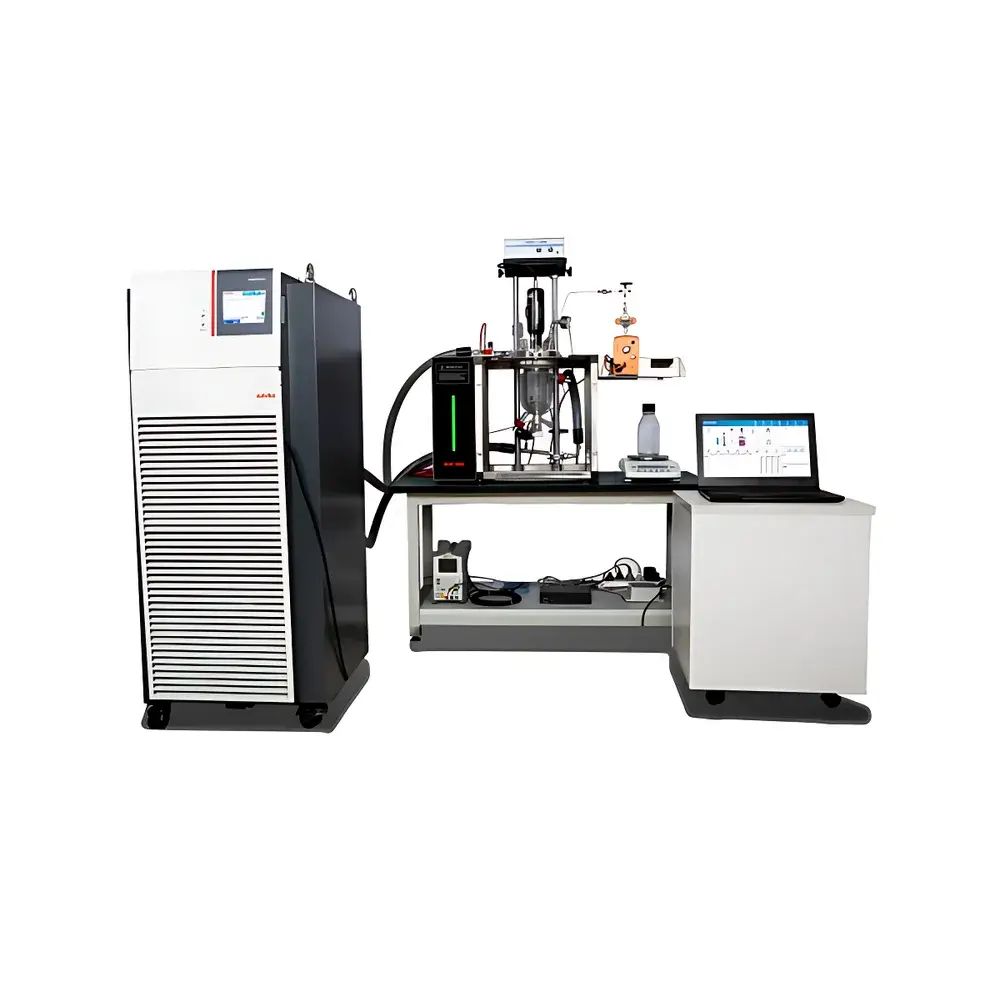
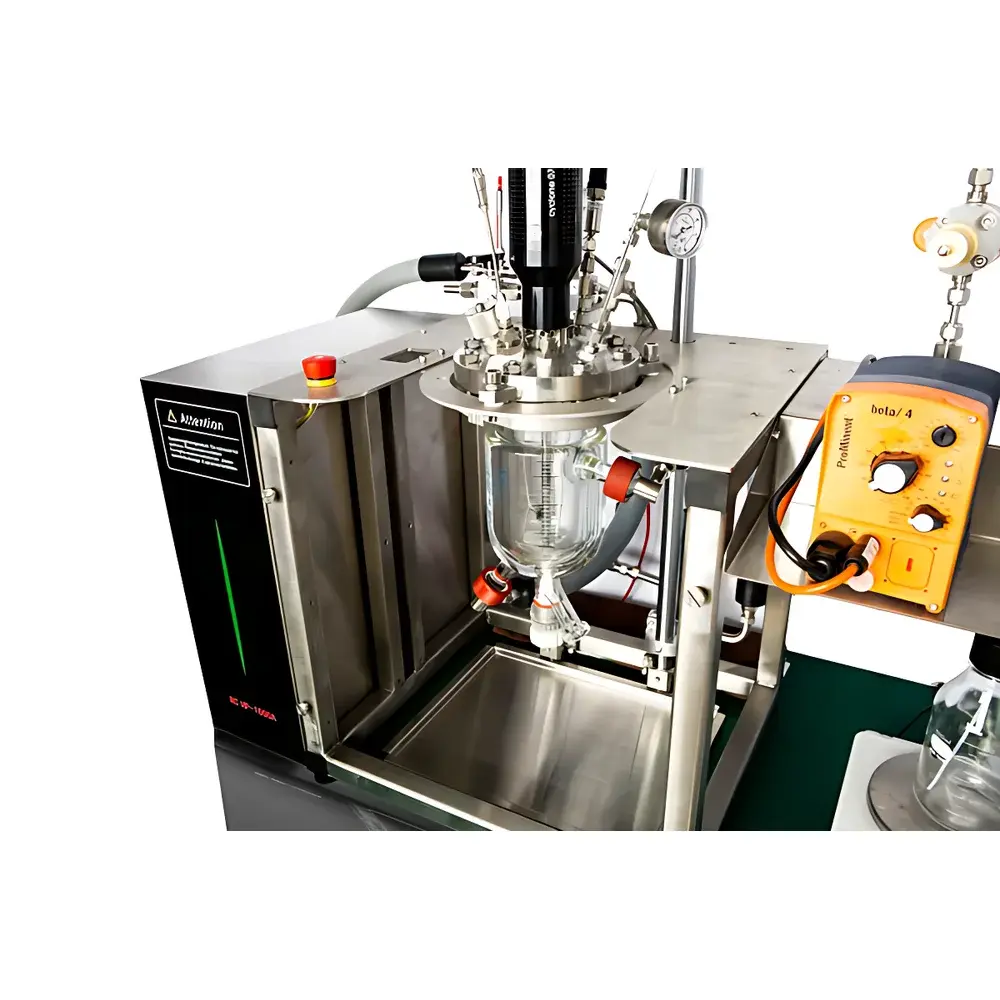
Young Instruments RC HP-1000A Automated Reaction Calorimeter for Process Safety Assessment
| Brand | Young Instruments |
|---|---|
| Origin | Zhejiang, China |
| Manufacturer | Yes |
| Product Type | Reaction Calorimeter |
| Measurement Modes | Heat-Flow, Power-Compensation (optional), Reflux (optional) |
| Temperature Control | Reactor –25 °C to 200 °C |
| Control Modes | Isothermal, Isoperibolic, Temperature Scan |
| Temperature Resolution | 1.0 mK |
| Temperature Stability | ±0.1 K |
| Oil Circulation Rate | 35–76 L/min |
| Heater Driver | 0–50 VDC, max 3.0 A, 120 W |
| Reactor Options | 1000 mL Glass (atmospheric/0.6 MPa/1.2 MPa), or 1000 mL Metal (10 MPa) |
| Materials | Borosilicate Glass, 316L SS, Hastelloy® |
| Agitator | up to 2000 rpm (optional 3000 rpm), torque up to 75 N·cm (optional 300 N·cm) |
| Impeller types | Anchor or Paddle |
| Materials | PTFE, 316L SS, Hastelloy® |
| Feeding System | 1 liquid + 1 solid + 1 gas inlet (expandable to 4) |
| Precision Balance | 3100 g / 0.01 g |
| Pumps | Medium-pressure solenoid diaphragm pump (2 L/h), high-pressure precision piston pump (2.4 L/h) |
| Power Supply | 3×400 V / 50 Hz (±10%) / 20 A |
| Total Power | 7000 VA |
| Footprint (Test Area) | 1200 × 600 × 1850 mm |
| Oil Bath Dimensions | 600 × 700 × 1300 mm |
| Oil Bath Mass | 210 kg |
| Unit Mass | 300 kg |
Overview
The Young Instruments RC HP-1000A is an automated reaction calorimeter engineered for rigorous process safety assessment under laboratory-scale conditions. It replicates industrially relevant batch and semi-batch reaction environments—enabling quantitative thermodynamic and kinetic characterization of exothermic and endothermic chemical transformations. Based on the heat-flow principle—with optional power-compensation and reflux calorimetry modes—the system measures thermal power release in real time by monitoring temperature differentials across a calibrated thermal resistance between reactor and jacket. This architecture ensures high reproducibility in determining key safety-critical parameters including reaction enthalpy (ΔHr), heat flow profiles, adiabatic temperature rise (ΔTad), time-to-maximum-rate (TMRad), and maximum theoretical temperature of runaway (MTSR). Designed for compliance with CCPS (Center for Chemical Process Safety) guidelines and aligned with ASTM E698 and ISO 11358 standards for reaction calorimetry, the RC HP-1000A supports hazard identification and criticality ranking per NFPA 704 and Dow Fire & Explosion Index methodologies.
Key Features
- Triple calorimetric methodology support: primary heat-flow mode plus selectable power-compensation and reflux configurations for cross-validation and extended dynamic range
- Precise dual-zone thermal control: independent regulation of reactor wall and oil bath temperatures with ±0.1 K stability and 1.0 mK resolution over –25 °C to 200 °C (reactor) and –45 °C to 250 °C (bath)
- Modular reactor platform: interchangeable 1000 mL vessels—including borosilicate glass (ambient/0.6 MPa/1.2 MPa) and metal variants (10 MPa) constructed from 316L stainless steel or Hastelloy® C-276
- High-fidelity feeding system: integrated gravimetric dosing (0.01 g resolution) combined with programmable liquid/gas/solid delivery paths; expandable to four independent channels
- Robust agitation architecture: digitally controlled motor delivering up to 2000 rpm (3000 rpm optional) and 75 N·cm torque (300 N·cm optional), compatible with anchor or paddle impellers in PTFE, 316L, or Hastelloy®
- Fail-safe operational design: configurable safety thresholds, automatic emergency cooling activation, real-time alarm logging, and hardware-triggered shutdown compliant with IEC 61511 functional safety requirements
Sample Compatibility & Compliance
The RC HP-1000A accommodates diverse sample chemistries—from aqueous and organic solvent systems to highly corrosive reagents and catalytic slurries—via material-selectable wetted parts. Glass reactors suit transparency-dependent monitoring (e.g., visual endpoint detection), while Hastelloy®-lined metal vessels enable testing under aggressive halogenated or acidic conditions typical in API synthesis. All configurations meet pressure containment requirements per PED 2014/68/EU and ASME BPVC Section VIII Div. 1. Data integrity adheres to FDA 21 CFR Part 11 through electronic audit trails, user-level access control, and immutable experiment logs—fully supporting GLP and GMP-regulated safety studies in pharmaceutical development and contract research organizations (CROs).
Software & Data Management
The native Windows-based control software provides a fully scriptable experimental workflow environment. Users define multi-step protocols—including temperature ramps, sequential reagent additions, and dynamic stirring profiles—with real-time parameter adjustment during active runs. Raw thermal data (heat flow, temperature, mass, RPM) are sampled at ≥10 Hz and synchronized via hardware timestamping. Post-acquisition, the platform computes reaction conversion (via heat balance), specific heat capacity (Cp), and thermal accumulation metrics using embedded ISO/ASTM-compliant algorithms. Reports export in PDF, CSV, and XML formats, with metadata embedding for traceability. The system integrates with LIMS via OPC UA and supports custom Python API extensions for automated report generation and statistical analysis pipelines.
Applications
- Reaction hazard evaluation per CCPS Guidelines for Safe Handling of Reactive Chemicals
- Kinetic parameter extraction for thermal runaway modeling (e.g., ARC, DSC correlation)
- Process validation of scale-up strategies in fine chemical and pharmaceutical manufacturing
- Design of emergency relief systems (ERS) using DIERS methodology inputs
- Thermal stability screening of intermediates, APIs, and formulations
- Supporting regulatory submissions (e.g., FDA IND/NDA, EMA CHMP assessments) with auditable calorimetric evidence
FAQ
What calorimetric principles does the RC HP-1000A implement?
It operates primarily on the heat-flow method, with optional power-compensation and reflux configurations available for method triangulation and extended measurement fidelity.
Can the system comply with FDA 21 CFR Part 11 requirements?
Yes—audit trails, electronic signatures, role-based access, and data immutability are natively implemented and validated.
Is reactor customization supported beyond standard 1000 mL volumes?
Yes—custom reactor geometries and capacities (e.g., 500 mL, 2000 mL) can be engineered upon request, subject to thermal and mechanical validation.
How is thermal calibration performed?
Calibration uses certified electrical heaters and NIST-traceable reference materials (e.g., KNO3) following ISO 11357-1 procedures; full calibration reports are generated per run.
Does the software support automated safety decision logic?
Yes—user-defined trigger conditions (e.g., dT/dt > X K/min) initiate pre-programmed mitigation actions including rapid coolant injection and agitation ramp-down.



