
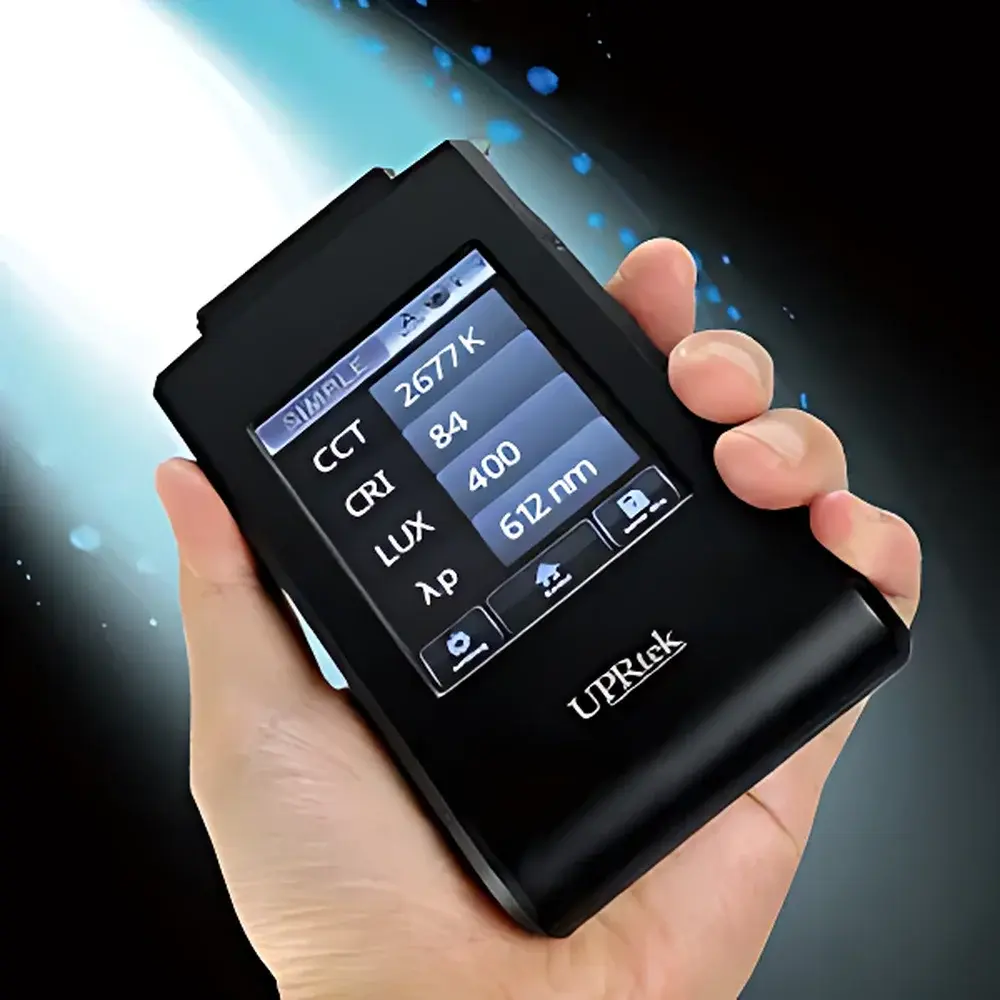
UPRTek MK350N Portable LED Spectrometer
| Origin | Taiwan |
|---|---|
| Manufacturer Type | Authorized Distributor |
| Origin Category | Domestic (Taiwan) |
| Model | MK350N |
| Pricing | Upon Request |
Overview
The UPRTek MK350N Portable LED Spectrometer is a handheld, self-contained optical measurement instrument engineered for high-fidelity spectral analysis of visible light sources in field and laboratory environments. Based on CMOS linear sensor technology with 1 nm wavelength resolution and a spectral bandwidth (FWHM) of approximately 12 nm, the MK350N operates across a calibrated range of 360–750 nm—covering the full human photopic response spectrum and extending into near-UV and near-IR edges. It employs direct spectral acquisition without requiring external computing hardware, enabling real-time calculation of photometric and colorimetric parameters including correlated color temperature (CCT), general color rendering index (CRI Ra), illuminance (lux), dominant wavelength (λd), peak wavelength (λp), and CIE 1931 (x, y) and CIE 1976 (u′, v′) chromaticity coordinates. Its cosine-corrected optical input (6.6 ± 0.1 mm aperture) ensures compliance with CIE S 023/E:2013 and ISO/CIE 19476:2014 for angular response in illuminance and spectral radiance measurements. Designed for traceability, the device supports on-site recalibration against NML/CMS-traceable standards and maintains wavelength reproducibility of ±1 nm under stable illumination conditions.
Key Features
- Self-powered portable spectrometer with integrated 3.5″ 320×240 capacitive touch LCD—no PC or external software required for operation
- CMOS linear array sensor with 16-bit digital resolution and spectral sampling interval of 1 nm
- Measurement modes: Single-shot integration (8–1000 ms exposure) and continuous monitoring (1 Hz refresh rate)
- Four simultaneous display interfaces: (1) Relative spectral power distribution (SPD) plot, (2) Simplified parameter view (CCT, CRI, lux, λp), (3) CIE 1931 (x, y) chromaticity diagram, (4) CIE 1976 (u′, v′) uniform chromaticity scale diagram
- Onboard data storage: Up to ~2,000 measurement records on SDHC cards (up to 32 GB), supporting Excel (.xlsx) for spectral data export and BMP for graphical interface snapshots
- USB 2.0 interface for direct file transfer; no proprietary drivers required
- Stray light rejection ≤ –25 dB (measured at 550 nm ±40 nm band under monochromatic input)
- Integrated zero-calibration function and user-accessible recalibration protocol compliant with NML/CMS metrological guidelines
Sample Compatibility & Compliance
The MK350N is validated for broadband and quasi-monochromatic visible light sources—including LEDs, OLEDs, fluorescent lamps, halogen sources, and architectural lighting systems—with the exception of narrowband emitters exhibiting full width at half maximum (FWHM) < 12 nm. It meets photometric accuracy requirements per CIE Publication 13.3-1995 (Method of Measuring and Specifying Colour Rendering of Light Sources) and conforms to IEC 62471:2006 for photobiological safety assessment support. Illuminance accuracy is ±5% against Standard Illuminant A (2856 K) at 20,000 lux; chromaticity coordinate repeatability is ±0.0005 in CIE 1931 (x, y); CCT uncertainty is ±2%; and CRI uncertainty is ±1.5%. The instrument supports GLP-compliant workflows through timestamped, non-editable data files and optional audit trail logging via external USB-connected PCs running UPRTek’s SpectraMagic™ software (v3.0+). It does not require FDA 21 CFR Part 11 compliance as it is not a regulated medical device, but its calibration traceability aligns with ISO/IEC 17025:2017 principles for testing laboratories.
Software & Data Management
While fully functional as a standalone instrument, the MK350N integrates seamlessly with UPRTek’s SpectraMagic™ desktop application (Windows/macOS) for advanced spectral analysis, comparative reporting, and database management. Data exported in Excel format includes raw spectral irradiance values (in µW/cm²/nm), normalized SPD, and calculated metrics with metadata (timestamp, GPS tag if enabled via external module, operator ID, and calibration certificate ID). BMP exports preserve all four display modes at native resolution for inclusion in technical reports, QA documentation, or regulatory submissions. Firmware updates are delivered via SD card or USB and maintain backward compatibility with legacy measurement files. All stored datasets include embedded EXIF-like headers containing instrument serial number, firmware version, calibration date, and environmental sensor readings (ambient temperature during acquisition).
Applications
- LED/OLED manufacturing: In-line spectral verification during R&D, production QA, and binning processes
- Architectural and theatrical lighting design: On-site CCT and CRI validation across luminaires, dimming curves, and spatial uniformity mapping
- Automotive lighting certification: Headlamp, DRL, and interior ambient light characterization per ECE R149 and SAE J1383
- Display backlighting validation: Spectral matching and blue-light hazard estimation for smartphone, tablet, and monitor backlights
- Research laboratories: Photobiology studies, circadian lighting research, and spectral reflectance proxy measurements
- Hospital and clinical environments: Verification of surgical lighting color fidelity (per IEC 60601-2-41) and therapeutic lamp spectral output
FAQ
Does the MK350N require annual factory recalibration?
No—users may perform on-site zero and reference calibration using certified calibration sources. However, for ISO/IEC 17025-accredited labs, NML/CMS-traceable recalibration every 12 months is recommended.
Can the MK350N measure UV-C or IR radiation?
No—it is optimized for 360–750 nm and does not detect below 360 nm (UVC/UVB) or above 750 nm (NIR). For extended spectral coverage, consider the MK350T (380–1000 nm) variant.
Is spectral data export compatible with MATLAB or Python?
Yes—Excel-formatted spectral data (.xlsx) contains tabular wavelength/intensity columns, enabling direct ingestion into NumPy/Pandas or MATLAB’s readmatrix() function without parsing overhead.
What is the illuminance measurement limit under low-light conditions?
The lower detection limit is 70 lux (±10% uncertainty), validated using tungsten-halogen reference sources under controlled darkroom conditions.
Does the device support Bluetooth or Wi-Fi connectivity?
No—wireless communication is intentionally omitted to ensure electromagnetic immunity in electrically noisy industrial and laboratory settings. Data transfer occurs exclusively via SD card or USB 2.0.





