
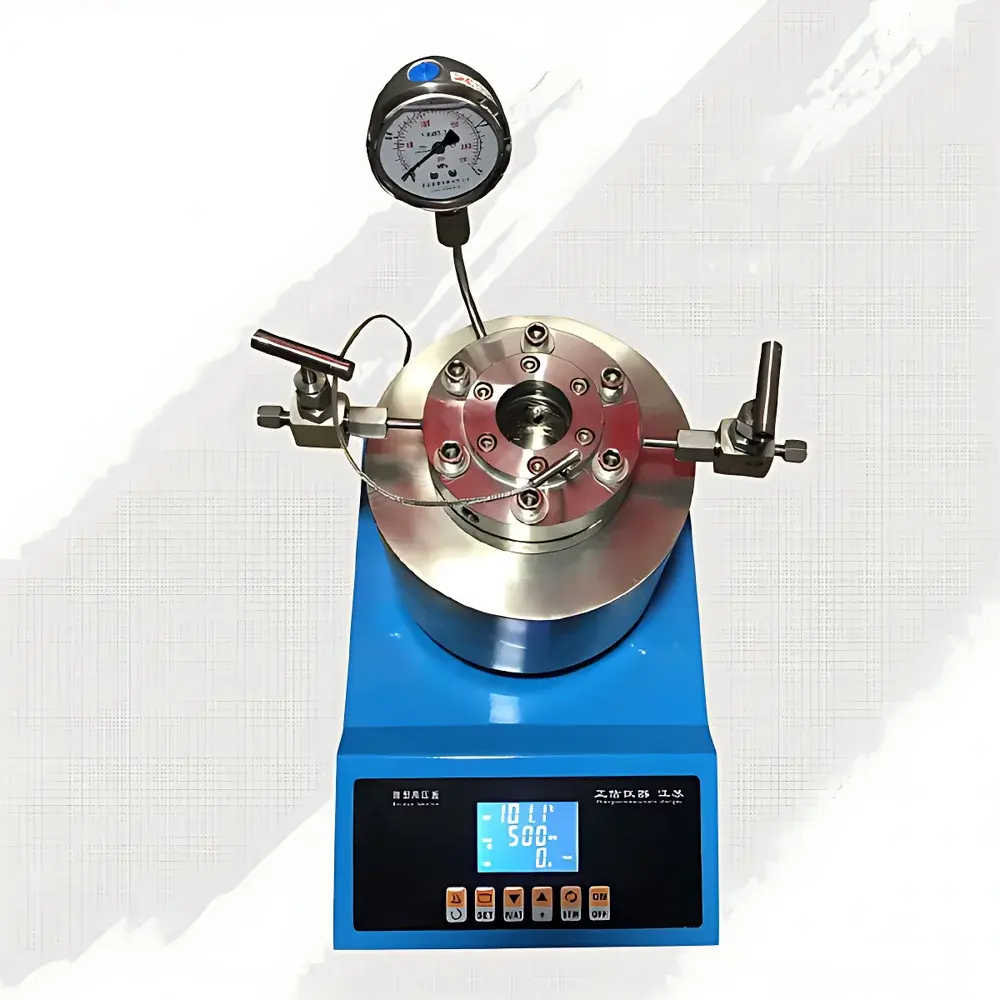
GPSK Series Magnetic Stirring Viewport High-Pressure Reactor (ZXYIQI GPSK-200mL)
| Brand | ZXYIQI |
|---|---|
| Origin | Jiangsu, China |
| Manufacturer Type | Authorized Distributor |
| Country of Origin | China |
| Model | GPSK-200mL |
| Capacity | 200 mL |
| Vessel Material | 304/316L Stainless Steel |
| Maximum Operating Pressure | 40 MPa |
| Vacuum Capability | −0.1 MPa |
| Operating Temperature Range | 0–400 °C |
| Stirring Speed | 0–1000 rpm |
| Window Material | Sapphire (standard), optional Quartz or Tempered Glass |
| Window Position | Top and/or side-mounted |
| Sealing Type | Dual-stage (soft + hard metal seal) |
| Heating Method | Embedded modular heater |
| Temperature Control | PID-based dual-loop intelligent control |
| Temperature Accuracy | ±1 °C |
| Pressure Indication | Analog or digital gauge (domestic or imported) |
| Safety Features | Overtemperature/overpressure auto-alarm, rupture disc (Hastelloy), programmable timer (0–999 min/h) |
| Power Supply | 220 V AC / 110 V AC (configurable) |
| Customization | Available for vessel geometry, lining (PTFE, PPL, quartz), ports, and instrumentation |
Overview
The ZXYIQI GPSK Series Magnetic Stirring Viewport High-Pressure Reactor is an engineered solution for controlled high-pressure synthesis, catalytic testing, and kinetic studies under visually monitored conditions. Designed around Couette-type magnetic coupling and sealed viewport architecture, it enables real-time observation of reaction dynamics—including phase separation, precipitation, gas evolution, and crystallization—without compromising pressure integrity. The reactor operates on the principle of contactless magnetic drive: a high-energy SmCo permanent magnet rotor inside the pressurized chamber couples with an external DC brushless motor, eliminating shaft seals and minimizing leakage risk. Its all-metal construction (304/316L stainless steel standard, optional 310S, 904L, Hastelloy, or titanium) supports compatibility with aggressive media (e.g., halogenated solvents, strong acids/bases, supercritical CO₂), while the sapphire viewport—rated to 40 MPa and resistant to thermal shock down to −196 °C—provides optical clarity across UV–VIS–NIR spectra. This design meets fundamental requirements for ISO 17025-compliant laboratories conducting method development, process safety evaluation, or scale-up validation.
Key Features
- Optical-grade sapphire viewport (≥99.9% transmittance, Vickers hardness >2000 HV) integrated at top and/or lateral positions for multi-angle visual monitoring
- Dual-seal system: primary soft seal (fluoroelastomer or PTFE envelope) backed by secondary metal-to-metal hard seal (316L alloy seat) for leak-tight performance up to 40 MPa
- Intelligent dual-loop PID temperature control with independent heating and sensing circuits; prevents overshoot via dynamic power modulation and anticipatory cooling compensation
- Modular embedded heating unit—separable from the vessel body—enables rapid thermal cycling and simplifies maintenance without disassembling the pressure boundary
- Quick-clamp flange interface (DIN 2501/ISO 2852 compliant) with dual O-ring grooves and torque-indicating bolts for repeatable sealing integrity
- Integrated safety subsystems: programmable overtemperature/overpressure cutoff, audible/visual alarm, certified Hastelloy C-276 burst disc (ASME BPVC Section VIII Div. 1 rated), and fail-safe power interlock
Sample Compatibility & Compliance
The GPSK reactor accommodates heterogeneous, homogeneous, and gas–liquid–solid multiphase systems. Standard configurations support corrosion-resistant linings—including PTFE, PPL (polyphenylsulfone), fused quartz, or glass-lined inserts—for applications involving HF, aqua regia, molten salts, or organometallic precursors. All wetted surfaces meet ASTM A240/A479 material certification standards; pressure components conform to PED 2014/68/EU Category IV requirements when equipped with CE-marked gauges and relief devices. Optional GMP/GLP-ready configurations include 21 CFR Part 11–compliant audit trails for temperature/pressure logs, electronic signature capability, and calibration certificate traceability to NIST standards.
Software & Data Management
While the base model features an LCD front panel with real-time display of setpoint/actual temperature, pressure, stirring speed, and elapsed time, optional RS485/Modbus RTU or Ethernet TCP/IP interfaces enable integration into LabArchives, DeltaV, or custom SCADA environments. Data logging (up to 10,000 points) includes timestamped values with configurable sampling intervals (1–60 s). Firmware supports user-defined ramp-soak profiles (up to 10 segments), automatic hold-on-alarm activation, and CSV export for post-run analysis in MATLAB or OriginLab. All firmware updates are digitally signed and validated against SHA-256 checksums to ensure integrity.
Applications
- Catalytic hydrogenation, hydroformylation, and Fischer–Tropsch screening under syngas (H₂/CO) at ≤40 MPa
- Supercritical fluid processing (scCO₂, scCH₃OH) for nanoparticle synthesis and polymer impregnation
- Hydrothermal/solvothermal crystallization of MOFs, perovskites, and battery cathode precursors
- Corrosion testing of alloys in simulated geothermal brines (pH 2–12, Cl⁻ ≤20 wt%, T ≤350 °C)
- Photochemical reactions using UV-transparent sapphire windows coupled with external LED or Xe lamp sources
- Reaction calorimetry via differential thermocouple pairs (optional K-type or T-type dual-sensor kits)
FAQ
What materials are available for the reactor body and internal lining?
Standard vessel bodies are fabricated from ASTM A240 304 or 316L stainless steel. Optional grades include 310S (for elevated-temperature oxidation resistance), 904L (high chloride environments), Hastelloy C-276 (reducing acid service), and Grade 2 titanium (for fluorinated media). Linings include PTFE (≤260 °C), PPL (≤200 °C), fused quartz (≤800 °C, transparent to 190 nm), and glass (borosilicate 3.3).
Is the sapphire viewport suitable for UV spectroscopy?
Yes—the monocrystalline sapphire window transmits light from 150 nm (vacuum UV) to 5500 nm (mid-IR), enabling in situ UV-Vis absorption, Raman probing, and laser-induced fluorescence measurements without spectral cutoff.
Can the reactor be integrated into automated reaction platforms?
Yes. With optional Modbus RTU or Ethernet communication modules, the GPSK series supports bidirectional command/control via PLCs or Python-based orchestration tools (e.g., PySerial, LabVIEW drivers). Digital I/O ports allow synchronization with dosing pumps, gas mass flow controllers, and FTIR spectrometers.
What third-party certifications are available?
Factory-calibrated pressure transducers carry UKAS-accredited certificates (traceable to NPL). ASME U-stamp fabrication documentation, CE marking per PED 2014/68/EU, and RoHS/REACH declarations are provided upon request. Explosion-proof motor variants (ATEX II 2G Ex db IIB T4 Gb) are available for Zone 1 hazardous areas.



