
UPRTek MF250N Handheld Flicker and Spectral Analyzer
| Origin | Taiwan |
|---|---|
| Manufacturer Type | Authorized Distributor |
| Product Origin | China (Domestic) |
| Model | MF250N |
| Price Range | USD 0–7,200 |
Overview
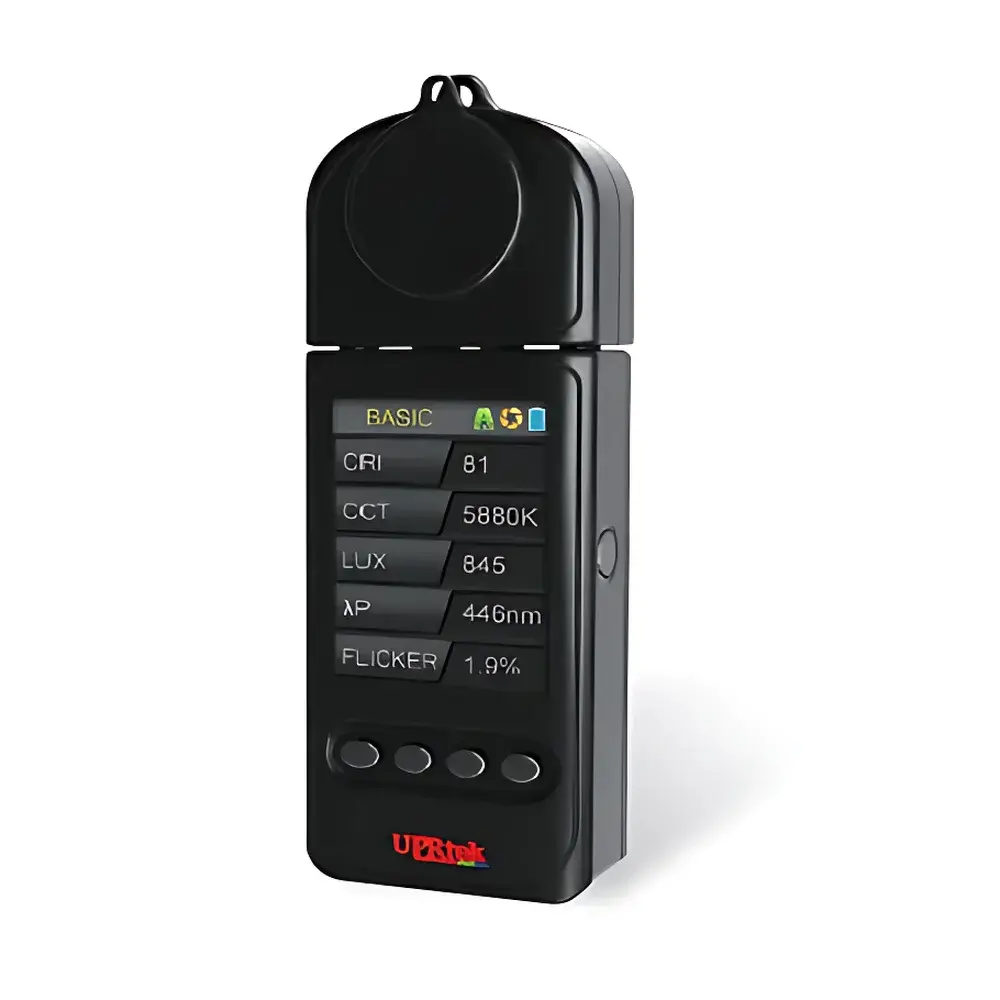
The UPRTek MF250N is a handheld, dual-function optical measurement instrument engineered for simultaneous flicker analysis and spectral radiometric characterization of light sources. Unlike conventional photometers or standalone flicker meters, the MF250N integrates a CMOS linear image sensor-based spectrometer with real-time waveform capture and Fast Fourier Transform (FFT) processing—enabling comprehensive evaluation of temporal light modulation (TLM) and spectral power distribution (SPD) in a single portable platform. Its core measurement principle combines photopic-weighted photometry (CIE 1931 V(λ) response), calibrated spectral acquisition across 380–780 nm, and time-domain sampling at 5 kS/s to resolve flicker phenomena from 5 Hz to 2,000 Hz. Designed for field-deployable compliance verification, the MF250N supports quantitative assessment of flicker metrics defined by authoritative standards—including IES TM-30-18, ASSIST Recommended Practices, ENERGY STAR Lamps V2.1, and VESA DisplayHDR™ Test Specifications—making it suitable for lighting quality assurance, display validation, LED manufacturing QA, and occupational health & safety evaluations.
Key Features
- Integrated dual-mode architecture: simultaneous flicker index (FI), percent flicker (%F), and SVM (Stroboscopic Visibility Measure) calculation per IEC TR 61547-1 and IEEE 1789-2015 guidelines
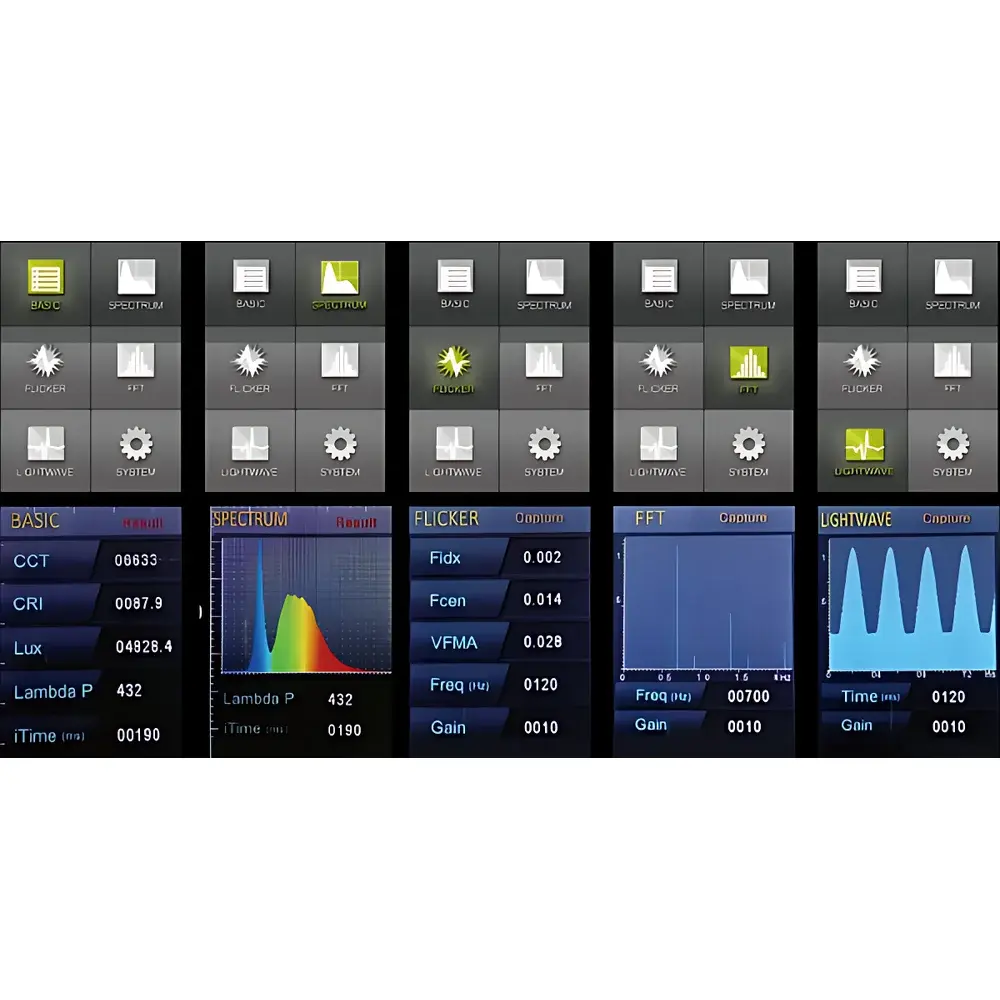
- Real-time light waveform capture with oscilloscope-like visualization in Light-Wave Mode, enabling qualitative assessment of periodicity and waveform symmetry
- FFT-based frequency-domain analysis for identifying dominant modulation frequencies and harmonic content without PC dependency
- High-fidelity spectral engine: 2 nm data interval, ~15 nm FWHM spectral bandwidth, ±1 nm wavelength repeatability under stable illumination
- Full photometric suite: illuminance (lux), correlated color temperature (CCT), CRI (Ra and R1–R15), peak wavelength (λp), and SPD (mW/m²/nm)
- Self-contained operation: 2.8-inch TFT display, onboard storage (up to 2.7 million Excel-formatted records on 32 GB microSD), and AA battery power (280 g, 180 × 65 × 30 mm)
- Compliance-ready calibration traceability: factory-calibrated against NIST-traceable standards; meets ISO/IEC 17025-aligned procedures for photometric accuracy (±5% lux, ±3.5% CCT, ±2.5% CRI)
Sample Compatibility & Compliance
The MF250N is optimized for measuring general lighting equipment (LED lamps, luminaires, OLED panels), display backlights (LCD, mini-LED), and horticultural lighting systems (e.g., PG100N-compatible fixtures). It accommodates both steady-state and modulated sources within 30–60,000 lx dynamic range. Its cosine-corrected optical input ensures angular response conformity per CIE S 023/E:2013. The instrument complies with international regulatory frameworks including IEC 61000-3-2 (harmonic current emissions), IEC TR 61547-1 (flicker immunity testing methodology), and FDA-relevant lighting safety guidance for medical and educational environments. Data integrity meets GLP/GMP documentation requirements through timestamped Excel export, audit-ready metadata logging (integration time, sensor temperature, battery level), and no proprietary binary formats.
Software & Data Management
All measurements are stored natively in .XLSX format on removable microSD cards (SDHC Class 10, up to 32 GB), eliminating vendor lock-in or mandatory software installation. Each record includes full spectral arrays (380–780 nm × 201 channels), time-series waveform snapshots (up to 1,200 ms duration), FFT magnitude spectra, and derived flicker indices. No cloud synchronization or subscription services are required—data remains fully under user control. For post-processing, exported files are compatible with MATLAB, Python (NumPy/Pandas), and industry-standard photometric analysis tools such as LMK or DIALux. Firmware updates are delivered via SD card without network connectivity.
Applications
- Office and classroom lighting validation: quantifying flicker risk in LED troffers and task lights per WELL Building Standard W09 and EU Directive 2019/2157
- Display manufacturing QA: evaluating temporal stability of monitors, TVs, and VR headsets during production line testing
- LED driver design verification: correlating PWM dimming frequency, duty cycle, and resulting %F/FI values
- Horticultural lighting certification: assessing spectral fidelity and temporal uniformity of grow lights per ASABE S640.2
- Occupational health assessments: supporting OSHA and HSE-compliant workplace lighting audits where flicker-induced visual fatigue is a documented concern
- Research-grade spectral profiling: capturing SPDs for daylight simulation studies, circadian lighting design, and photobiological safety screening (IEC 62471)
FAQ
Does the MF250N require external software to view spectral data?
No. All spectral curves, time-domain waveforms, and FFT plots are rendered directly on the device’s 2.8-inch display in real time.
Is the instrument compliant with FDA 21 CFR Part 11 for electronic records?
While the MF250N does not implement electronic signatures or role-based access control, its Excel-based data export, immutable timestamps, and absence of editable metadata fields enable alignment with Part 11 principles when used within validated laboratory workflows.
Can it measure flicker in pulsed or strobed lighting systems?
Yes—the 5 kS/s sampling rate and 6–1,200 ms adjustable integration window support accurate capture of non-sinusoidal, transient, and burst-mode modulation patterns.
What is the spectral stray light performance?
Stray light rejection is ≤ –25 dB, measured as the ratio of signal at 550 nm ±40 nm to incident monochromatic 550 nm light—ensuring reliable SPD fidelity in mixed-wavelength environments.
How is calibration maintained over time?
The unit includes built-in reference LED diagnostics and supports user-initiated zero-point calibration. Annual recalibration against traceable standards is recommended for metrological continuity in regulated environments.






