
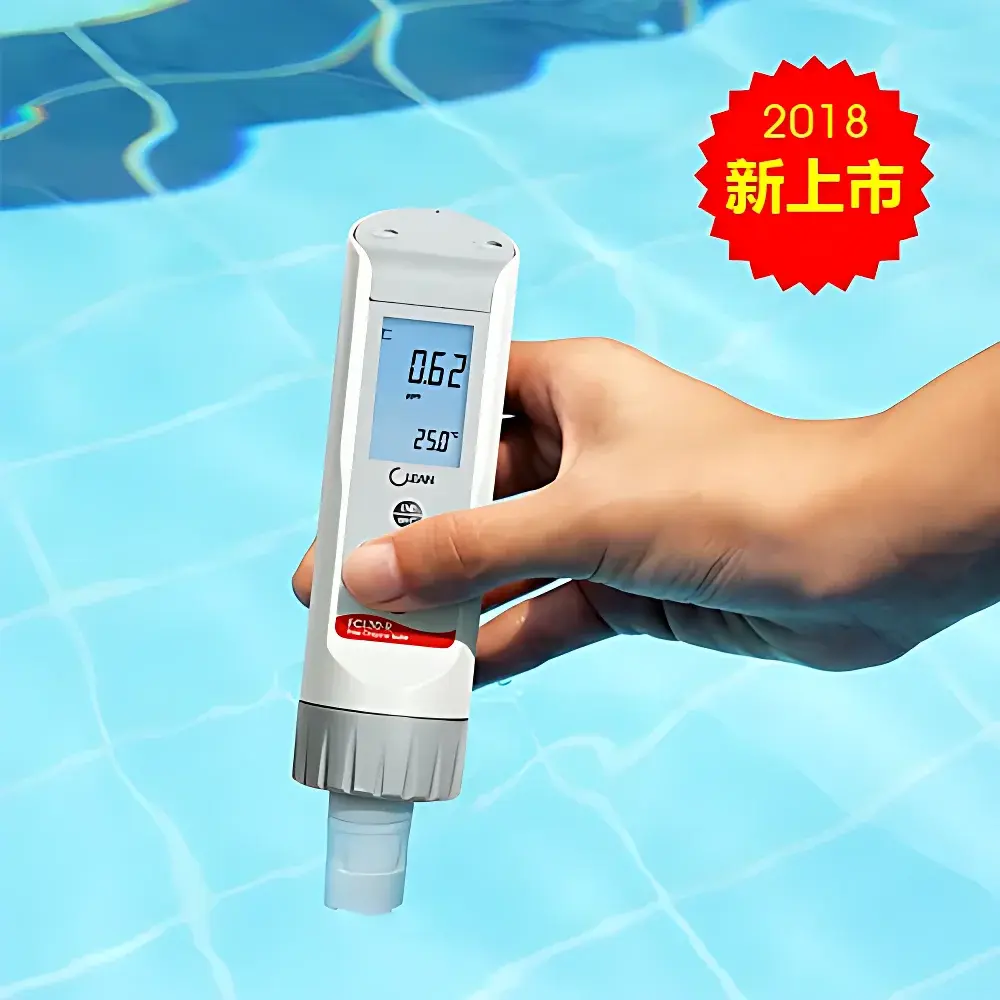
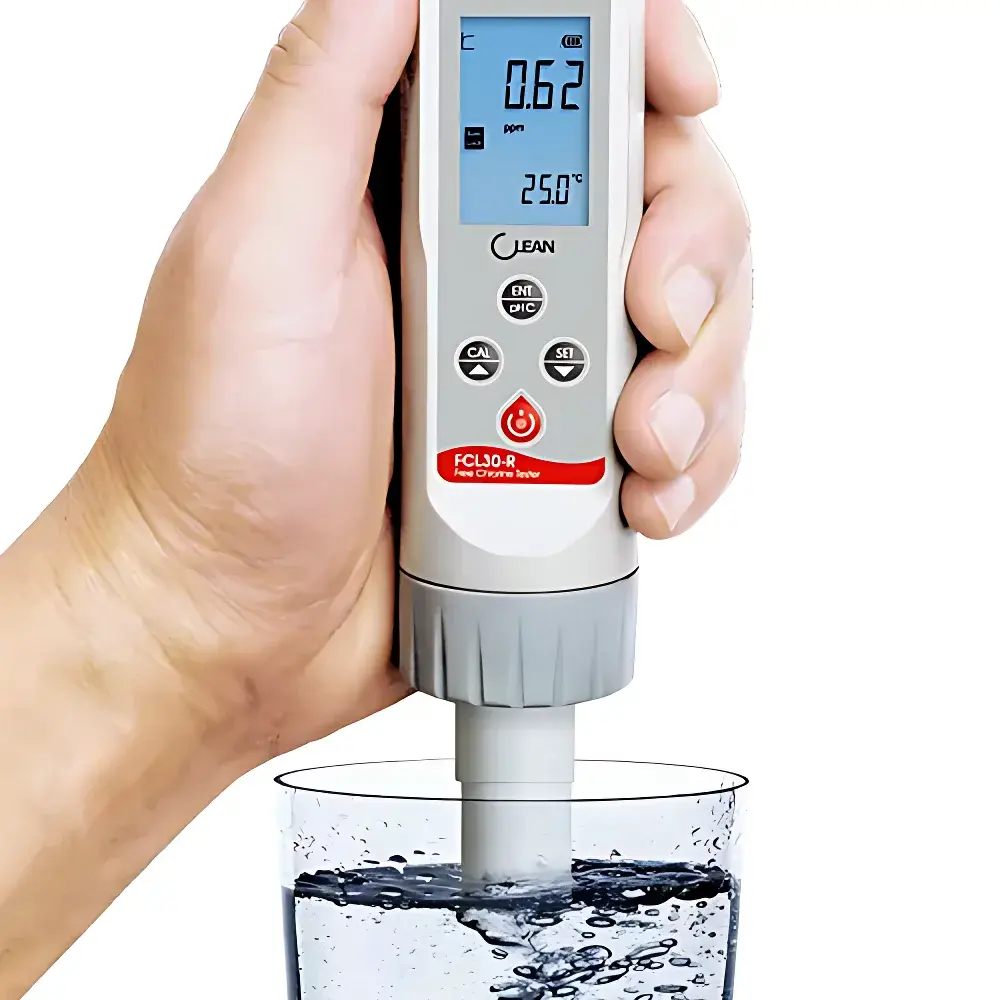
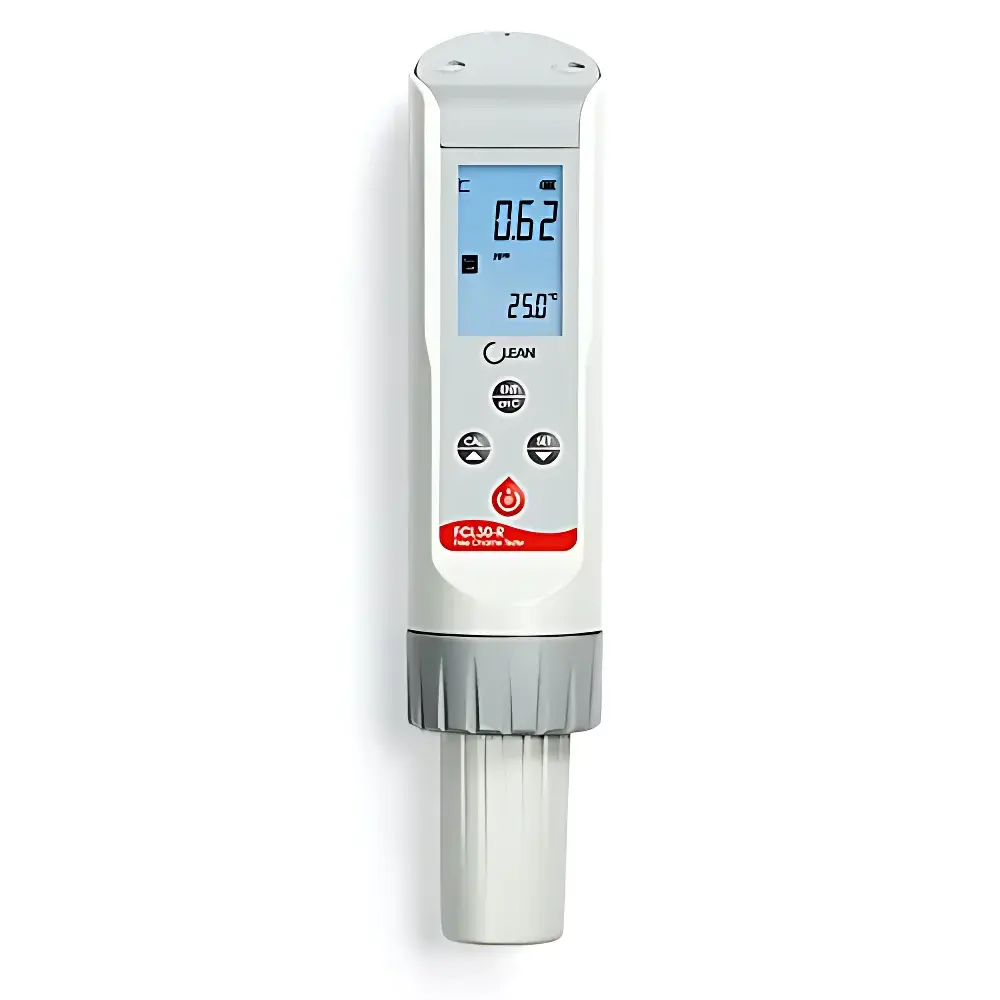
CLEAN FCL30-R Portable Residual Chlorine Analyzer
| Brand | CLEAN |
|---|---|
| Origin | Taiwan |
| Model | FCL30-R |
| Instrument Type | Portable |
| Measurement Principle | Electrochemical Potentiometric Sensor |
| Measured Parameter | Free Residual Chlorine |
| Range | 0–2.00 mg/L |
| Accuracy | ±1% F.S. |
| Repeatability | ±1% F.S. |
| Resolution | 0.01 mg/L |
| LOD | 0.035 mg/L |
| Auto Temperature Compensation | 5.0–45.0 °C |
| pH Compensation Input Range | 6.5–8.5 |
| Electrode | Replaceable CS5931 Free Chlorine Sensor |
| Display | Backlit LCD (20 × 30 mm) |
| Power | 1 × 1.5 V AAA battery |
| IP Rating | IP67 |
| Dimensions (H×W×D) | 185 × 40 × 48 mm |
| Weight | 95 g |
Overview
The CLEAN FCL30-R Portable Residual Chlorine Analyzer is a field-deployable electrochemical potentiometric instrument engineered for precise, real-time quantification of free residual chlorine in recreational water systems. It operates on the principle of selective membrane-covered amperometric/potentiometric detection, where the CS5931 chlorine-specific electrode generates a stable potential proportional to the activity of hypochlorous acid (HOCl) — the dominant biocidal species in aqueous solution at typical pool pH. Unlike colorimetric DPD methods, which require reagent addition, reaction timing, and photometric interpretation, the FCL30-R delivers direct, interference-resistant readings without consumables or calibration drift induced by turbidity, coloration, or low flow conditions. Its design aligns with international water safety frameworks including WHO Guidelines for Safe Recreational Water Environments and the U.S. CDC’s Model Aquatic Health Code (MAHC), supporting compliance with mandated free chlorine residuals of 0.3–0.5 mg/L in public swimming pools.
Key Features
- Electrochemical potentiometric measurement using a replaceable, membrane-protected CS5931 free chlorine sensor — enabling long-term stability and minimal drift
- Integrated automatic temperature compensation (5.0–45.0 °C) and manual pH input (6.5–8.5) to correct for HOCl/OCl⁻ speciation effects on sensor response
- No requirement for controlled sample flow rate or filtration — validated performance across variable turbidity, low-temperature (<10 °C), and colored water matrices
- High-resolution display (0.01 mg/L) with auto-backlighting and multi-line LCD (20 × 30 mm) optimized for outdoor and wet-environment readability
- IP67-rated enclosure ensures full dust ingress protection and submersion resistance up to 1 m for 30 minutes — suitable for deck-side, spa, and mobile inspection use
- Tool-free maintenance architecture: battery and electrode replacement performed manually without disassembly tools or technical training
- Low-power electronics with auto-shutdown after 5 minutes of inactivity — extending single AAA battery life to >1,000 measurements per charge
Sample Compatibility & Compliance
The FCL30-R is validated for use in chlorinated recreational water environments including swimming pools, spas, hot tubs, thermal springs, and hydrotherapy facilities. It meets functional equivalence requirements outlined in ASTM D6503 (Standard Test Method for Determination of Free Chlorine in Water by Amperometric Titration) and supports GLP-aligned documentation when paired with external logging software. While not a primary regulatory instrument under FDA 21 CFR Part 11, its traceable electrode calibration protocol and audit-ready measurement history (via optional PC interface) facilitate integration into facility QA/QC programs compliant with ISO/IEC 17025 and local health department reporting mandates. The device does not measure combined chlorine or chlorine dioxide directly; users requiring dual-parameter analysis must deploy complementary instrumentation.
Software & Data Management
The FCL30-R operates as a standalone field meter with no embedded data storage or wireless transmission capability. However, its analog output signal (0–200 mV) and standardized electrode interface are compatible with third-party data loggers and SCADA-compatible acquisition modules. Calibration records — including date, temperature, pH input, and reference point — are retained in non-volatile memory and can be reviewed via the LCD menu. For laboratories operating under 21 CFR Part 11 or EU Annex 11, CLEAN provides optional CSV export templates and electronic calibration certificate generation tools through its desktop configuration utility (v2.1+), enabling secure audit trails and electronic signature support when used with validated Windows-based workstations.
Applications
- Routine verification of free chlorine residuals during daily operational checks in municipal and commercial aquatic facilities
- Pre- and post-filtration monitoring to assess disinfection system efficiency and hydraulic residence time adequacy
- On-site validation of DPD colorimetric test kit results in quality assurance audits
- Field assessment of chlorine decay kinetics during shock dosing protocols or seasonal turnover events
- Training and certification exercises for lifeguards, facility operators, and environmental health inspectors
- Compliance verification for NSF/ANSI 50-certified circulation systems and EPA-recommended disinfection practices
FAQ
Does the FCL30-R measure total chlorine or only free chlorine?
The instrument measures free residual chlorine exclusively — defined as the sum of hypochlorous acid (HOCl) and hypochlorite ion (OCl⁻) — and does not detect chloramines or other combined chlorine species.
Can it be used in seawater or salt-chlorinated pools?
Yes, but elevated chloride concentrations (>3,000 mg/L) may accelerate electrode membrane fouling; frequent cleaning with deionized water and periodic recalibration are recommended.
Is pH compensation mandatory for accurate readings?
Manual pH entry is strongly advised when measuring outside the 7.2–7.6 range, as HOCl concentration varies nonlinearly with pH — critical for regulatory compliance at 0.3–0.5 mg/L thresholds.
How often should the CS5931 electrode be calibrated?
Calibration is required before each day’s use or after exposure to high-chlorine (>1.5 mg/L) or organic-laden samples; two-point calibration using 0.2 mg/L and 1.0 mg/L NIST-traceable standards is recommended.
What is the expected service life of the CS5931 sensor under normal pool monitoring conditions?
Typical electrode lifespan is 12–18 months with weekly use and proper storage in electrode storage solution; performance degradation is indicated by sluggish response time (>30 s to 95% stabilization) or calibration slope deviation >15%.
Related Products







