
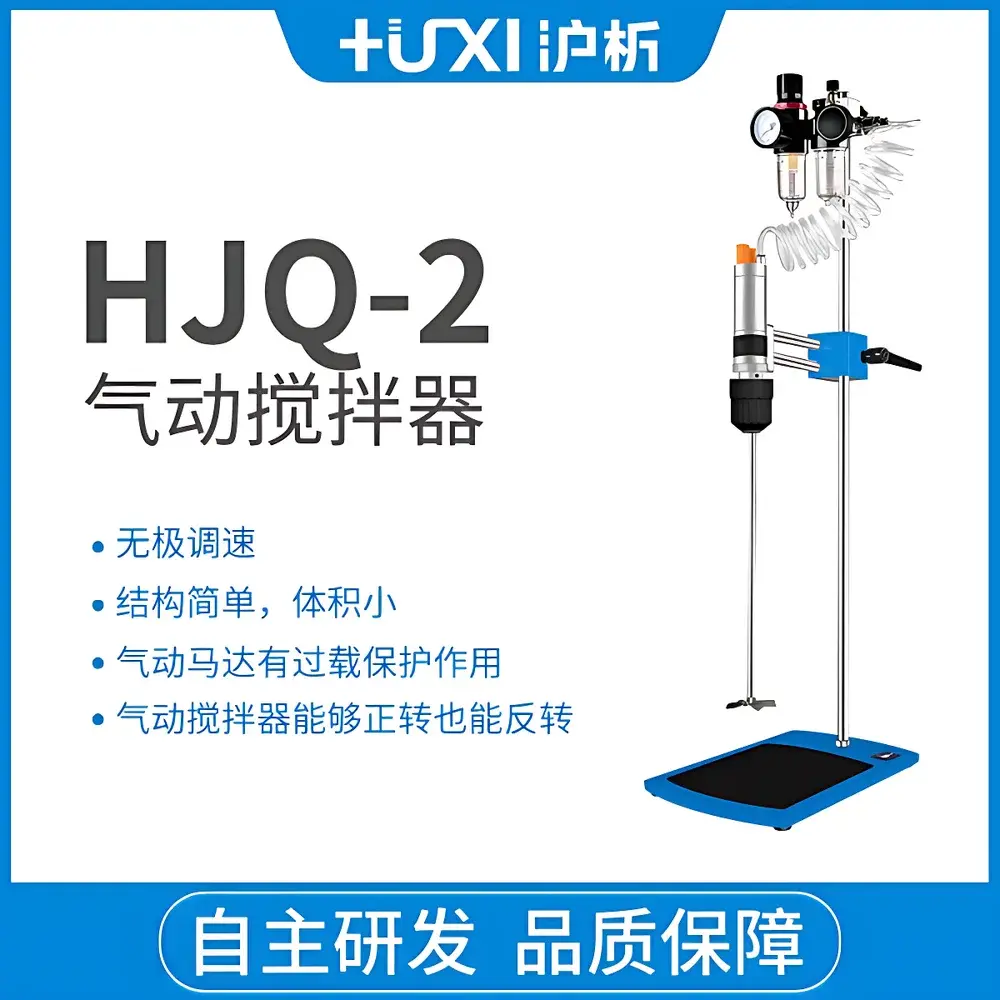
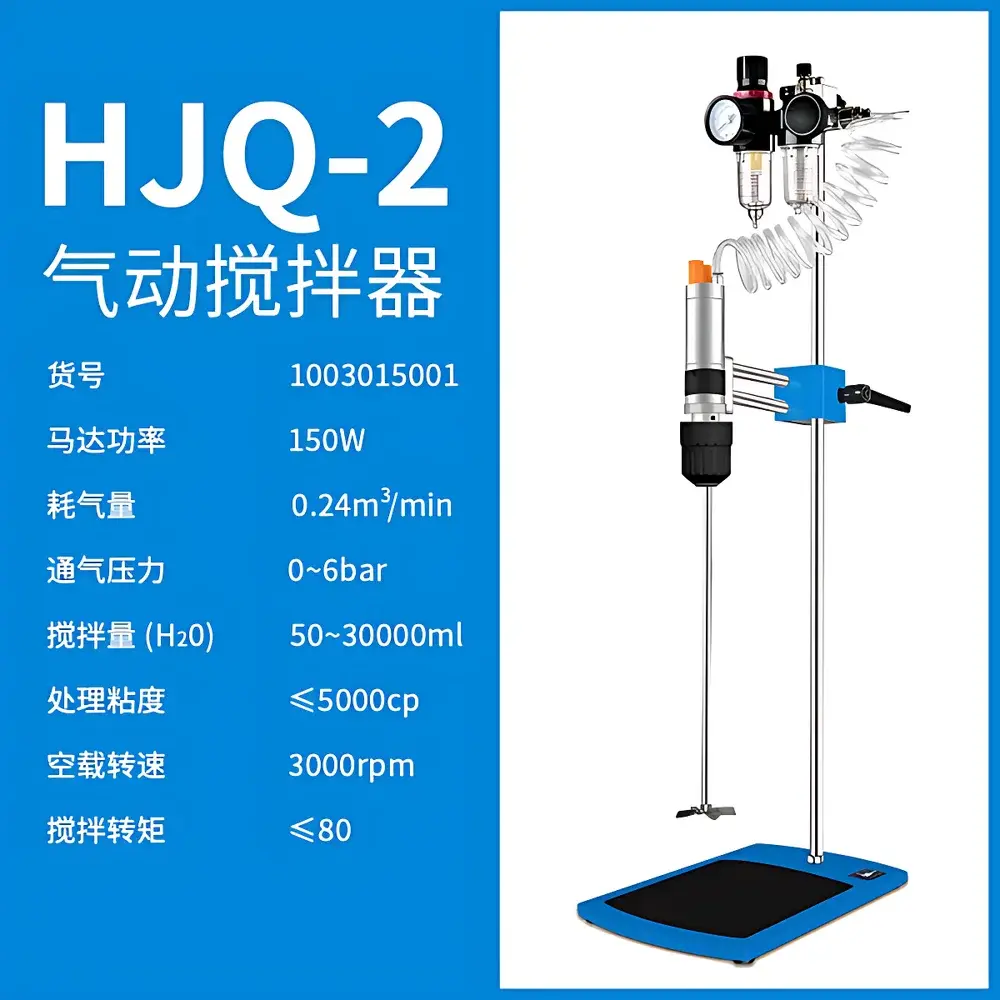
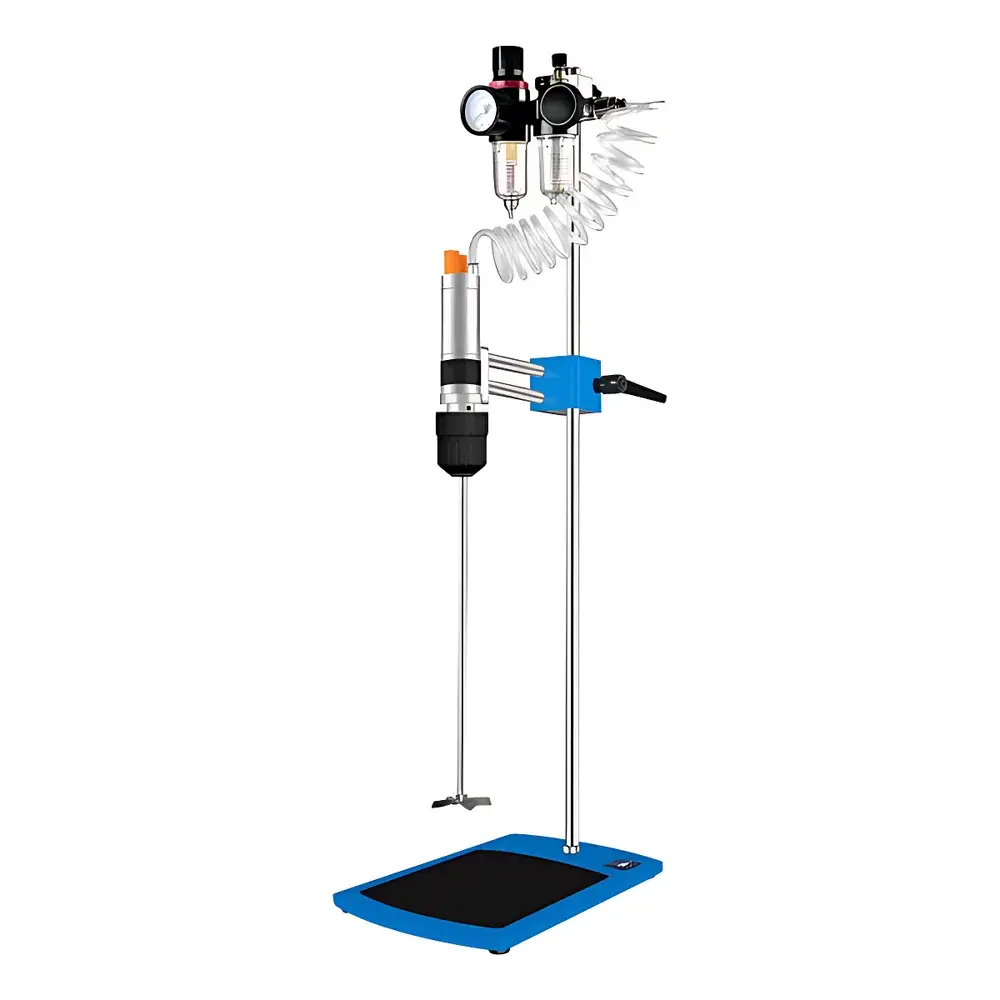
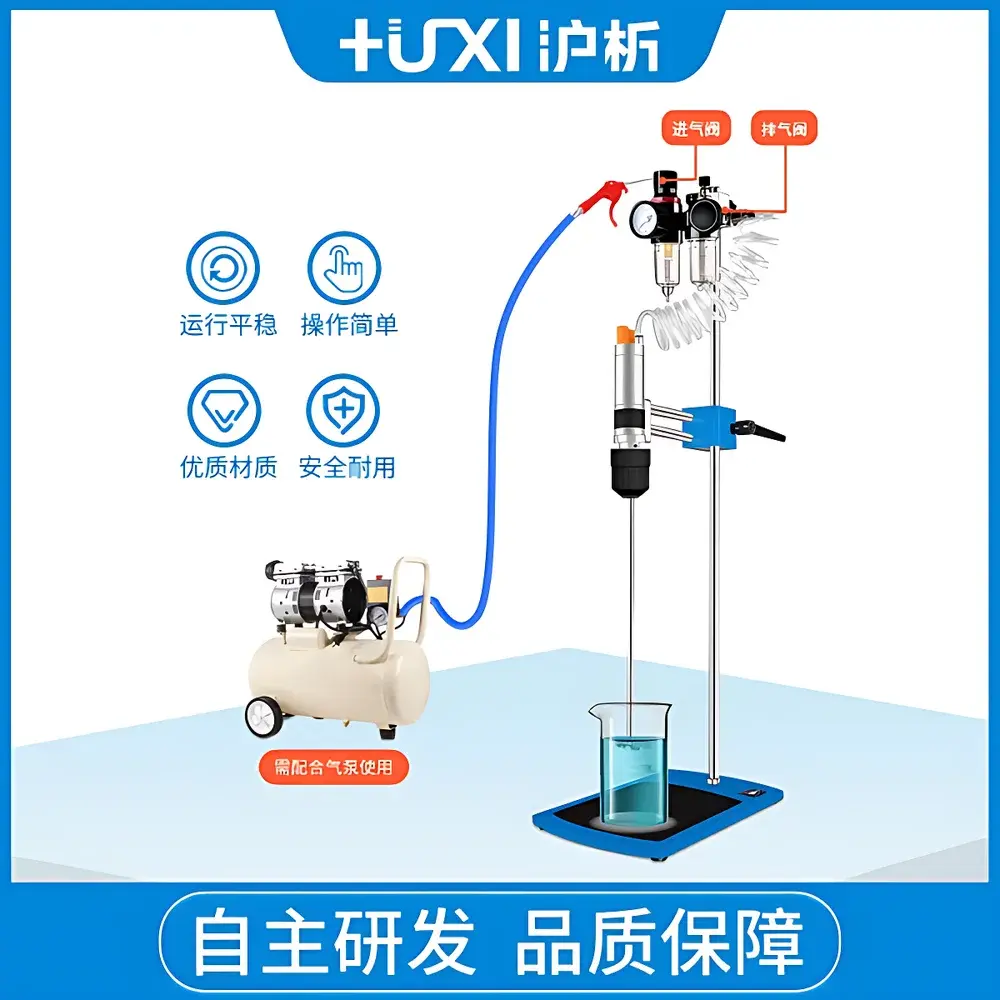
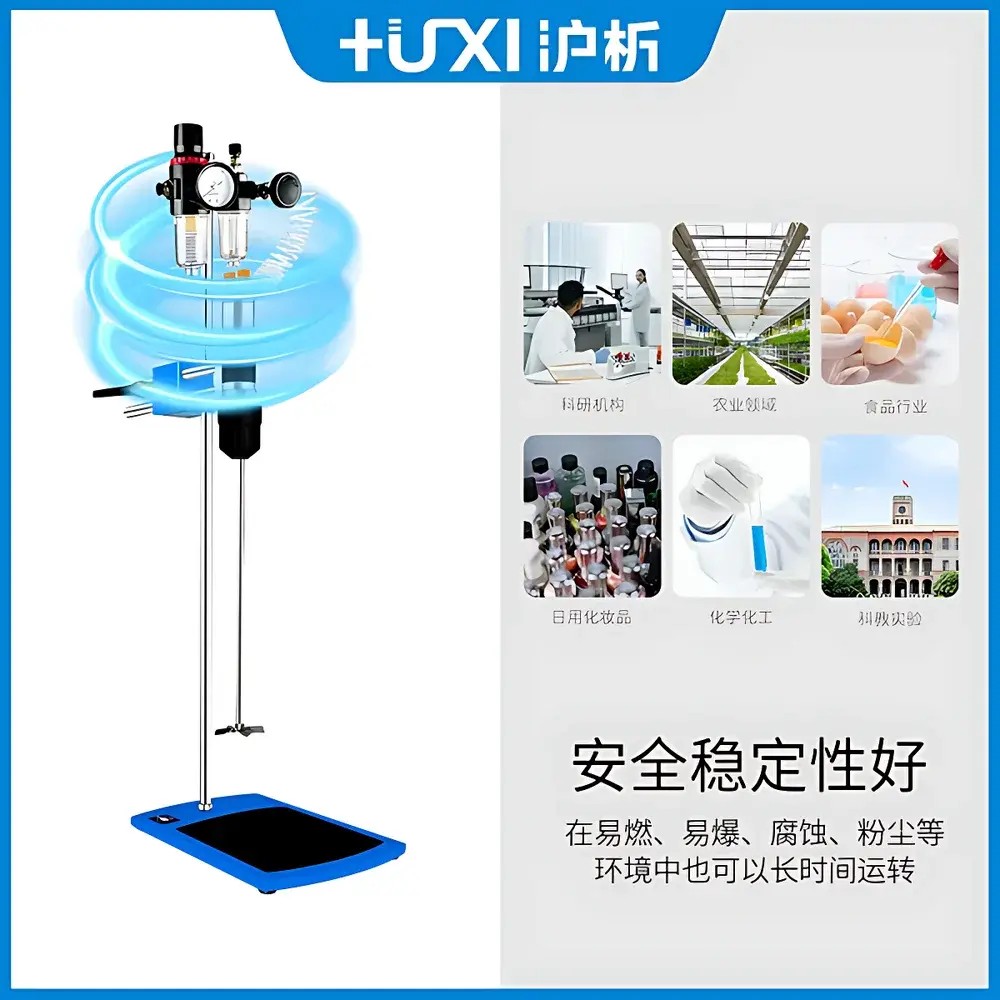
HUXI HJQ-2 Pneumatic Laboratory Stirrer
| Brand | HUXI |
|---|---|
| Origin | Shanghai, China |
| Manufacturer Type | Direct Manufacturer |
| Product Category | Domestic (China-Made) |
| Model | HJQ-2 |
| Instrument Type | Pneumatic Stirrer |
| Max. Mixing Volume | 30 L |
| Speed Range | 0–3000 rpm |
| Torque | ≤80 N·cm |
| Motor Power | 150 W |
| Operating Air Pressure | 0–6 bar |
| Max. Viscosity Handling | ≤5000 cP |
| Ambient Temp. Range | 5–40 °C |
| Relative Humidity | ≤80% |
| Dimensions (W×D×H) | 315×200×800 mm |
| Net Weight | 9.5 kg |
| Gross Weight | 11.5 kg |
| Standard Impeller | Four-blade stainless steel |
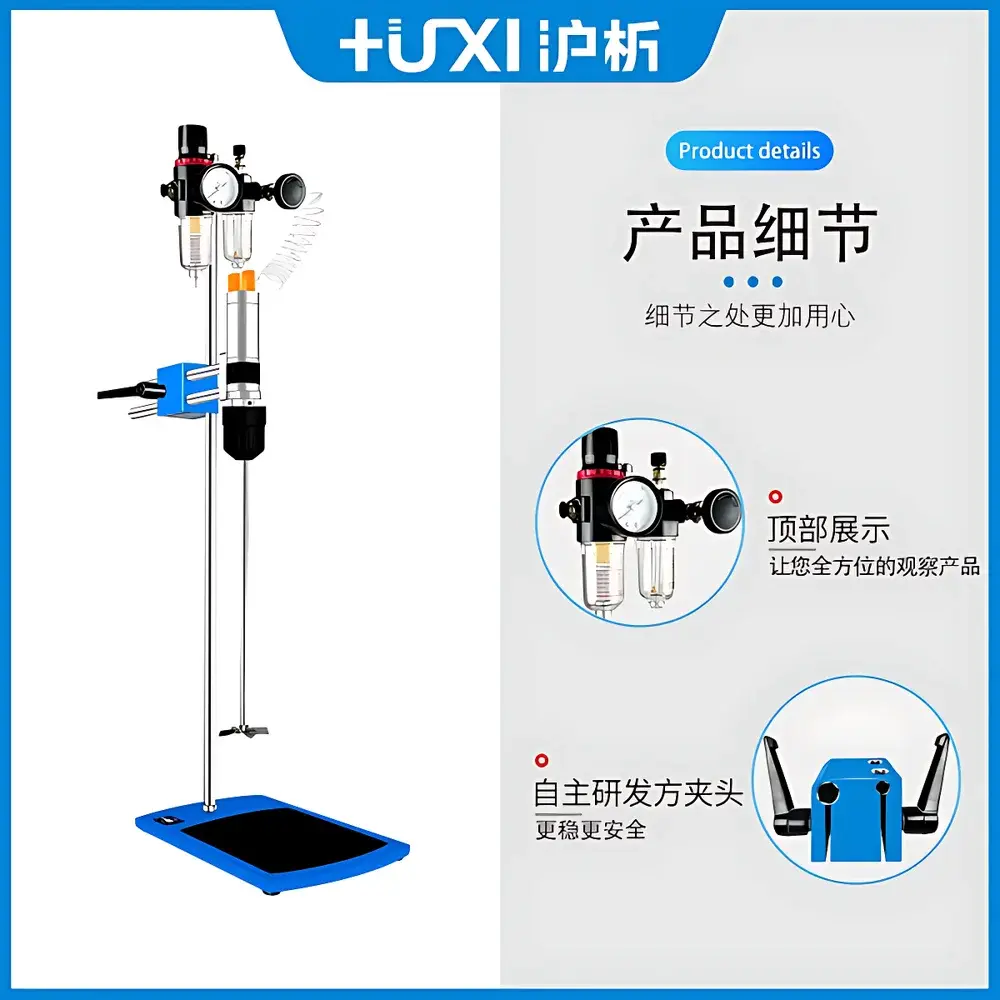
| Clamping Mechanism | Self-locking chuck |
| Vertical Adjustment | Dual-hole square clamp |
| Safety Certification Basis | Spark-free, static-dissipative pneumatic motor design |
Overview
The HUXI HJQ-2 Pneumatic Laboratory Stirrer is an intrinsically safe mixing solution engineered for demanding laboratory and pilot-scale applications where electrical spark hazards, high ambient temperatures, or flammable vapors preclude the use of conventional electric stirrers. Unlike electromechanical systems, this unit operates exclusively on compressed air—converting pneumatic energy into rotational motion via a precision-engineered vane-type air motor. This fundamental design eliminates electrical components from the drive train, ensuring zero risk of ignition in Class I, Division 1 hazardous locations (per NEC/IEC 60079 standards). The device delivers consistent torque output across its full speed range (0–3000 rpm), enabling reliable agitation of low- to medium-viscosity liquids—including organic solvents, paint formulations, reactive polymer precursors, and solvent-based coatings—without thermal drift or electromagnetic interference. Its compact footprint (315 × 200 × 800 mm) and lightweight construction (9.5 kg net) support flexible integration into fume hoods, glove boxes, and explosion-proof enclosures.
Key Features
- Intrinsically safe operation: Spark-free, static-dissipative air motor compliant with ATEX/IECEx principles for use in flammable atmospheres;
- High-torque capability: Rated torque ≤80 N·cm enables direct-load startup and stable mixing of viscous batches up to 5000 cP;
- Precision speed control: Continuous 0–3000 rpm regulation via inline pressure regulator; integrated pressure gauge enables real-time monitoring of supply pressure (0–6 bar);
- Robust mechanical interface: Imported self-locking chuck ensures <0.05 mm radial runout and secure impeller retention under dynamic load;
- Adjustable vertical positioning: Dual-hole square clamp allows infinite height adjustment and rigid fixation across diverse vessel geometries (50 mL–30 L capacity);
- Modular impeller compatibility: Accepts standard ISO 228/ISO 724 threaded shafts; supports interchangeable four-blade stainless steel impellers (included) as well as optional anchor, propeller, and paddle configurations.
Sample Compatibility & Compliance
The HJQ-2 is validated for batch-wise mixing of non-corrosive and mildly corrosive liquid-phase samples within ambient temperature limits of 5–40 °C and relative humidity ≤80%. It is routinely deployed in R&D laboratories handling volatile organic compounds (VOCs), epoxy resins, nitrocellulose lacquers, and peroxide-initiated monomer systems. While not certified to UL/CSA or IEC 61000-6-2 by default, its pneumatic architecture inherently satisfies key functional safety requirements outlined in ISO 8573-1 (compressed air purity), ISO 13849-1 (control system safety integrity), and NFPA 497 (recommended practices for hazardous area classification). Users operating under GLP or GMP frameworks may implement documented calibration procedures for air pressure and rotational speed using traceable NIST-certified instruments.
Software & Data Management
As a manually operated, analog-control pneumatic device, the HJQ-2 does not incorporate embedded firmware, digital displays, or data logging capabilities. All operational parameters—including inlet pressure, rotational speed (measured externally via handheld tachometer), and mixing duration—are recorded manually in laboratory notebooks or electronic lab notebooks (ELNs) compliant with 21 CFR Part 11 when configured with audit-trail-enabled software platforms. Optional integration with programmable air regulators or industrial PLC-controlled pneumatic manifolds permits semi-automated sequence execution in validated process environments.
Applications
- Agitation of flammable solvent mixtures during formulation development (e.g., acetone/toluene-based coatings);
- Mixing heat-sensitive reagents in exothermic reaction monitoring setups;
- Homogenization of pigment dispersions prior to rheological or particle size analysis;
- Stirring in inert-atmosphere gloveboxes (N₂ or Ar) where electrical feedthroughs pose contamination or leakage risks;
- QC testing of viscosity stability in batch-manufactured adhesives and sealants;
- Preparation of calibration standards for spectrophotometric or chromatographic analysis where electromagnetic cleanliness is critical.
FAQ
Is the HJQ-2 suitable for continuous-duty operation?
Yes—when supplied with clean, dry, oil-free compressed air meeting ISO 8573-1 Class 3.2.3 specifications and maintained within the rated pressure range (0.5–6 bar), the motor supports uninterrupted operation for ≥8 hours per shift.
Can it be used in a Class I, Division 1 hazardous location?
It meets the fundamental safety criteria for such environments due to its spark-free design; however, final area classification approval requires site-specific assessment per NFPA 497 and local authority review.
What maintenance is required?
Monthly inspection of air filter elements, quarterly lubrication of vane motor bearings with food-grade silicone grease (if permitted by facility policy), and annual verification of chuck concentricity using optical alignment tools.
Does it comply with FDA 21 CFR Part 11?
The device itself has no electronic records; compliance is achieved at the procedural level through ELN documentation practices and controlled access to calibration records.
Are custom impellers available?
Yes—HUXI provides OEM machining services for impellers conforming to ASTM D562 and ISO 2557-2 dimensional tolerances, including Hastelloy C-276, titanium Grade 2, and PTFE-coated variants upon request.



