
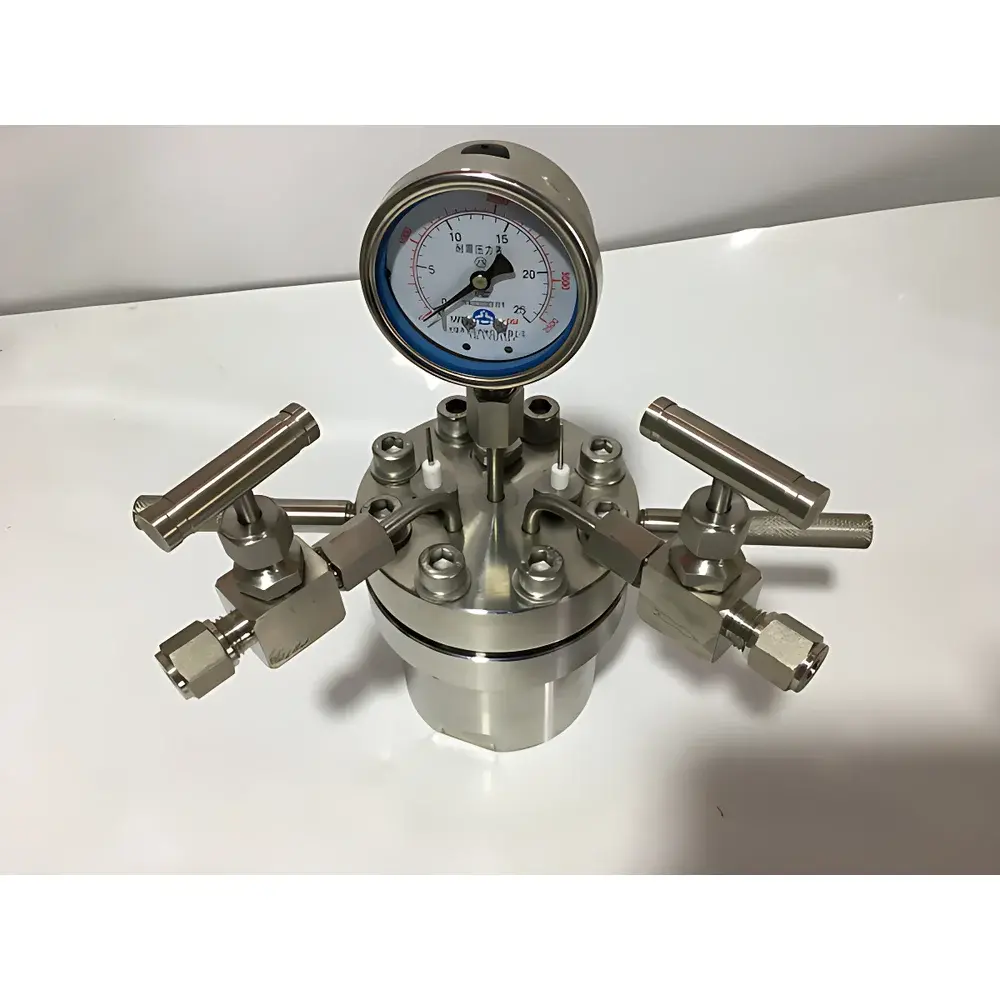
Zhengxin WP-100ML Hydrogenation Electrode Autoclave Reactor
| Brand | Zhengxin Instrument Factory (ZXYIQI) |
|---|---|
| Origin | Jiangsu, China |
| Manufacturer Type | Authorized Distributor |
| Country of Origin | China |
| Model | WP-100ML |
| Capacity | 100 mL |
| Construction Material | Stainless Steel (304/316L standard) |
| Operating Pressure Range | Low-pressure, up to 70 MPa (optional configuration) |
| Vacuum Capability | –0.1 MPa |
| Heating Method | Integrated Modular Electric Heater |
| Temperature Control | PID Intelligent Controller with Auto-Tuning (AT) and Timer |
| Temperature Range | Ambient to 1000 °C (configurable) |
| Electrode Configuration | 1–4 electrodes, customizable (Pt, Ag, or user-specified) |
| Safety System | Pressure Relief Valve + Explosion-Proof Housing |
| Cooling | Optional Finned Heat Dissipation Assembly |
| Compliance | Designed for GLP-compliant lab environments |
Overview
The Zhengxin WP-100ML Hydrogenation Electrode Autoclave Reactor is a precision-engineered benchtop pressure reactor designed for electrochemical hydrogenation, catalytic reduction, gas–liquid–solid phase reactions, and controlled electrochemical synthesis under elevated temperature and pressure. It operates on the principle of sealed high-integrity containment combined with integrated electrochemical measurement capability—enabling real-time monitoring of redox behavior during hydrogen uptake, electrode kinetics, and catalyst performance evaluation. The reactor’s modular architecture separates the heating module from the pressure vessel body, facilitating rapid assembly, cleaning, and electrode servicing—critical for reproducible electrochemical experimentation in academic research labs, pharmaceutical process development, and advanced materials synthesis.
Key Features
- Modular design: Fully detachable heater and reactor body for efficient maintenance, electrode replacement, and cross-contamination prevention.
- Electrode integration: Configurable mounting ports (1–4 positions) for inert or catalytically active electrodes—including Pt mesh, Ag wire, Ni foam, or custom-configured working/reference/counter electrode assemblies.
- Precision thermal management: LCD-display PID controller with auto-tuning (AT), ±1 °C (standard) or ±0.1 °C (optional) accuracy, ramp rate control (≤10 °C/min), and programmable timer functions.
- Robust pressure containment: Seamless stainless steel 304/316L construction rated for service up to 70 MPa (with optional high-pressure configuration); includes calibrated stainless steel Bourdon tube pressure gauge (0–100 MPa range).
- Vacuum & gas handling: Dual high-purity needle valves (3 mm and 6 mm Swagelok-compatible fittings) for vacuum evacuation, inert gas purging (N₂, Ar), and controlled H₂ introduction—compatible with mass flow controllers and gas chromatography interfaces.
- Safety-certified protection: Dual-stage overpressure relief system with rupture disc and spring-loaded safety valve; explosion-proof housing meets IEC 60079-0 requirements for laboratory use.
- Thermal efficiency: Optional finned aluminum heat sink assembly for active cooling during exothermic electrochemical cycles, minimizing thermal drift and improving long-term sensor stability.
Sample Compatibility & Compliance
The WP-100ML supports heterogeneous, homogeneous, and electrocatalytic reactions involving organic substrates, metal complexes, nanoparticle dispersions, and proton-exchange electrolytes. Compatible with corrosive media via optional liners (quartz, Hastelloy C-276, titanium, or zirconium). All wetted parts comply with USP Class VI and ASTM F899 standards for biocompatibility and extractables testing. Designed for adherence to Good Laboratory Practice (GLP) and pre-GMP environments: audit-ready operation logs (when paired with optional data acquisition module), traceable calibration records, and full documentation support per ISO/IEC 17025 clause 7.8.
Software & Data Management
While the base unit operates via standalone PID controller, optional RS485/USB interface enables integration with LabVIEW™, MATLAB®, or custom SCADA platforms. Real-time logging of temperature, pressure, and (when equipped with potentiostat interface) current/voltage profiles supports time-synchronized analysis. Data export formats include CSV and TDMS. Firmware supports 21 CFR Part 11–compliant user authentication, electronic signatures, and immutable audit trails when deployed with validated third-party software suites.
Applications
- Electrocatalytic hydrogenation of unsaturated bonds (alkenes, nitroarenes, nitriles) under mild H₂ partial pressures.
- High-temperature/pressure studies of PEM fuel cell catalyst degradation and CO tolerance.
- In situ XRD/XAS-compatible reaction cells (with quartz or sapphire viewports).
- Pharmaceutical intermediate synthesis requiring strict oxygen/moisture exclusion and redox potential control.
- Development of single-atom catalysts and MOF-based electrochemical reactors.
- Accelerated aging tests of battery electrode materials under simulated operating conditions.
FAQ
Can the WP-100ML be used for hydrogen gas reactions at >10 bar?
Yes—standard configuration supports up to 10 MPa (100 bar); higher-pressure variants (up to 70 MPa) are available with reinforced sealing and certified pressure components.
Is electrode wiring feedthrough compatible with standard potentiostats?
Yes—feedthroughs accept 2 mm diameter ceramic-insulated leads; optional BNC or LEMO connectors available upon request.
What certifications accompany the reactor for international shipment?
CE marking (for non-explosive zone use), RoHS compliance, and manufacturer’s Declaration of Conformity per Machinery Directive 2006/42/EC are provided with each unit.
Can quartz or sapphire viewports be installed for in situ spectroscopy?
Yes—custom viewport integration (diameter 10–25 mm, thickness 5–10 mm) is supported with O-ring-sealed flange mounts and anti-reflective coating options.
Is technical support available for method development and validation?
Yes—Zhengxin provides application engineering consultation, including reactor setup protocols, safety interlock configuration, and GLP-aligned operational SOP templates.



