
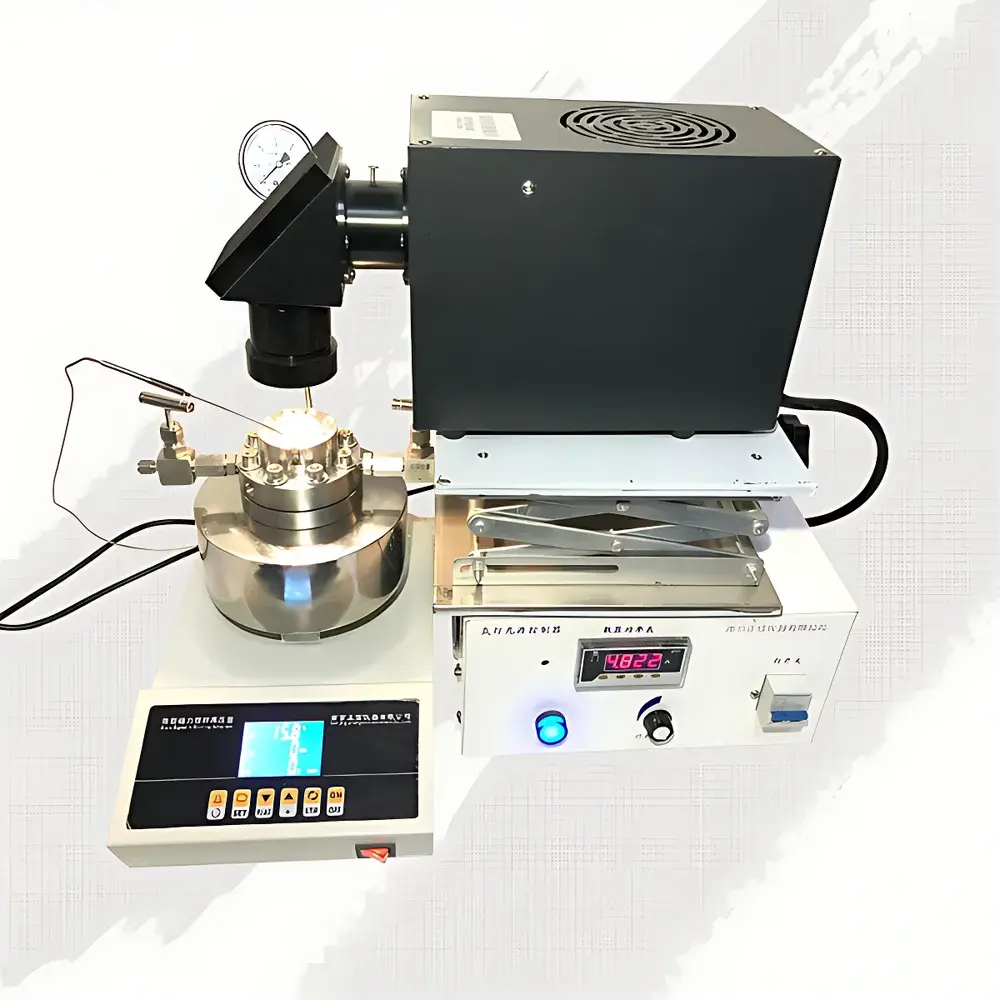
Zhengxin Instruments EPSK Series Photocatalytic High-Pressure Reaction Vessel
| Brand | Zhengxin Instruments |
|---|---|
| Model | EPSK |
| Type | Photocatalytic High-Pressure Batch Reactor |
| Construction Material | 304/316L/310S/904L Stainless Steel, Hastelloy, Titanium |
| Working Volume | 25–1000 mL |
| Operating Pressure Range | –0.1 to 40 MPa |
| Vacuum Capability | Up to 10 MPa (gauge vacuum) |
| Maximum Temperature | 350 °C |
| Temperature Control | Dual-loop PID with K-type thermocouple (±1 °C accuracy) |
| Stirring | Magnetic suspension drive, 0–1000 rpm, bidirectional programmable |
| Viewport Material | Sapphire (standard), optional fused quartz for low-pressure applications |
| Sealing | Dual-stage soft/hard sealing system with Hastelloy rupture disc |
| Heating | Embedded modular stainless steel heater |
| Safety Systems | Overtemperature/overpressure auto-alarm, pressure-relief burst disc, timed shutdown |
| Compliance | Designed for GLP-compliant laboratory use |
Overview
The Zhengxin Instruments EPSK Series Photocatalytic High-Pressure Reaction Vessel is an engineered batch reactor designed for controlled photochemical synthesis and catalytic degradation under elevated temperature and pressure conditions. It operates on the principle of heterogeneous photocatalysis—where incident UV–visible light activates semiconductor catalysts (e.g., TiO₂, g-C₃N₄, or plasmonic metal oxides) immobilized on reactor internals or suspended in solution—enabling bond cleavage, redox transformations, and C₁ chemistry under rigorously defined thermal and mechanical boundary conditions. Unlike ambient-pressure photoreactors, the EPSK series integrates robust pressure containment (up to 40 MPa), precise dual-loop thermal regulation, and high-transmittance sapphire viewport technology to support real-time optical access during pressurized irradiation. This architecture is essential for kinetic studies of CO₂ hydrogenation to CH₃OH or CH₄, NOₓ abatement, formaldehyde mineralization, and other gas–liquid–solid triphasic reactions where mass transfer limitations and photon flux attenuation must be quantitatively decoupled from intrinsic catalytic activity.
Key Features
- High-integrity pressure vessel fabricated from seamless forged 316L or Hastelloy C-276, with optional titanium or 904L variants for aggressive halide- or fluoride-containing media.
- Sapphire viewport (≥99.9% transmittance from 190–5500 nm) mounted in a reinforced flanged interface, rated for full operational pressure and thermal cycling up to 350 °C.
- Dual-stage sealing system combining fluoropolymer-encapsulated metal gaskets (soft seal) and precision-machined alloy seating surfaces (hard seal) to ensure leak-tight integrity across repeated thermal–pressure cycles.
- Magnetic suspension stirring mechanism eliminates rotating shaft penetrations, eliminating dynamic seal failure modes and enabling maintenance-free operation at 0–1000 rpm under inert or reactive atmospheres.
- Modular embedded heating system with rapid thermal response (<5 min to 250 °C), coupled with PID-controlled dual-sensor feedback (vessel wall + internal probe) to suppress overshoot and stabilize temperature within ±1 °C.
- Integrated safety architecture: real-time pressure monitoring via digital transducer, automatic acoustic/visual alarm upon deviation beyond user-defined thresholds, and certified Hastelloy rupture disc calibrated to 110% of maximum allowable working pressure (MAWP).
Sample Compatibility & Compliance
The EPSK reactor accommodates heterogeneous slurries, viscous organometallic precursors, supercritical CO₂ mixtures, and aqueous photocatalytic suspensions. Its chemically inert internal surface (standard PTFE or PPL lining) ensures compatibility with strong acids (e.g., HNO₃, HF-diluted systems), alkalis, and oxidants (H₂O₂, persulfates). All wetted materials conform to ASTM F899 (stainless steels) and ASTM B575 (Hastelloy), while pressure components are ASME BPVC Section VIII Div. 1–rated. The system supports audit-ready operation under GLP and GMP environments: electronic logs capture timestamped temperature/pressure/stirring profiles, and optional firmware enables 21 CFR Part 11–compliant user authentication and data immutability.
Software & Data Management
While the base configuration employs a front-panel LCD interface with programmable ramp–soak–hold thermal profiles and timer-based reaction termination, optional Ethernet-enabled controllers provide remote SCADA integration via Modbus TCP or OPC UA. All process variables—including real-time irradiance (when paired with calibrated photodiode input), pressure decay rates, and stirrer torque estimation—are logged at 1 Hz resolution to encrypted CSV or SQLite databases. Exported datasets include ISO 8601 timestamps, sensor calibration IDs, and operator credentials—facilitating traceable reporting per ISO/IEC 17025 clause 7.7.
Applications
- Photocatalytic CO₂ reduction pathways: quantitative evaluation of CH₄, CH₃OH, HCOOH, and C₂H₆ selectivity under tunable pCO₂ (0.1–10 MPa) and H₂ co-feed conditions.
- Advanced oxidation processes (AOPs): kinetic modeling of •OH-mediated formaldehyde degradation in wastewater simulants under UV-A/UV-C irradiation.
- Nitrogen oxide remediation: stoichiometric and catalytic reduction of NO/NO₂ mixtures using TiO₂–Pt composites under simulated flue-gas composition.
- High-pressure photo-Fenton chemistry: Fe²⁺/H₂O₂ activation kinetics in acidic chloride media at 2–8 MPa, monitored via inline UV-Vis spectroscopy.
- Materials synthesis: solvothermal photocatalyst crystallization (e.g., BiVO₄, ZnIn₂S₄) with simultaneous light exposure and controlled nucleation kinetics.
FAQ
What light sources are compatible with the EPSK reactor?
Standard configurations accept collimated LED arrays (365–455 nm), mercury-xenon arc lamps (200–800 nm), and fiber-coupled laser diodes. Optical coupling requires external port alignment; custom flange-mounted collimators are available.
Can the reactor be used for in situ Raman or FTIR spectroscopy?
Yes—the sapphire viewport meets ASTM F2617 specifications for spectroscopic-grade transmission. Optional side-arm quartz ports (for orthogonal probe insertion) and motorized XYZ stages enable spatially resolved spectral acquisition.
Is third-party calibration documentation provided?
Each unit ships with NIST-traceable calibration certificates for pressure transducer, K-type thermocouple, and rotational speed encoder, valid for 12 months from date of manufacture.
How is catalyst recovery performed post-reaction?
The reactor includes a bottom-mounted PTFE-lined sampling valve and optional integrated filtration sleeve (3–10 µm pore size); for nanoscale catalysts, a centrifuge-compatible discharge vial is available as an accessory.
Does the system support automated gas dosing and analysis?
Gas-phase operation is supported via integrated Swagelok fittings (¼″ VCR) for mass flow controllers and online GC/TCD interfacing; OEM integration kits for Agilent 7890/8890 systems are available upon request.



