
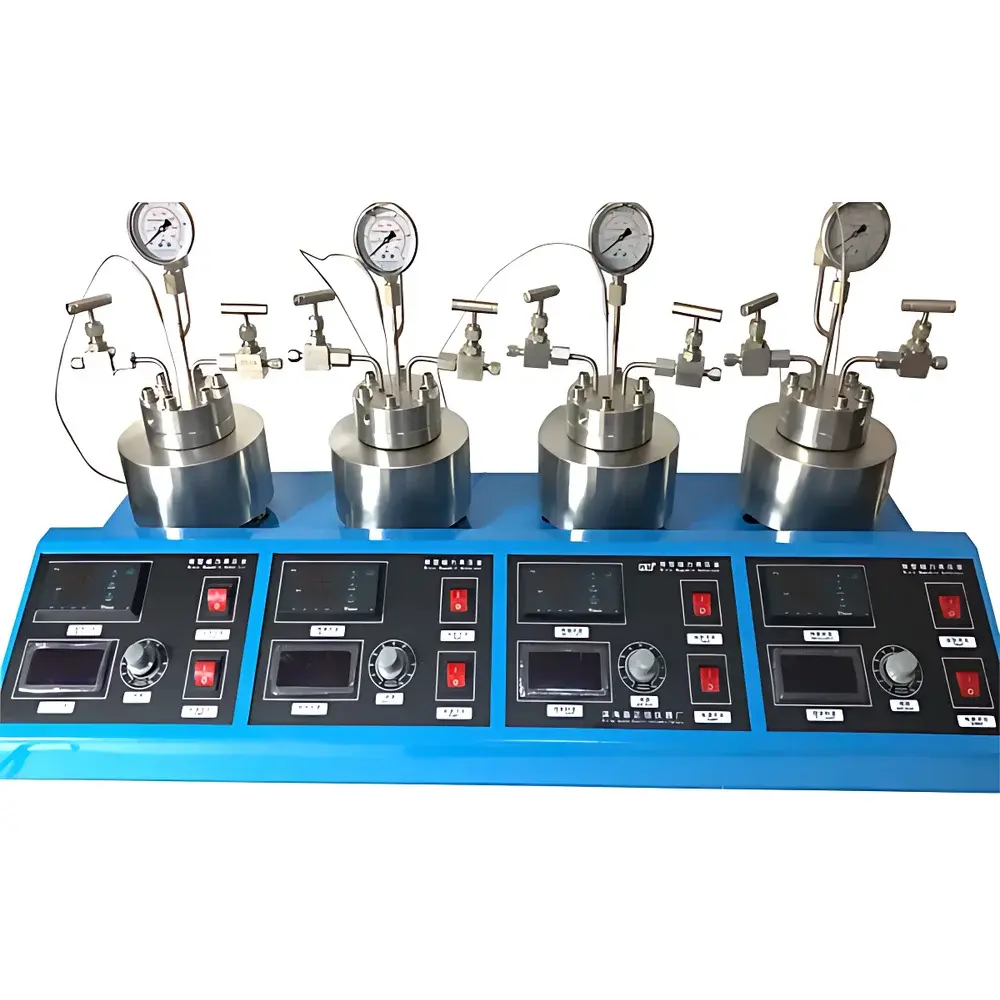
Zhengxin PSK-100 Multi-Vessel Magnetic Stirring Reactor System
| Brand | Zhengxin Instrument Factory |
|---|---|
| Origin | Jiangsu, China |
| Model | PSK-100 |
| Vessel Capacity | 50–5000 mL (configurable per vessel) |
| Construction Material | 316L stainless steel (standard) |
| optional | 304 SS, Hastelloy, titanium, zirconium, PTFE/PPL/quartz liners |
| Operating Pressure Range | –0.1 to 60 MPa |
| Temperature Range | 0–350 °C |
| Heating Method | Modular electric cartridge heaters (400–1800 W total) |
| Stirring Mechanism | Magnetic coupling with external rare-earth drive motor |
| Stirring Speed | 0–1500 rpm |
| Temperature Control | LCD-display PID controller with auto-tuning (AT), timer function (0–999 min/h), dual-mode timing (hold-time / run-time) |
| Vacuum Capability | ≤ –0.1 MPa (absolute) |
| Pressure Monitoring | Stainless steel Bourdon-tube pressure gauge |
| Gas Handling | 3 mm Swagelok-compatible inlet/outlet needle valves |
| Compliance | Designed for GLP-compliant synthesis workflows |
Overview
The Zhengxin PSK-100 Multi-Vessel Magnetic Stirring Reactor System is an engineered platform for parallel batch synthesis under controlled temperature, pressure, and inert-atmosphere conditions. It employs magnetic coupling technology to achieve hermetic sealing between the reaction vessels and the external drive unit—eliminating mechanical shaft seals and minimizing contamination risk while enabling operation under vacuum or elevated pressure. Each reactor vessel operates independently with dedicated thermal regulation, stirring control, and real-time process monitoring. The system is optimized for laboratory-scale catalytic screening, kinetic studies, crystallization optimization, and high-throughput reaction condition mapping in pharmaceutical, fine chemical, and materials science research environments.
Key Features
- Modular multi-vessel architecture supporting 2–6 identical or mixed-capacity reactors (50–5000 mL per vessel), configurable for uniform or differentiated operating parameters.
- 316L stainless steel construction (ASTM A240) for main pressure boundary components; optional liner materials—including PTFE, PPL, quartz, titanium, and zirconium—ensure compatibility with aggressive reagents, halogenated solvents, or high-pH media.
- Integrated modular electric heating elements provide rapid thermal response and spatial uniformity (±1.5 °C across vessel volume at steady state), with independent power zoning per vessel where configured.
- Magnetic drive system utilizes high-coercivity NdFeB permanent magnets and brushless DC motors delivering consistent torque up to 1500 rpm—enabling efficient mixing of viscous slurries or heterogeneous suspensions without seal wear or lubricant ingress.
- LCD-based PID temperature controller features auto-tuning (AT), dual-mode timing (hold-time for isothermal holds; run-time for total experiment duration), and programmable ramp-soak profiles.
- Full vessel–heater decoupling allows rapid disassembly for cleaning, inspection, or liner replacement—reducing downtime between experiments and supporting routine maintenance per ISO/IEC 17025 Section 6.4.
- Gas management subsystem includes precision Swagelok®-compatible 3 mm needle valves (inlet/outlet), calibrated stainless steel pressure gauges (0–60 MPa full scale), and optional integrated mass flow controllers for quantitative gas dosing.
Sample Compatibility & Compliance
The PSK-100 accommodates a broad range of sample types including organometallic precursors, air-sensitive catalysts, pyrophoric reagents, and thermally labile intermediates. Its sealed design supports Schlenk-line equivalent operations—including vacuum degassing, inert gas purging (N₂, Ar), and controlled-pressure hydrogenation. All wetted surfaces meet USP Class VI biocompatibility standards when specified with PTFE or PPL liners. Pressure containment complies with PED 2014/68/EU Annex I essential safety requirements for Group 1 fluids (Category IV) when operated within rated limits. Documentation packages include material traceability certificates, pressure test reports (hydrostatic at 1.5× MAWP), and calibration records for temperature and pressure sensors—supporting audit readiness for FDA 21 CFR Part 11–aligned electronic lab notebooks (ELNs).
Software & Data Management
While the base configuration uses standalone PID controllers, optional RS485/Modbus RTU interface enables integration with third-party SCADA or LIMS platforms (e.g., LabArchives, DeltaV, or custom Python-based acquisition scripts). Temperature, pressure, and stir speed data can be logged at user-defined intervals (1–60 s) with timestamped CSV export. Audit trails record parameter changes, alarm events, and operator logins—meeting ALCOA+ principles for data integrity. Firmware updates are delivered via secure USB key with cryptographic signature verification to ensure traceability and prevent unauthorized modification.
Applications
- Parallel catalyst screening across variable T/P/gas composition matrices for asymmetric hydrogenation or C–C coupling reactions.
- Crystallization process development under controlled supersaturation, including anti-solvent addition kinetics and polymorph screening.
- Hydrothermal synthesis of metal–organic frameworks (MOFs) and nanomaterials requiring precise pH, redox, and thermal gradients.
- Accelerated stability testing of active pharmaceutical ingredients (APIs) under stress conditions (e.g., oxidative, thermal, hydrolytic).
- Electrochemical precursor synthesis where oxygen exclusion and reproducible mixing intensity are critical to particle morphology.
FAQ
Can the PSK-100 be used for exothermic reactions requiring active cooling?
Yes—when paired with external recirculating chillers (–20 to +150 °C) connected via jacketed vessel variants (optional configuration). Standard models rely on passive heat dissipation above ambient.
Is validation documentation available for GMP environments?
IQ/OQ protocols and associated templates are provided upon request; PQ execution requires site-specific operational qualification under user-defined test cases aligned with ICH Q7 Annex 19.
What maintenance intervals are recommended for magnetic drive units?
No scheduled maintenance is required for the magnetic coupling assembly; however, annual verification of magnet alignment tolerance (±0.1 mm) and bearing preload is advised per manufacturer service bulletin SB-PSK-2023-04.
Are explosion-proof versions available for flammable solvent handling?
ATEX-certified variants (II 2G Ex db IIB T4 Gb) with intrinsically safe stir controllers and purge-protected enclosures are available as custom-engineered configurations.
How is trace moisture controlled during inert-gas purging?
Optional inline desiccant traps (molecular sieve 3Å) and dew point monitors (–70 °C Td) can be integrated into the gas supply train to achieve <1 ppmv H₂O in reactor headspace.



