
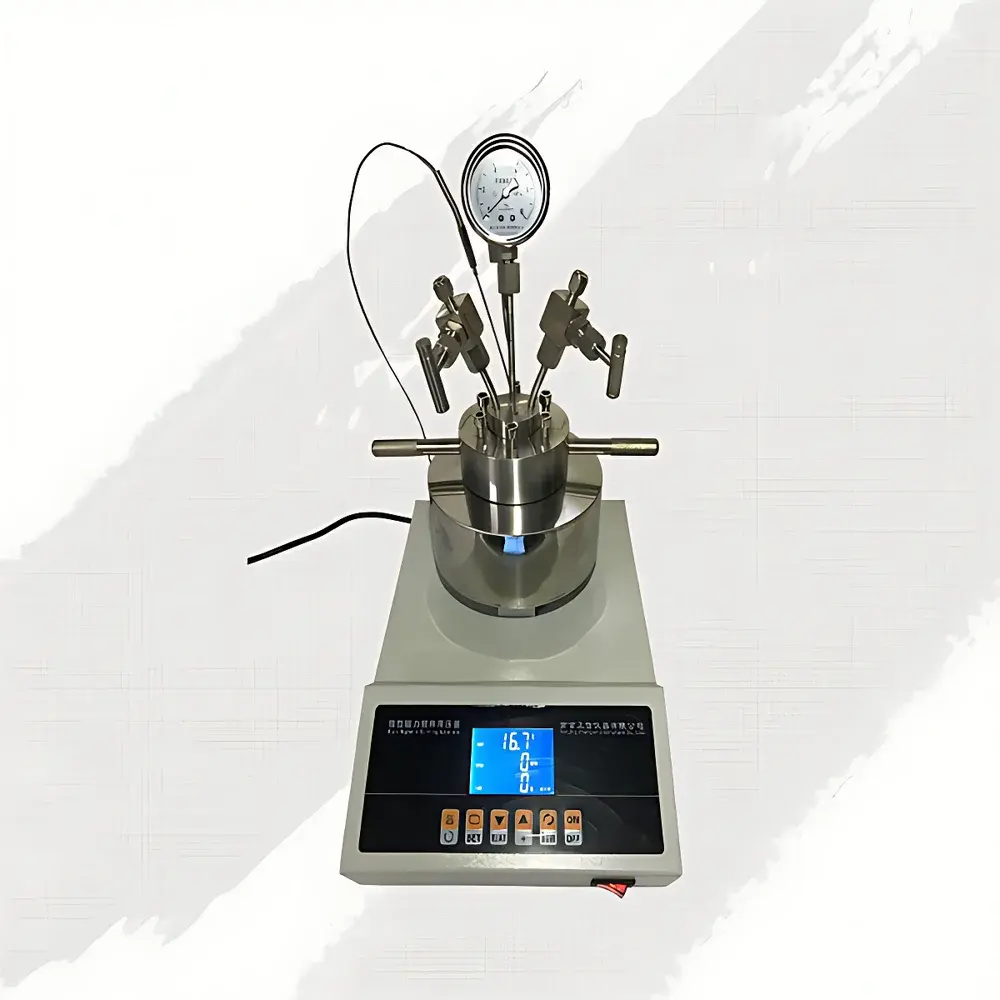
Zhengxin PSK-200mL Quick-Release Magnetic Stirring Laboratory Reactor
| Brand | Zhengxin Instrument Factory |
|---|---|
| Origin | Jiangsu, China |
| Model | PSK-200mL |
| Capacity | 200 mL (usable volume) |
| Working Pressure | 0–25 MPa |
| Vacuum Range | –0.1 to 0 MPa (gauge) |
| Operating Temperature | 0–350 °C |
| Heating Method | Embedded modular stainless steel heater |
| Stirring Mechanism | Rare-earth permanent magnet coupling with brushless DC motor |
| Stirring Speed | 0–1000 rpm |
| Sealing Type | Dual-stage (soft PTFE + hard metal alloy face seal) |
| Temperature Sensor | K-type thermocouple (316L sheath, Φ2.0 mm) |
| Control System | PID-based dual-loop temperature control with programmable ramp/soak profiles |
| Safety Features | Over-temperature alarm, over-pressure rupture disc (Hastelloy C-276), automatic pressure relief |
| Construction Materials | Optional 304, 316L, 310S, 904L, Hastelloy C-276, or titanium alloy body |
| Internal Lining | PTFE, quartz, or PPL (optional) |
| Power Supply | 220 V AC / 50 Hz (110 V option available) |
Overview
The Zhengxin PSK-200mL Quick-Release Magnetic Stirring Laboratory Reactor is an engineered solution for controlled, small-scale chemical synthesis under elevated temperature and pressure conditions. Designed using Couette-flow magnetic coupling principles, it enables hermetic containment while delivering precise agitation without mechanical shaft penetration—eliminating seal wear and leakage risks common in conventional stirred reactors. Its monolithic forged body, machined in a single CNC operation, ensures structural integrity under cyclic thermal and pressure loads up to 25 MPa. The reactor operates within a validated temperature range of 0–350 °C and supports vacuum-to-high-pressure environments (–0.1 to +25 MPa gauge), making it suitable for catalytic hydrogenation, polymerization, supercritical fluid reactions, and inert-atmosphere syntheses. It complies with fundamental design expectations aligned with ASME BPVC Section VIII Div. 1 for pressure boundary components and incorporates fail-safe mechanisms required for GLP-compliant laboratory workflows.
Key Features
- Quick-release flange system secured by 4/6/10 high-strength bolts—enabling rapid, tool-assisted separation of lid and vessel for efficient charging and sampling without disassembly of instrumentation.
- Dual-seal architecture: primary soft seal (PTFE or PPL) backed by secondary metal-to-metal face sealing (alloy-coated valve cores), rated for continuous operation at ≥300 °C and 20 MPa.
- Brushless DC drive with rare-earth magnetic coupling—delivering consistent torque transmission up to 1000 rpm with zero electromagnetic noise and >10,000-hour operational life under nominal load.
- Modular heating assembly with embedded aluminum-sheathed resistive elements—providing uniform thermal distribution and enabling full thermal decoupling from the reactor body for independent maintenance or replacement.
- PID-controlled dual-loop temperature regulation with programmable ramp/soak profiles; ±1 °C accuracy across the full operating range; integrated K-type thermocouple with 316L mineral-insulated sheath (Φ2.0 mm).
- Hastelloy C-276 rupture disc and spring-loaded safety valve—configured to activate at user-defined setpoints and meet ISO 4126-2 requirements for pressure-relief device certification.
Sample Compatibility & Compliance
The PSK-200mL reactor accommodates diverse sample chemistries including corrosive halogenated solvents, strong acids (e.g., H₂SO₄, HF), basic melts, and organometallic precursors. Optional linings—PTFE, fused quartz, or polyphenylsulfone (PPL)—extend compatibility into aggressive media where metallic wetted surfaces are unsuitable. Standard configurations meet general-purpose laboratory safety standards per IEC 61010-1 and include electrical insulation verification, grounding continuity testing, and CE-marked power modules. For regulated environments, optional audit-trail-enabled controllers support 21 CFR Part 11-compliant electronic records when paired with validated software packages. All pressure-bearing components undergo hydrostatic proof testing at 1.5× maximum allowable working pressure (MAWP) prior to shipment.
Software & Data Management
While the base unit features an integrated LCD interface with real-time display of temperature, pressure, stirring speed, and elapsed time, optional USB- or RS485-connected controllers enable external data logging via PC-based platforms compatible with ASTM E2500-13 traceability frameworks. Logged parameters include timestamped process variables, alarm events (with cause code), and manual override actions—all stored in CSV or XML format for integration into LIMS or ELN systems. Firmware supports configurable alarm hysteresis, password-protected parameter editing, and automatic shutdown on communication timeout—ensuring robustness during unattended overnight runs.
Applications
This reactor is routinely deployed in academic and industrial R&D settings for: catalytic screening (e.g., Fischer–Tropsch, hydrodesulfurization), step-growth and chain-growth polymerizations (polyesters, polyamides, epoxies), nanoparticle synthesis under supercritical CO₂, hydrogenation of unsaturated pharmaceutical intermediates, and kinetic studies of heterogeneous catalysis under realistic process conditions. Its compact footprint and modular design facilitate integration into automated reaction stations and parallel synthesis arrays, particularly where pressure-rated containment and reproducible mass transfer are critical.
FAQ
What materials are available for the reactor body and internal lining?
Standard body options include ASTM A240 304, 316L, 310S, 904L, Hastelloy C-276, and Grade 2 titanium. Linings include PTFE (up to 260 °C), fused quartz (inert to HF, ≤1000 °C short-term), and PPL (chemical resistance comparable to PTFE with higher creep resistance).
Can the reactor be operated under vacuum and positive pressure simultaneously?
Yes—it is rated for full vacuum (–0.1 MPa gauge) up to 25 MPa positive pressure, with all seals and gasketing validated across this entire differential range.
Is third-party calibration documentation provided?
Each unit ships with factory calibration certificates for temperature (NIST-traceable thermocouple) and pressure (deadweight tester-verified gauge), compliant with ISO/IEC 17025 guidelines for in-house calibration laboratories.
How is stirring performance verified at elevated temperatures?
Magnetic coupling efficiency is confirmed via torque-load testing at 300 °C ambient and 10 MPa internal pressure; minimum sustained speed retention is 95% of room-temperature nominal value.
Are custom geometries or port configurations supported?
Yes—Zhengxin accepts OEM drawings for non-standard flange layouts, additional thermowell or sampling ports, and integration-ready mounting brackets, subject to mechanical feasibility review and ASME code compliance verification.



