
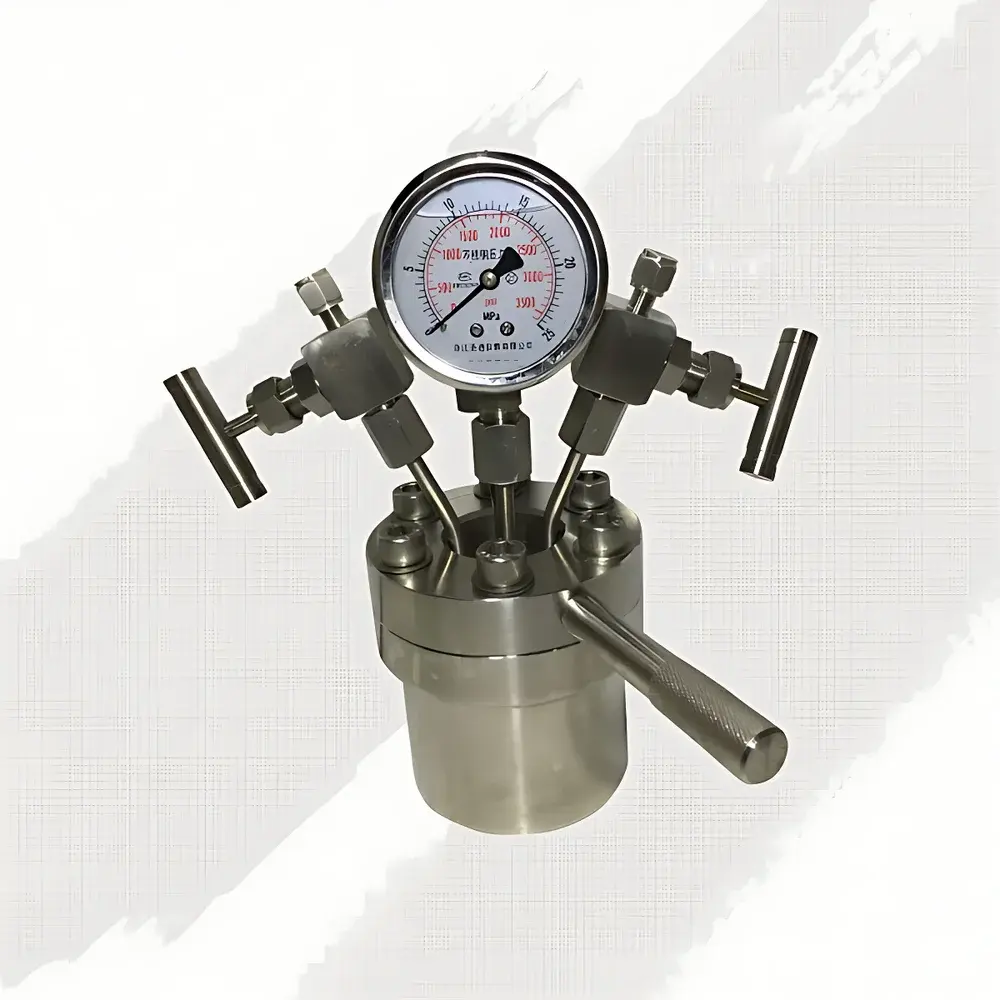
Zhengxin Instruments EP Series High-Temperature & High-Pressure Reaction Vessel
| Brand | Zhengxin Instruments |
|---|---|
| Origin | Jiangsu, China |
| Manufacturer Type | Authorized Distributor |
| Country of Origin | China |
| Model | EP-150ML |
| Capacity | 150 mL |
| Construction Material | 304 Stainless Steel |
| Operating Pressure Range | –0.1 to 6 MPa |
| Operating Temperature Range | 0–400 °C |
| Vacuum Capability | –0.1 MPa (absolute) |
| Heating Method | External Electric Heating Mantle |
| Temperature Control | LCD PID Controller (±1 °C accuracy, ≤10 °C/min ramp rate) |
| Optional Accessories | High-Pressure Inlet/Outlet Needle Valves (1/8″ & 1/4″ Swagelok®-compatible), Digital Pressure Gauge, PT100 Immersion Thermocouple, Rupture Disc Safety Relief, Finned Heat Dissipation Sleeve, Quartz or Metal Liner |
Overview
The Zhengxin Instruments EP Series High-Temperature & High-Pressure Reaction Vessel is an engineered laboratory-scale batch reactor designed for controlled chemical synthesis, catalytic studies, hydrothermal reactions, and material precursor development under elevated thermal and pressure conditions. Built upon Couette-type sealed vessel architecture with static internal geometry, the EP-150ML operates on a robust pressure-retention principle utilizing precision-machined conical sealing surfaces and high-torque torque-controlled closure mechanisms. Its design conforms to fundamental safety requirements outlined in ISO 4775 (Laboratory Glassware — Pressure Vessels) and incorporates mechanical integrity considerations aligned with ASME BPVC Section VIII, Division 1 guidelines for low-volume pressure containment systems. The vessel supports both inert-atmosphere processing and reactive gas introduction (e.g., H₂, CO, NH₃, O₂), enabling reproducible kinetic investigations and phase behavior analysis across academic research labs, polymer R&D centers, and fine chemical process development units.
Key Features
- Modular pressure containment system featuring 304 stainless steel main body with optional upgrade paths to 316L, Hastelloy C-276, titanium, or zirconium for aggressive media compatibility
- Full-range operational envelope: –0.1 MPa (vacuum) to +6 MPa gauge pressure, with continuous duty up to 400 °C using external heating mantles
- Integrated dual-seal configuration combining metal-to-metal conical seating and auxiliary elastomeric secondary seal (FKM/Viton® rated to 300 °C)
- Standardized 1/8″ and 1/4″ Swagelok®-compatible tube fittings for inlet/outlet gas lines, facilitating seamless integration with mass flow controllers and gas purification modules
- LCD-based PID temperature controller with programmable ramp/soak profiles, real-time data logging via RS485 interface, and ±1 °C steady-state accuracy
- Factory-calibrated pressure monitoring capability (optional digital gauge with 0.5% FS accuracy) and certified rupture disc assembly (ASME-compliant burst tolerance at 1.5× MAWP)
- Thermal management options include finned aluminum heat sink sleeves for passive cooling and threaded ports for active coolant loop integration
Sample Compatibility & Compliance
The EP-150ML accommodates heterogeneous, homogeneous, and slurry-phase reaction mixtures including organometallic complexes, nanoparticle precursors, biomass derivatives, and corrosion-prone electrolytes. Internal liner options—quartz, PTFE-coated stainless steel, or custom alloy inserts—extend compatibility to HF-containing systems, molten salts, and strongly oxidizing environments. All standard configurations meet general laboratory safety standards per EN 61000-6-3 (EMC) and IEC 61010-1 (electrical safety). Optional accessories comply with ISO 15190:2020 (laboratory biosafety) when used with appropriate ventilation and containment protocols. Documentation packages support GLP audit readiness, including calibration certificates for temperature and pressure transducers traceable to NIST standards.
Software & Data Management
While the base unit operates via standalone PID controller, optional PC connectivity enables data acquisition through Modbus RTU protocol (RS485) or USB-to-serial adapter. Compatible software platforms support time-stamped parameter logging (T, P, t), alarm event tagging, and export to CSV/Excel formats. Audit trail functionality—including user login history, setpoint modification logs, and calibration timestamping—meets minimum requirements for FDA 21 CFR Part 11 compliance when deployed in regulated QC/QA environments. Firmware updates are delivered via secure HTTPS portal; no cloud dependency or remote access services are embedded.
Applications
- Hydrothermal synthesis of metal oxides, MOFs, and quantum dots
- Catalytic hydrogenation, oxidation, and carbonylation screening under tunable p–T conditions
- Supercritical fluid extraction method development (CO₂, ethanol)
- Electrolyte stability testing for next-generation battery chemistries
- Corrosion resistance evaluation of candidate alloys in simulated geothermal brines
- Pre-polymerization kinetics of thermosetting resins and silicone elastomers
- Green chemistry route optimization involving solvent-free or low-solvent stoichiometries
FAQ
What is the maximum allowable working pressure (MAWP) for the EP-150ML?
The vessel is rated for continuous operation up to 6 MPa gauge pressure at 200 °C; derating applies above this temperature per ASME B16.5 interpolation guidelines.
Can the reactor be used under vacuum prior to gas pressurization?
Yes—the system supports evacuation to –0.1 MPa absolute and subsequent inert gas purging via dual needle valves for oxygen-sensitive reactions.
Is third-party calibration certification available for pressure and temperature sensors?
Calibration reports traceable to national metrology institutes (NIM, China) are provided upon request; NIST-traceable certificates incur additional lead time and cost.
Does the unit support automated pressure control via external solenoid valves?
No native closed-loop pressure control is built-in, but analog 4–20 mA output signals from optional pressure transducers enable integration with external PLC-based regulation systems.
What maintenance intervals are recommended for seals and safety components?
Metal gaskets require inspection after every 50 thermal cycles; rupture discs must be replaced after any activation event or annually during routine shutdowns per ISO 4126-2.



