
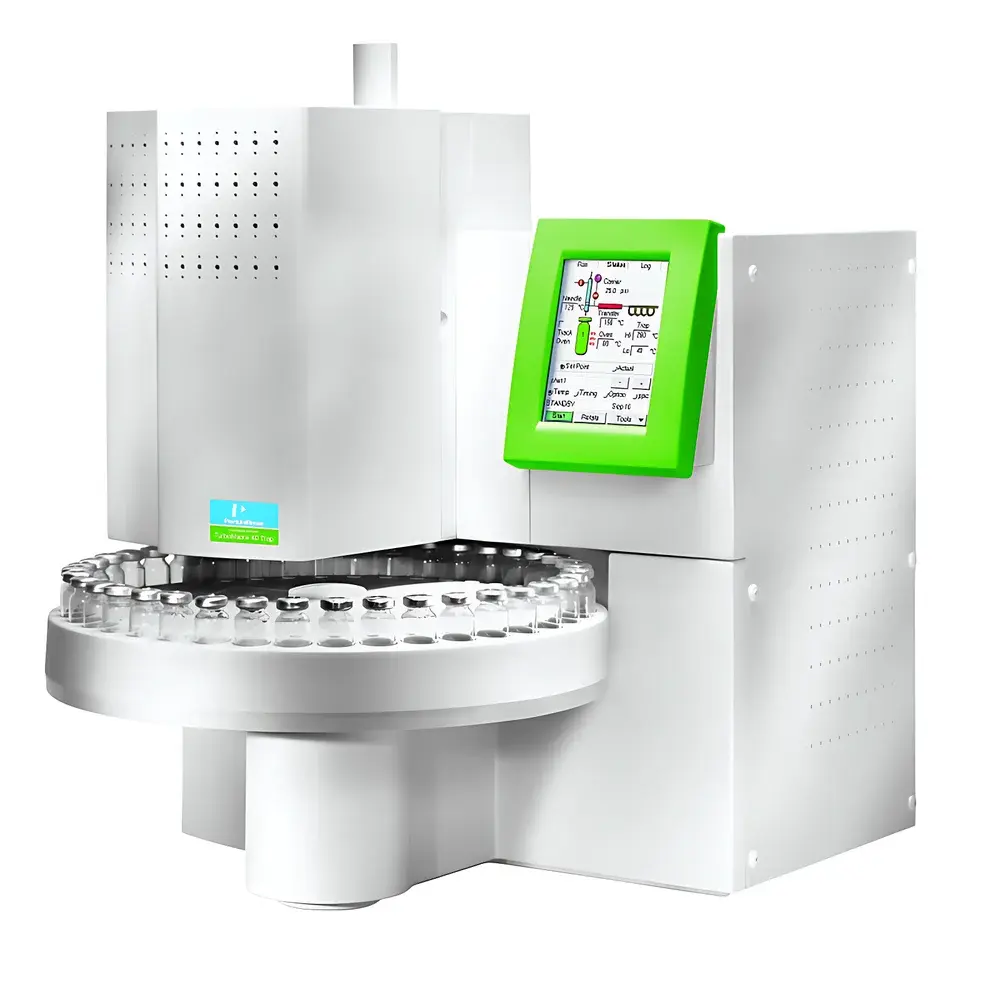
PerkinElmer TurboMatrix HS Headspace Sampler with Trap
| Brand | PerkinElmer |
|---|---|
| Origin | USA |
| Manufacturer Type | Original Equipment Manufacturer (OEM) |
| Product Category | Imported Instrument |
| Model | TurboMatrix HS |
| Instrument Type | Static Headspace Sampler |
| Automation Level | Fully Automatic |
| Sample Tray Capacity | 16 / 40 / 110 positions |
| Sample Vial Heating Range | 35–210 °C (1 °C increments) |
| Pressure Control Options | Manual (0–60 psig) or Electronic Pneumatic Control (EPC/PPC) |
| Detection Limit Enhancement | Integrated Focused Cryo-Trap for analyte enrichment |
| Typical Application Performance | ≤1.5% RSD for 0.4% aqueous ethanol |
Overview
The PerkinElmer TurboMatrix HS Headspace Sampler with integrated cryogenic trap is a fully automated static headspace sampling system engineered for high-precision, trace-level volatile organic compound (VOC) analysis in complex aqueous and solid matrices. It operates on the principle of phase equilibrium partitioning—where analytes distributed between a liquid/solid sample matrix and its overlying vapor phase are quantitatively transferred to a gas chromatograph (GC) without liquid-phase injection. The system employs pressure-balanced transfer technology, ensuring zero dilution of the headspace vapor during transfer through a fully enclosed, inert capillary pathway. This eliminates peak broadening and preserves chromatographic resolution—critical for compliance with regulatory methods requiring narrow peak widths and reproducible retention times (e.g., EPA Method 502.2, ASTM D3695, ISO 15686-2). The integrated cryo-trap enables cold focusing of volatiles prior to GC injection, significantly enhancing sensitivity and lowering method detection limits (MDLs), particularly for low-boiling, highly volatile compounds such as BTEX, chlorinated solvents, and residual monomers.
Key Features
- Pressure-balanced, closed-loop vapor transfer ensures quantitative delivery with no carrier gas dilution—maintaining original headspace concentration integrity.
- Graphical color touchscreen interface with intuitive workflow navigation and real-time status monitoring; supports multilingual UI configuration (English default).
- Dual injection control modes: precise time-based injection and fixed-volume injection via calibrated loop or pressure-controlled transfer—enabling method flexibility across regulatory and research applications.
- Three configurable sample tray options: 16-, 40-, and 110-position configurations accommodate high-throughput QC labs and method development environments.
- Programmable vial heating range from 35 °C to 210 °C (1 °C resolution), with independent temperature control for oven, transfer line, and valve zones to prevent condensation or thermal degradation.
- Optional electronic pneumatic control (EPC/PPC) delivers superior pressure stability and method reproducibility compared to manual regulators—essential for GLP/GMP-compliant laboratories.
- Support for multiple operational modes: standard single-cycle, continuous overlapping (up to 12 vials heated simultaneously), and multiple headspace extraction (MHE) for improved precision in heterogeneous or bound-matrix samples.
Sample Compatibility & Compliance
The TurboMatrix HS accommodates standard 10 mL, 20 mL, and 22 mL crimp-top or screw-cap headspace vials—including those compliant with ASTM D6866, USP , and ICH Q3C guidelines. Its robust thermal management and inert flow path ensure compatibility with aggressive matrices (e.g., wastewater, soil extracts, pharmaceutical suspensions, polymer leachates) without carryover or adsorption artifacts. The system meets key regulatory requirements for audit readiness: full event logging, user-access controls, and optional 21 CFR Part 11-compliant software modules (when paired with PerkinElmer’s Chromera CDS or third-party validated GC data systems). It supports validation protocols aligned with ISO/IEC 17025 and FDA guidance on analytical instrument qualification (AIQ).
Software & Data Management
Control and method development are performed via PerkinElmer’s TurboMass or Chromera Chromatography Data System (CDS), offering seamless bidirectional communication, method templating, and sequence scheduling. All instrument parameters—including vial temperature ramp profiles, equilibration times, trap cooling/focusing cycles, and valve timing—are stored as encrypted, version-controlled method files. Audit trails record operator ID, timestamped parameter changes, run start/stop events, and error logs—ensuring full traceability per GLP and GMP documentation standards. Remote diagnostics and firmware updates are supported over secure LAN connections.
Applications
This system is routinely deployed in environmental testing (EPA SW-846 Methods 502.2, 8260D), pharmaceutical residual solvent analysis (USP , ICH Q3C), food and beverage flavor profiling, forensic toxicology (blood alcohol quantitation), and polymer quality control (monomer residue testing per ISO 10363). Its cryo-trap capability extends utility to ultra-trace analysis—such as sub-ppb benzene in drinking water or ethylene oxide residuals in sterilized medical devices—where conventional static headspace lacks sufficient sensitivity.
FAQ
Which gas chromatographs is the TurboMatrix HS compatible with?
It interfaces natively with all PerkinElmer Clarus and Autosystem GC platforms, and supports universal analog/digital I/O protocols for integration with Agilent, Thermo Fisher, Shimadzu, and other major GC manufacturers.
Does the system support method validation according to USP ?
Yes—the combination of precise temperature control, pressure-stable transfer, low carryover (<0.01%), and full electronic logging satisfies USP requirements for residual solvent testing in pharmaceuticals.
Can the cryo-trap be bypassed for routine static headspace analysis?
Yes—trap operation is fully programmable; users may disable cryofocusing and operate in direct-transfer mode for higher throughput when sensitivity permits.
Is remote monitoring and control supported?
When connected to a local network and configured with PerkinElmer’s CDS, real-time status, alarm notifications, and method execution can be managed remotely via secure web interface or desktop client.
What maintenance is required for long-term reliability?
Routine maintenance includes quarterly valve seal inspection, annual calibration verification of temperature and pressure sensors, and periodic cleaning of the transfer line and trap assembly—documented in the included IQ/OQ/PQ protocol templates.
Related Products





