
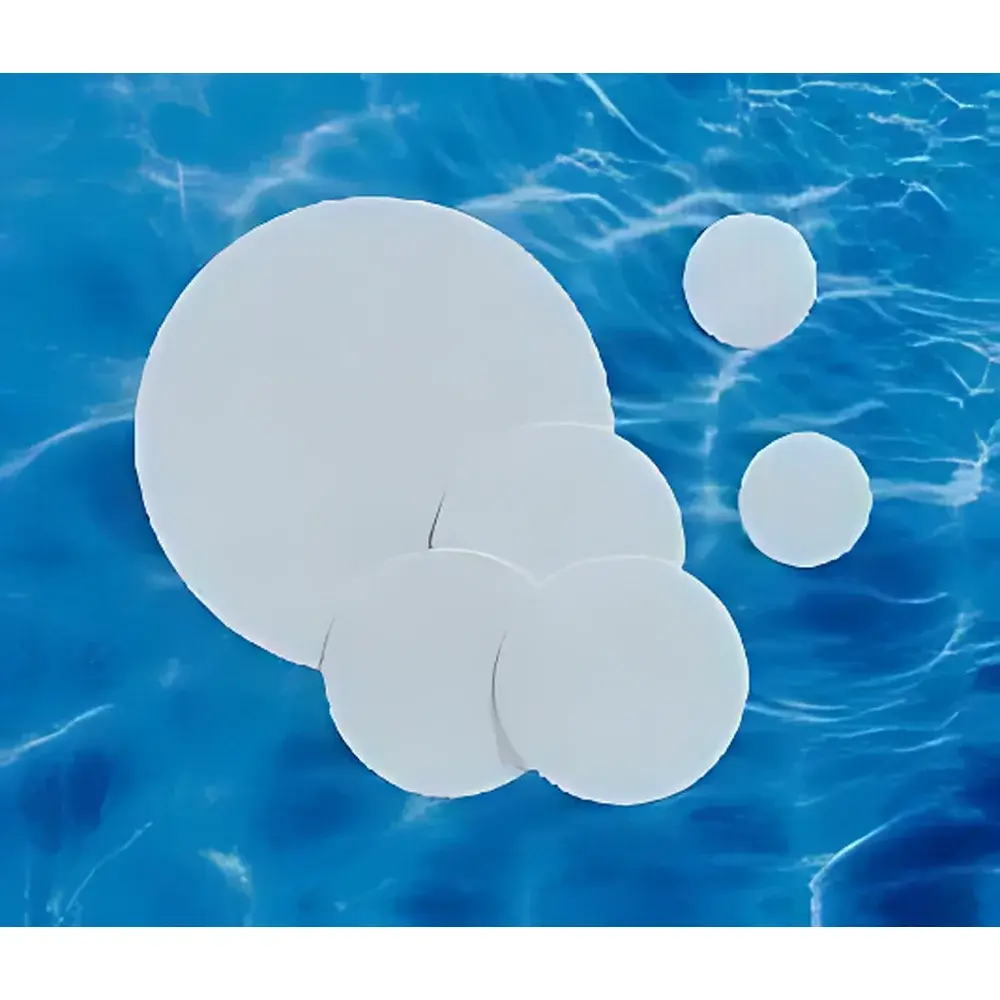
VWR Glass Fiber Filters – Grade 691, 693, 696, GF/A, and 934-AH (RTU & Non-RTU)
| Brand | VWR |
|---|---|
| Origin | USA |
| Filter Grades | 691, 693, 696, GF/A, 934-AH |
| Diameter Range | 2.1–30.5 cm |
| Particle Retention | 1.1–1.6 µm |
| Porosity | Fine |
| Max Operating Temperature | 550 °C |
| Basis Weight | 64 g/m² |
| Filtration Speed | 47 sec/100 mL (Herzberg) |
Overview
VWR® Glass Fiber Filters are high-purity, binder-free borosilicate glass microfiber filters engineered for demanding analytical and environmental laboratory applications. Designed to meet rigorous method requirements—including EPA Method 160.1, ISO 7027, ASTM D5907, and USP —these filters provide consistent performance in gravimetric, radiochemical, microbiological, and water quality testing. Unlike cellulose-based alternatives, VWR glass fiber filters exhibit no extractables, negligible ash content (<0.01%), and thermal stability up to 550 °C—enabling direct ignition and weight determination without pre-conditioning (except for non-RTU variants). Their uniform microstructure ensures reproducible particle retention across batches, supporting GLP-compliant data integrity in regulated environments.
Key Features
- Binder-free construction eliminates organic interference in low-level radiometric assays (e.g., weak beta-emitter scintillation counting) and trace metal analysis.
- Three standardized grades—691, 693, and 696—each optimized for distinct retention profiles, flow kinetics, and application-specific validation (e.g., 693 for dissolved/suspended solids per Standard Methods 2540D; 696 for marine particulate filtration and Hg monitoring).
- GF/A-grade filters match the performance specifications of Whatman® GF/A, delivering 1.6 µm nominal retention with fine porosity and fast flow—ideal for protein precipitation, cell harvesting, and airborne particulate gravimetry (NIOSH Method 0500).
- 934-AH™ filters offer enhanced loading capacity and 1.5 µm retention at 98% efficiency (per liquid challenge test), validated for turbid water matrices and bacterial culture clarification under ISO 9308-1.
- Ready-to-Use (RTU) 934-AH filters are pre-washed, pre-weighed, and packaged in aluminum pans with heat-resistant labels—fully compliant with Standard Method 2540D and eliminating operator-dependent conditioning steps.
- All formats maintain dimensional stability under vacuum, pressure, or centrifugal force; wet burst strength ≥17 in. H₂O ensures integrity during high-volume filtration of viscous or particulate-laden samples.
Sample Compatibility & Compliance
VWR Glass Fiber Filters are validated for use with aqueous, organic, and mixed-phase samples—including acidic digestates (pH 0–12), ethanol/water mixtures, and saline seawater matrices. Grade 691 is routinely specified in radioimmunoassay (RIA) protocols requiring minimal background radiation and high precipitate recovery (>99.5% for BSA aggregates). Grade 693 supports EPA-approved total suspended solids (TSS) determinations in wastewater and drinking water, while Grade 696 meets ASTM D3921 criteria for mercury speciation workflows. RTU 934-AH filters are auditable under FDA 21 CFR Part 11 when integrated into LIMS-controlled workflows, with documented weight traceability to NIST-traceable balances. All grades comply with ISO 17025 documentation requirements for filter lot certification, including ash content, thickness uniformity (±5%), and retention efficiency verification reports.
Software & Data Management
While inherently hardware-based, VWR Glass Fiber Filters integrate seamlessly into digital laboratory ecosystems through standardized catalog numbering (VWR Catalog Number) and supplier-assigned lot-level QC documentation. Each filter batch is accompanied by a Certificate of Analysis (CoA) listing retention validation data, ash content, and thermal stability test results—exportable as PDF or CSV for inclusion in electronic lab notebooks (ELN) or audit-ready archives. For laboratories operating under 21 CFR Part 11, the RTU format’s pre-weighed mass (±0.02 mg tolerance) enables direct entry into validated data acquisition systems without manual transcription, reducing ALCOA+ compliance risk. VWR’s online ordering portal provides real-time lot tracking, CoA retrieval, and expiration date alerts aligned with ISO/IEC 17025 clause 7.7.
Applications
- Environmental Monitoring: Gravimetric TSS and total dissolved solids (TDS) per EPA 160.1; airborne PM₁₀/PM₂.₅ collection per ISO 7708; seawater particulate organic carbon (POC) isolation.
- Clinical & Life Sciences: Lymphocyte harvesting in incorporation assays; scintillation counting of ³H/¹⁴C-labeled antigens; filtration of serum-derived immune complexes.
- Pharmaceutical QA/QC: Particulate matter testing per USP ; sterile filtration validation support; residual solvent removal in API purification.
- Industrial Hygiene: Collection of respirable crystalline silica (RCS) on 25-mm holders per NIOSH 7602; acid digestion support for ICP-MS trace metal analysis.
- Food & Beverage: Clarification of fruit juice suspensions prior to HPLC analysis; yeast cell separation in fermentation monitoring.
FAQ
Are VWR Glass Fiber Filters suitable for high-temperature ashing in gravimetric analysis?
Yes—binder-free construction and borosilicate composition enable direct ignition at 550 °C for ≥2 hours without residue interference. Ash content is consistently <0.01% w/w.
What is the difference between Grade 693 and 934-AH?
Grade 693 is a general-purpose grade optimized for sanitary water analysis with 1.1 µm retention; 934-AH offers higher basis weight (64 g/m²) and superior turbidity removal in highly loaded samples, validated for EPA 160.1 and ISO 9308-1.
Do RTU filters require pre-ashing before use?
No—RTU 934-AH filters are supplied pre-washed, pre-ashed, and pre-weighed per Standard Method 2540D, with certified mass printed on each aluminum pan label.
Can these filters be sterilized by autoclaving?
Autoclaving is not recommended—thermal cycling may compromise fiber matrix integrity. Sterile versions are available upon request with gamma irradiation validation (SAL 10⁻⁶).
How are lot-to-lot performance variations controlled?
Each production lot undergoes retention efficiency testing per ISO 4003, Herzberg flow rate measurement, and ash content verification against internal specification limits—data included in the CoA.
Related Products



