
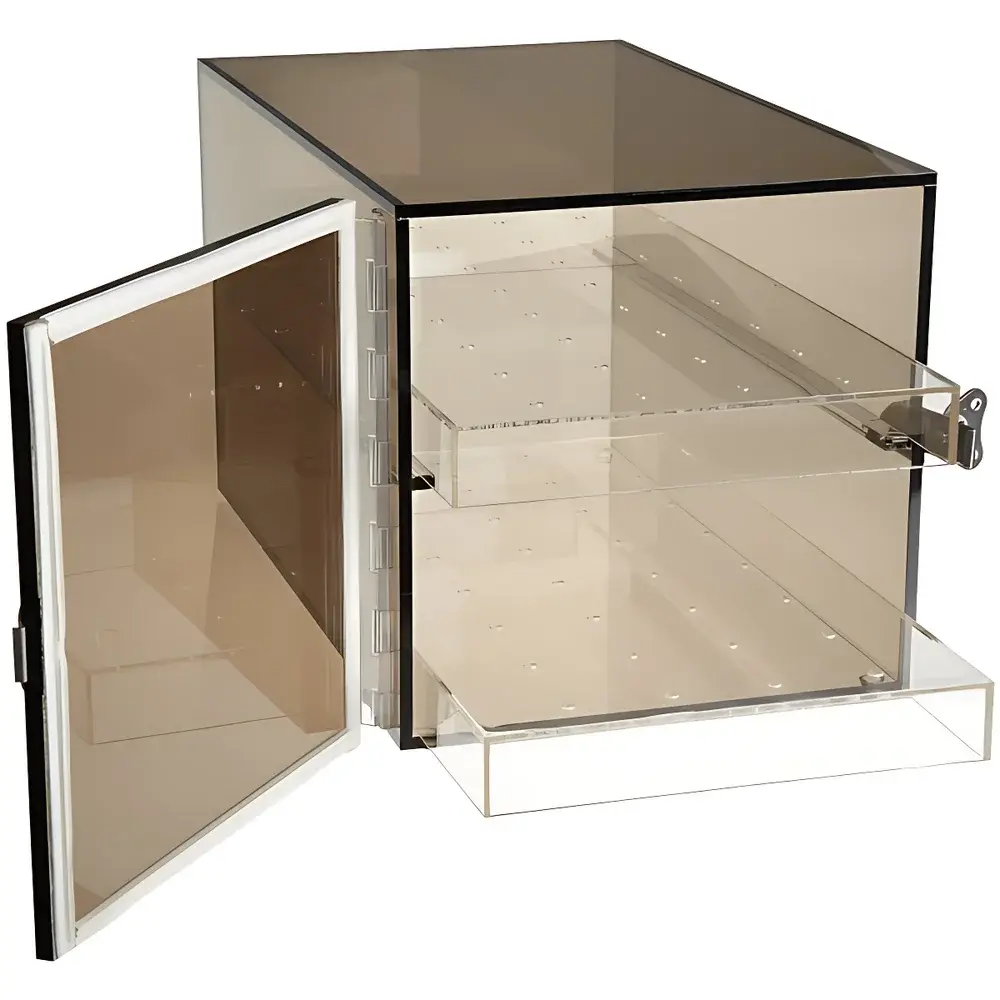
VWR Acrylic Desiccator Cabinets – Model 32800-046 / 32800-048 / 5317-0070 / 24987-056
| Brand | VWR |
|---|---|
| Origin | USA |
| Construction | 6.35 mm (1/4") clear or bronze-tinted acrylic |
| Door | Gasketed, left-opening, 9.5 mm (3/8") acrylic with full-length hinges and stainless steel twist-lock latches |
| Trays | Removable, perforated, lipped, slide-in |
| Tray capacity | 2–4 adjustable vented shelves |
| Dimensions (H × W × D) | 18 × 18 × 25.4 cm (7 × 7 × 10 in), 23 × 23 × 40.6 cm (9 × 9 × 16 in), 30.5 × 30.5 × 30.5 cm (12 × 12 × 12 in), 45.7 × 30.5 × 30.5 cm (18 × 12 × 12 in) |
| Compliance | Designed for GLP-compliant storage environments |
Overview
VWR® Acrylic Desiccator Cabinets are precision-engineered enclosures designed to maintain low-humidity, particulate-free storage conditions for moisture-sensitive, hygroscopic, and light-sensitive materials. Constructed from high-purity, optically transparent 6.35 mm (1/4″) cast acrylic, these cabinets provide exceptional chemical resistance, dimensional stability, and long-term clarity—critical for visual monitoring without compromising structural integrity. Unlike glass desiccators, acrylic offers superior impact resistance and reduced risk of shattering during routine handling or transport. The cabinet operates on passive desiccation principles: sealed internal volume combined with removable solid desiccant (e.g., silica gel or phosphorus pentoxide) enables sustained dew point suppression—typically achieving <10% RH when properly charged and maintained. Units are validated for stable operation across ambient laboratory temperatures (15–30°C) and within refrigerated environments (2–8°C), making them suitable for both QC labs and cold-chain storage workflows.
Key Features
- Dual-material visibility options: Clear acrylic for real-time sample observation; bronze-tinted acrylic (optical density ~3.0 at 365 nm) for UV-sensitive compounds including photolabile pharmaceuticals, oligonucleotides, and organic peroxides.
- Airtight sealing system: Compression-molded neoprene gasket integrated into the door frame ensures repeatable leak rates <0.5 mL/min under 25 Pa differential pressure—verified per ASTM D3078.
- Modular tray architecture: Perforated, lipped trays (standard 3.2 mm aperture spacing) promote uniform desiccant vapor distribution and prevent sample migration during cabinet movement. Shelf positions are secured via precision-machined grooves enabling ±1.5 mm vertical repeatability.
- Corrosion-resistant hardware: Stainless steel (A2-70 grade) twist-lock latches withstand >50,000 operational cycles without torque degradation; full-length piano hinges eliminate lateral play and ensure consistent gasket compression across the entire door perimeter.
- Thermal compatibility: Acrylic housing maintains mechanical performance down to –20°C, permitting safe use inside standard laboratory refrigerators and cold rooms without microcracking or haze formation.
Sample Compatibility & Compliance
These cabinets meet critical requirements for storing anhydrous reagents (e.g., TiCl₄, AlCl₃), lithium aluminum hydride (LiAlH₄), enzyme powders, reference standards (USP/EP), and microelectronic components susceptible to humidity-induced oxidation. They are routinely deployed in ISO/IEC 17025-accredited testing laboratories where documented environmental control is mandated for method validation. While not intrinsically rated for explosion-proof or Class I Division 1 environments, their non-sparking construction and static-dissipative surface (surface resistivity 10⁹–10¹¹ Ω/sq) support safe handling of electrostatic-sensitive devices (ESD). Units comply with RoHS Directive 2011/65/EU and are free of phthalates and heavy metals per EN 71-3.
Software & Data Management
This is a manually operated, non-electronic storage system—no embedded firmware, sensors, or connectivity interfaces. Environmental monitoring must be performed externally using calibrated hygrometers (e.g., Rotronic HC2-S, Vaisala HMP110) placed inside the cabinet alongside samples. For GLP/GMP-regulated facilities, users implement paper-based or LIMS-integrated logbooks to record desiccant replacement dates, RH verification timestamps, and cabinet access events. Audit trails for desiccant lot numbers, calibration certificates of monitoring instruments, and cabinet maintenance history are retained per FDA 21 CFR Part 11 Annex 11 expectations for ancillary storage equipment.
Applications
- Pharmaceutical stability studies: Storage of placebo tablets, excipients, and active pharmaceutical ingredients (APIs) under ICH Q1A(R3) intermediate condition protocols requiring controlled humidity.
- Materials science: Conditioning of metal-organic frameworks (MOFs), perovskite precursors, and battery electrode materials prior to XRD or BET analysis.
- Electronics manufacturing: Pre- and post-reflow storage of moisture-sensitive level 3 (MSL-3) components per J-STD-033.
- Academic research: Long-term preservation of lyophilized antibodies, CRISPR-Cas9 ribonucleoprotein complexes, and air-sensitive Grignard reagents.
- Reference material management: Archival storage of certified reference materials (CRMs) where certified moisture content must remain invariant between calibrations.
FAQ
What desiccants are compatible with these cabinets?
Silica gel (indicating and non-indicating), calcium sulfate (Drierite™), phosphorus pentoxide (P₂O₅), and molecular sieves (3Å or 4Å) are all chemically compatible. Avoid alkaline desiccants (e.g., KOH) that may etch acrylic surfaces.
Can these cabinets be used under vacuum?
No. The design is optimized for atmospheric-pressure desiccation only. Vacuum application risks panel deformation and gasket extrusion due to lack of internal reinforcement ribs.
How often should desiccant be regenerated or replaced?
Regeneration frequency depends on ambient humidity, cabinet opening frequency, and desiccant type. As a baseline: silica gel requires reactivation every 7–14 days in 50% RH lab environments; P₂O₅ may last 3–5 days. Always verify internal RH with a traceable sensor before critical use.
Are replacement trays or gaskets available as spare parts?
Yes. VWR part numbers for accessories include: 32800-099 (perforated tray set), 5317-0020 (neoprene gasket kit), and 24987-062 (stainless steel latch assembly). All carry full OEM warranty and certification documentation.
Do these cabinets meet USP <671> requirements for container performance?
While not classified as primary packaging, they satisfy USP <671> “Containers—Performance Testing” criteria for secondary storage systems when used with validated desiccant loading protocols and periodic RH mapping per USP <1151>.



