
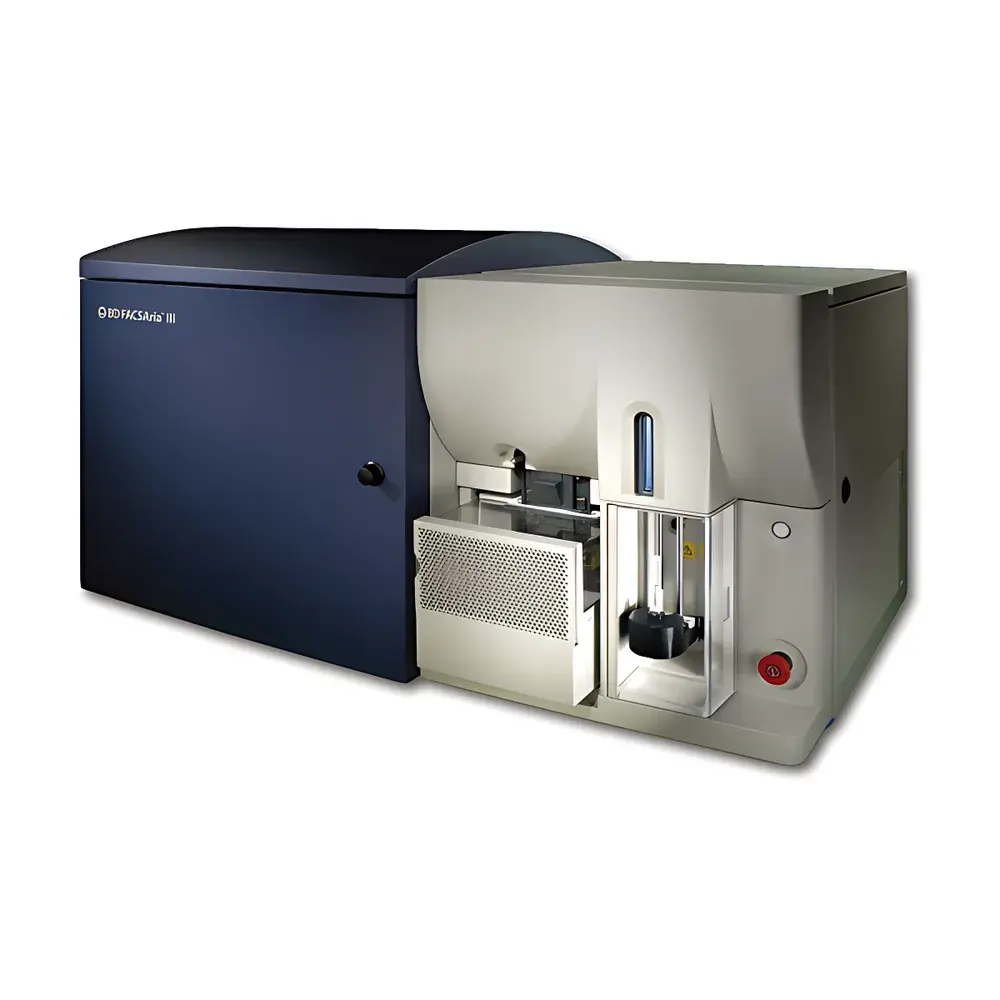
BD FACSAria™ III Flow Cytometer
| Brand | BD |
|---|---|
| Origin | USA |
| Manufacturer | BD Biosciences |
| Product Type | High-Performance Fluorescence-Activated Cell Sorter (FACS) |
| Laser Configuration | Up to 5 Lasers (355, 405, 488, 561, 633 nm) |
| Optical Detectors | 20 PMTs |
| Simultaneous Parameters | 18-color fluorescence + 2 scatter channels |
| Nozzle Options | 70, 85, 100, 130 µm |
| Fluidic Drive | Positive-pressure air-driven sheath system |
| Sterility Support | Integrated aerosol containment, automated sterile setup & wash protocols |
| Software Platform | BD FACSDiva™ v8.0+ with CS&T, AccuDrop™, and Sweet Spot™ technologies |
| Regulatory Compliance | Designed for GLP/GMP environments |
Overview
The BD FACSAria™ III Flow Cytometer is a high-performance, benchtop fluorescence-activated cell sorter engineered for precision, reproducibility, and long-term experimental continuity in demanding research and clinical development settings. Built upon BD’s patented Stability Optics™ architecture — featuring optically bonded quartz cuvette flow cells, spatially separated laser excitation spots (9 × 65 µm), and an octagonal/triangular reflective photodetection pathway — the system delivers exceptional signal-to-noise ratio, low coefficient of variation (CV), and high-resolution multicolor discrimination without requiring elevated laser power. Its hydrodynamic focusing mechanism ensures consistent single-cell alignment within the interrogation zone, while the positive-pressure air-driven fluidics provide stable, contamination-resistant sample delivery across variable pressure ranges (5–75 psi). Unlike traditional air-excited systems, the BD FACSAria™ III employs fiber-coupled solid-state lasers and optimized light collection optics to maximize photon capture efficiency — enabling reliable detection of dim antigens and rare subpopulations even at sorting speeds exceeding 70,000 events per second.
Key Features
- Stability Optics™ platform: Permanently aligned, vibration-damped optical train with optically bonded quartz cuvette flow cell ensures day-to-day and instrument-to-instrument reproducibility.
- Modular laser architecture: Supports up to five independently addressable lasers (355, 405, 488, 561, 633 nm) with four spatially isolated excitation foci — enabling flexible panel design and future expandability without hardware replacement.
- High-parameter detection: Twenty photomultiplier tube (PMT) detectors configured for simultaneous acquisition of 18 fluorescence parameters plus forward and side scatter signals.
- AccuDrop™ technology: Real-time visualization and software-guided optimization of droplet delay time; eliminates manual calibration and ensures consistent electrostatic charge application during sorting.
- Sweet Spot™ dynamic drop monitoring: Automatically maintains optimal break-off point and halts sorting upon nozzle occlusion or pressure fluctuation — preserving sample integrity and collection tube sterility.
- Interchangeable nozzle system: Four standardized nozzle sizes (70, 85, 100, 130 µm) with tool-free insertion and position-locked mounting — enabling rapid adaptation to particle size, viability requirements, and purity/yield trade-offs.
- Integrated aerosol management: Fully enclosed fluidic path from sample introduction through collection; optional Aerosol Management Option (AMO) provides active vacuum evacuation of the sort chamber to meet BSL-2/3 biosafety standards.
Sample Compatibility & Compliance
The BD FACSAria™ III accommodates a broad range of biological samples — including primary human PBMCs, dissociated tissues, stem cell suspensions, microbial cultures, and fixed or live-transfected cells — across volume formats from 1.0 mL microtubes to 15 mL conical tubes. Integrated temperature-controlled sample loading and agitation modules maintain cellular viability during extended sort sessions. All fluidic components — including the stainless-steel sheath reservoir (autoclavable), ethanol decontamination tank, and waste container — are designed for compliance with Good Laboratory Practice (GLP) and current Good Manufacturing Practice (cGMP) workflows. When operated with BD FACSDiva™ Secure Mode (optional), the system supports full 21 CFR Part 11 compliance, including electronic signatures, audit trail logging, role-based access control, and data integrity validation — making it suitable for regulated preclinical assay development and QC release testing.
Software & Data Management
BD FACSDiva™ software v8.0 and later serves as the unified control interface for instrument configuration, acquisition, compensation, gating, and sorting logic definition. Its Calibration and Setup Tracking (CS&T) module automates daily performance verification using BD CS&T beads, generating Levey-Jennings plots and quantitative pass/fail metrics for sensitivity, resolution, and linearity. The software supports template-driven experiment replication, batch analysis with user-defined gate propagation, and hierarchical population annotation across multiple files. Compensation matrices are stored per detector configuration and applied non-destructively during analysis. Raw FCS 3.1 files are generated with embedded metadata (instrument settings, date/time stamps, operator ID), ensuring traceability and interoperability with third-party analysis tools such as FlowJo™, Cytobank, or R/Bioconductor packages. Data export options include CSV, PDF reports, and image-based overlays for publication-ready figures.
Applications
The BD FACSAria™ III is routinely deployed in immunology, oncology, stem cell biology, virology, and regenerative medicine applications requiring high-fidelity isolation of functionally defined subsets. Representative use cases include: purification of CD45RA⁺/CD45RA⁻ regulatory T cells for adoptive transfer studies; enrichment of antigen-specific TCR-transduced lymphocytes for CAR-T manufacturing; isolation of rare circulating tumor cells (CTCs) from whole blood; sorting of GFP⁺ reporter-expressing iPSC clones; and multi-parametric phenotyping of bone marrow hematopoietic progenitors. Its ability to resolve closely spaced fluorochrome emissions — particularly in violet (405 nm) and UV (355 nm) excitation channels — supports complex tandem dye panels and spectral unmixing strategies. The system’s robustness in high-throughput screening environments has been validated in academic core facilities, biopharma discovery labs, and contract research organizations performing GCLP-compliant assays.
FAQ
Can the BD FACSAria™ III be upgraded from older FACSAria platforms?
Yes — BD offers certified upgrade paths from BD FACSAria and BD FACSAria II systems to BD FACSAria™ III functionality, including new optics modules, fluidics controllers, and software licenses.
What level of biosafety does the system support out-of-the-box?
The base configuration meets BSL-2 containment requirements; optional Aerosol Management Option (AMO) extends compliance to BSL-3 environments when used with appropriate PPE and facility ventilation.
Is BD FACSDiva™ compatible with other BD cytometers?
Yes — BD FACSDiva™ is the common software platform across BD’s analytical and sorting platforms, including BD LSRFortessa™, BD FACSCanto™ II, and BD FACSymphony™ A5 SE, enabling seamless method transfer and cross-platform data harmonization.
How does the system ensure consistent droplet formation during long sorts?
Through real-time pressure monitoring, Sweet Spot™ feedback control, and integrated acoustic sensors that detect early-stage nozzle clogging — triggering automatic shutdown before droplet instability compromises sort purity.
Are maintenance logs and performance reports exportable for quality audits?
Yes — all CS&T results, instrument usage logs, error histories, and software version records are exportable in PDF or CSV format and can be archived within a validated LIMS environment.
Related Products




