
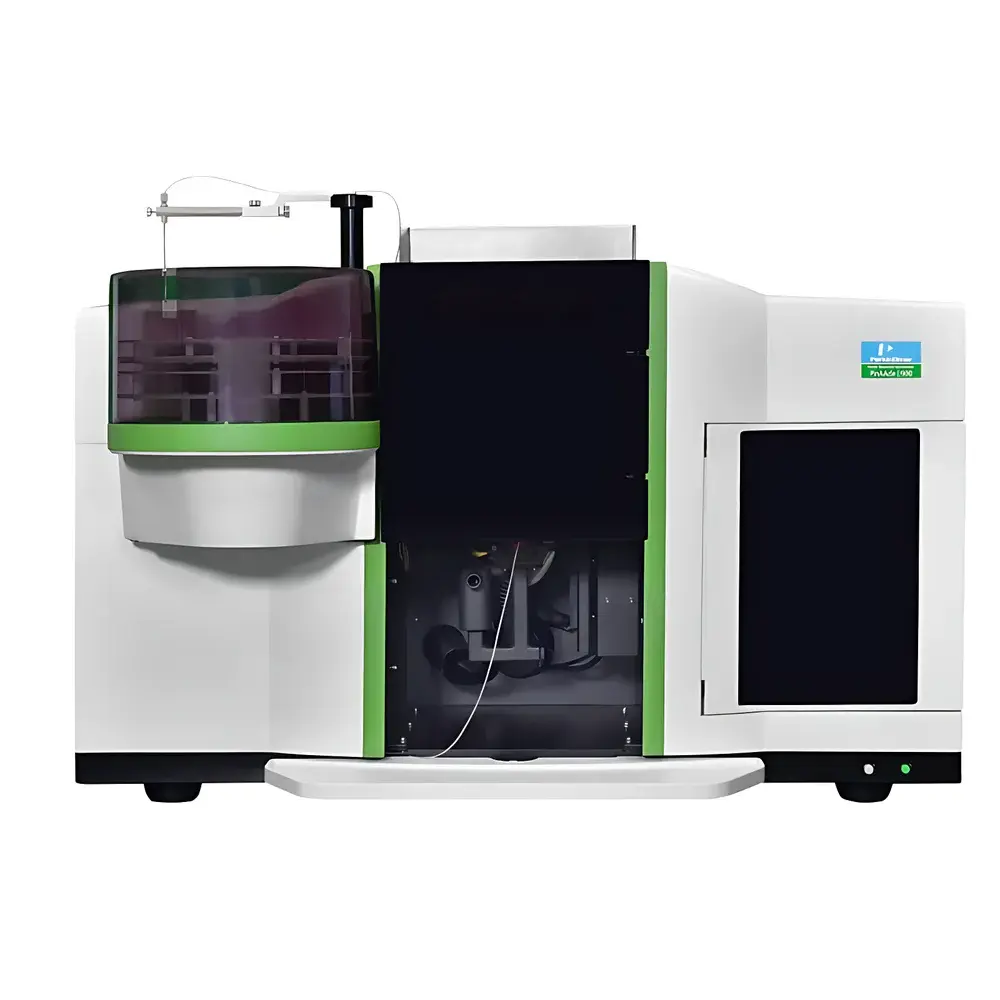
PerkinElmer PinAAcle D900 Flame and Graphite Furnace Atomic Absorption Spectrometer
| Brand | PerkinElmer |
|---|---|
| Origin | Singapore |
| Manufacturer Type | Original Equipment Manufacturer (OEM) |
| Origin Category | Imported Instrument |
| Model | PinAAcle D900 |
| Instrument Type | Flame and Graphite Furnace AAS |
| Monochromator | Plane Grating |
| Optical System | Double-Beam |
| Detector | Photomultiplier Tube (PMT) |
| Background Correction | Deuterium Lamp Correction |
| Safety Interlocks | 7 Integrated Sensors |
| Automation | Dual-Mode Autosampler Compatible with Both Flame and GF Modes |
| Software Interface | Touchscreen-Controlled Method Wizard with Real-Time Camera Integration |
| Reporting | Customizable PDF Reports Including Calibration Curves and Sample Data |
Overview
The PerkinElmer PinAAcle D900 is a dual-mode atomic absorption spectrometer engineered for precision, regulatory compliance, and operational continuity in high-throughput analytical laboratories. It integrates flame atomic absorption spectroscopy (FAAS) and graphite furnace atomic absorption spectroscopy (GFAAS) into a single, unified platform—enabling quantitative elemental analysis across concentration ranges spanning parts-per-trillion (ppt) to percent-level matrices. The instrument operates on the fundamental principle of atomic absorption: ground-state atoms in a gaseous state absorb characteristic wavelengths of light emitted by hollow cathode lamps; the degree of absorption is proportional to analyte concentration per Beer-Lambert law. Its double-beam optical architecture compensates for source intensity fluctuations and lamp drift, while the plane grating monochromator delivers consistent spectral resolution across the 190–900 nm wavelength range. Designed for laboratories subject to GLP, GMP, and ISO/IEC 17025 requirements, the PinAAcle D900 supports full audit trails, electronic signatures, and 21 CFR Part 11–compliant data integrity protocols.
Key Features
- Dual-mode operation: Fully integrated flame and graphite furnace systems sharing one optical path, detector, and software interface—eliminating cross-platform calibration drift and reducing method transfer time.
- Intelligent dual-mode autosampler: Capable of sequential or simultaneous sample handling for both FAAS and GFAAS, including programmable dilution, standard addition, and matrix-matched calibration without manual intervention.
- Rotatable 90° burner head: Enables direct analysis of high-concentration samples (e.g., 1% NaCl matrix) without pre-dilution, minimizing contamination risk and improving throughput.
- Deuterium-lamp background correction with auto-energy balancing: Dynamically adjusts D2 lamp output to match continuum intensity with line-source emission, delivering background correction performance comparable to transverse Zeeman systems—without the complexity or cost of magnet-based hardware.
- Seven-point safety interlock system: Monitors gas pressure, flame status, graphite furnace temperature, cooling water flow, argon purge integrity, door position, and power supply stability—ensuring automatic shutdown under non-compliant conditions.
- Real-time color camera integration: Provides live visualization of graphite furnace tube interior during atomization, enabling precise optimization of pyrolysis and atomization temperatures for complex biological or environmental matrices.
- Three-step method setup wizard: Guides users—from novice to expert—through lamp selection, wavelength configuration, and measurement parameter definition via intuitive touchscreen interface.
Sample Compatibility & Compliance
The PinAAcle D900 accommodates liquid samples (aqueous, acidic digests, organic extracts), slurries (soil, sediment), and digested solids (food, tissue, polymers) following standardized preparation protocols (e.g., EPA Method 200.7, ASTM D1976, ISO 11885). Its robust graphite furnace design supports rapid thermal ramping (up to 2000 °C/s) and extended temperature hold times, essential for refractory elements such as Al, V, and Mo. All firmware and software comply with FDA 21 CFR Part 11 for electronic records and signatures. Full traceability—including raw signal data, peak integration parameters, and instrument configuration logs—is retained for audit readiness. The system meets ICH Q2(R2) guidelines for analytical method validation and supports ISO 17025 clause 7.7 (result reporting) through customizable, metadata-rich PDF reports.
Software & Data Management
Syngistix™ for AAS software provides a unified environment for instrument control, data acquisition, quantitation, and report generation. It features embedded method templates aligned with USP , ASTM E1746, and EN 14802 standards. Data files are stored in vendor-neutral .csv and .xml formats, compatible with LIMS integration via ASTM E1384 or HL7 interfaces. Audit trail functionality logs all user actions—including method edits, calibration updates, and result overrides—with timestamps, operator IDs, and IP addresses. Raw absorbance vs. time profiles, background-corrected signals, and multi-point calibration curves are exportable for third-party statistical review (e.g., JMP, Minitab).
Applications
- Environmental monitoring: Multi-element analysis of drinking water, wastewater, and leachates per EPA Methods 200.7 and 200.9.
- Food safety testing: Quantification of toxic metals (Pb, Cd, As, Hg) in infant formula, spices, and seafood per EU Commission Regulation (EC) No 1881/2006.
- Pharmaceutical quality control: Trace metal screening in active pharmaceutical ingredients (APIs) and excipients per USP and .
- Geological and mining: Determination of base metals (Cu, Zn, Ni) and precious elements (Au, Pt) in acid-digested rock and ore samples.
- Consumer product safety: Lead and cadmium testing in toys, plastics, and electronics per CPSIA and RoHS directives.
- Clinical and biological research: Quantitative analysis of essential (Fe, Zn, Cu) and toxic (Al, Pb) elements in serum, urine, and tissue homogenates.
FAQ
Does the PinAAcle D900 support hydride generation or cold vapor techniques?
No—the PinAAcle D900 is optimized for flame and graphite furnace AAS only. Hydride generation and cold vapor accessories are not supported natively; those applications require dedicated instrumentation (e.g., PerkinElmer AA800 with HGA-120).
Can the instrument be operated remotely via network connection?
Yes—Syngistix software supports secure remote access over LAN/WAN using TLS 1.2 encryption. Remote sessions maintain full audit trail integrity and require two-factor authentication.
What maintenance intervals are recommended for the graphite furnace components?
Graphite tubes should be replaced after 200–300 firings depending on matrix aggressiveness; platform inserts every 500 firings; and end caps every 1,000 firings. Auto-diagnostic routines monitor furnace resistance and thermal response to flag degradation prior to failure.
Is method validation documentation provided with the system?
Yes—PerkinElmer supplies IQ/OQ/PQ protocol templates, system suitability test procedures, and validation worksheets compliant with ISO/IEC 17025 Annex A.2 and USP .
How does the deuterium background correction compare to Zeeman correction for high-salt matrices?
In 1% NaCl solutions, the auto-balanced D2 system achieves <±3% background error at 283.3 nm (Pb), matching transverse Zeeman performance for broadband absorption—while maintaining lower operational cost and reduced maintenance overhead.
Related Products




